"The Case of the Three Devils!"
Writer: Bill Finger
Pencils: Bob Kane
Inks: Jerry Robinson and George Roussos
Synopsis: Batman and Robin, while on patrol, spot a trio of men in bright red devil costumes leaping across rooftops carrying a purse. Batman (correctly) assumes the purse is stolen and the Dynamic Duo jumps down and starts fighting the devils, who manage to get away using some impressive acrobatics.
The three devils go on a crime spree which the GCPD is powerless to stop (there's an amusing panel of Gordon yelling at his men for results and his men essentially giving up). After they steal some diamonds, Bruce explains to Dick (and thus, the audience) that they will need to take the diamonds to a fence in order to get any money, so Batman and Robin stake out the only two fences big enough to handle the diamonds involved.
It is at this point that Robin decides to take along "those rocket-powered roller skates we developed recently", and we may have the debut of the first overly ridiculous Batman gadgets. Granted we've seen the batarangs, bat-gyro, batplane (that turns into a batboat), a crude batmobile and some IR goggles and radioactive paint, but all of that stuff is fairly plausible for a 1940s billionaire and also have become tried and true elements of Batlore. But rocket powered roller skates? Oy.
Anyways, the devils show up at Frankie the fence's, and Batman and Robin swoop down to fight them. During the fight, Frankie pulls a knife on Batman, but Robin knocks him out by literally throwing the book at him (a book titled "Crime Does Not Pay", no less). Batman gets knocked out (by hitting his head on a table while ducking a bulllet!) and the devils escape. Robin then becomes the best sidekick ever by deciding that Batman will probably be fine and going after the devil's car using his rocket-powered roller skates. Oh, jeez.
When Batman wakes up, a police patrolman has arrived on the scene. The policeman has Batman cornered, but admits he actually admires the Dark Knight's work, and suggests that if Batman were to say, knock him out, then he could get away while the cop could still have appeared to have done his duty. Batman obliges, punches the cop in the face, and makes his escape.
Robin follows the devils to their hideout in an abandoned subway track. The devils attack and leave Robin to be run over by a coming train, but Robin pulls the old trick of lying flat between the rails and letting the train pass over him (something I see in movies all the time and that I totally doubt works). Robin then meets up with Batman and leads them to the lair. The devils are gone, out on a job, so Batman looks around the hideout and finds evidence that the devils are in fact ex circus acrobats turned to crime (gee, what tipped you off?) and finds clues pointing to their next job.
The Dynamic Duo surprises the devils on the observation floor of a clock tower and there's a fight. Robin ends up falling and getting his cape caught on one of the giant hands of the clock, dangling precariously -- a soon-to-be classic Batman image.
The kid gets rescued, and Batman uses the bell in the tower to defeat the devils, kicking them down to a lower level where they presumably are knocked unconscious rather than killed. Batman and Robin then escape into the night, remarking that the devils should have stayed with the circus rather than try to gain wealth "the easy way". Frankly it seems like working at the circus would be easier than being criminals. Meanwhile, since Batman didn't really do anything than knock out the devils, unless the police show up right away then they have clearly been left at large.
My Thoughts: This is a really lightweight story. Kind've thing that just feels like a filler, get it out and done kind've deal. Basically nothing happens. Crooks show up, Batman defeats them. They've got a gimmick look and MO, so Finger/Kane are clearly aware that even their second-string villains need to be colourful, but there's nothing really to go on in this story. There's some "crime does not pay" moralizing, and interestingly there are several situations where the devils could've just shot Batman but don't because "it would bring the cops down on them", but that's about it. They don't even take advantage of the fact that these guys are ex-circus like Robin is, other than giving them some nifty fight moves. But that similarity isn't actually brought up in text. Would've been neat if they were from the same circus, for example.
The Art: The art is good. On the same high level it has been recently. That really saves this story because it makes it enjoyable to read. There's some really good, dramatic panels, great use of shadows, and some dynamic action scenes.
The Story: It's just so... forgettable. Nothing motivates the devils. They are criminals because... they decided it was easier than being circus performers? We don't know if they were down on their luck or what. Basically it's just a series of action and chase scenes. Nothing really happens. Crooks show up, Batman defeats them. Finger seems to be taking a breather this month and letting the art do all the work.
Oh, look! It's the pirates from Batman #4. I wonder when the idea of a comic book cover actually having something to do with the story inside on a regular basis will come into play?
"Clayface Walks Again!"
Writer: Bill Finger
Pencils: Bob Kane
Inks: Jerry Robinson and George Roussos
Synopsis: So after a brief recap of the last Clayface story (and by brief I mean a single-panel of all-text infodump), we start in the office of Bentley, head of Argus Pictures, who is discussing the reviews of their latest picture Dread Castle, which starred Bruce Wayne's fiancee Julie Madison. Julie has been getting rave reviews, so Bentley and his publicity man, Gabby (yeesh), decide to remake her as a Hollywood star and push her into the public eye. In a fairly goofy satire of the process, they rename her Portia Storme and spread her face over all the national magazines. His girl now a major star, Bruce heads to LA to see "Portia", who confides that she is tired of waiting for Bruce to do something with his life and breaks off their engagement (although, like a good '40s woman she promises to come back to him if he ever makes something of himself). Bruce is mildly taken aback, but quickly gets accustomed to the idea and announces he'll always be there for her when she needs him ("I'm free!", you can practically see him thinking).
Meanwhile, someone else is soon to be free as well, when the transport carrying horror movie star cum psychotic serial murderer Basil Karlo to the State Asylum is crashed into a ditch during a freak thunderstorm. Karlo wastes no time, immediately heading to a make-up/costume store and resuming his role as the killer Clayface.
Clayface's escape and return makes the news, which of course Bruce and Dick are reading. I swear in these Golden Age stories Batman finds out about crime only three ways: happening upon it accidentally during a patrol, hearing about it from Commissioner Gordon, or most frequently reading about in the newspaper. Anyways, Bruce immediately deduces Clayface must be after Julie, ahem, "Portia" and Bentley at Argus since they were pretty much the only people he didn't kill last time. Sure enough, they show up at the studio and there's Clayface. Finger and Kane have fun with props, including having Clayface and Batman fighting over a miniature movie set in a scene that reminds me of Godzilla movies that won't be made for another twenty-five years or so. Clayface attacks Robin, knocks him out, and sets the studio on fire.
Clayface escapes, and the fire department shows up to combat the blaze. Batman douses himself with water and dives into the blazing inferno to save the Boy Wonder. Bruce swears he's going to get Clayface if it's the last thing he does. Which it won't. Meanwhile, Clayface has taken the TMZ route and begun obsessively stalking Portia everywhere she goes. Portia feels threatened but insists they continue shooting her latest movie because "if you stop now, you'll lose a fortune!" Portia is a producer's actor, that's for sure. Gabby, excited by the publicity possibilities, actually promotes that the star of the movie is being threatened by a serial killer. Batman decides to take action, and confronts Portia with a plan...
The next day, Clayface sneaks onto the set by -- I shit you not -- stealing a robe from the wardrobe department (it appears to be a medieval period piece) and wearing it OVER HIS CLAYFACE MAKE-UP. This is how you know Basil Karlo is completely insane. We know he's a master of disguise and could appear as anyone he wished, but he's become so consumed by the murderous persona of Clayface that he continues to use that appearance and attempt to cloak it rather than adopt a new one.
Batman and Robin, meanwhile, attempt to get on the lot to protect Portia, but are confronted by the guards hired by the studio to protect her. The guards fight the Dynamic Duo, which is odd because the head of the studio has multiple times expressed great affinity for them, and during the commotion Robin grabs Portia and takes her off into an alcove. Immediately after, the Duo retreats from the guards. Seizing his opportunity, Clayface strikes by firing an arrow into the back of Portia Storme.
Batman rushes in to fight Clayface, and after a gripping battle promptly knocks him cold. Bentley rushes in to discover that in fact the Portia that was shot was Robin wearing a cloak and a life preserver lined with cork and cotton to stop the arrow (what if Clayface had aimed for the head?) and that Portia had escaped with Batman wearing a Robin costume! (Rule 63!)
Once again Bentley offers the Dynamic Duo a job in movies, once more they turn him down, while Portia once again wishes Bruce would be more like Batman, albeit it's too late for him now.
My Thoughts: So we get a Clayface follow-up story that's basically a retread of the original minus the mystery angle and plus a few new elements. I'll discuss the new elements here. First up, we have the exit of Julie Madison as a "regular" castmember. She was the first recurring love interest for Bruce Wayne, and she's the first to leave him. Bruce seems only mildly affected, which makes sense given that Julie's only appeared in a handful of stories largely as a damsel-in-distress. You get the sense Bruce was engaged to her for appearance's sake rather than any real emotional connection -- she was part of his playboy disguise. Still, Finger and many other writers will continue to try and find a love interest character for Bruce, and to this day, none have been successful, at least not to the degree of Lois Lane and Superman. A whole list of female characters have been tried, to the point where the Christopher Nolan feature films even invented one for themselves, but none really work. I think it's because largely there isn't a place for a love interest in Batman. Bruce is so devoted to his cause that the love interest always falls into the pattern of choosing either love or Batman, and he's always gonna choose Batman so she's always gonna go away. She's to be rescued or to be pitied. The only way I could see to make it work would be to really change the formula and to have Batman's partner in crime fighting be his life partner as well. Only a woman dedicated to all of Bruce Wayne's personality could ever last. The closest thing to a lasting relationship with a woman Batman has is with a criminal, Catwoman, and that's very telling of his devotion to the war on Crime, I think.
The return of Clayface speaks once more to Finger and Kane's love of the movies -- I feel like the main reason for using Clayface again had to do with using a character with history with Julie so they could axe her, and provide a setting for the great studio props department battles. Eventually Finger will stop finding rationales for weird props and start inserting them everywhere. Every time Bentley begs to put Batman in a movie, it feels like Kane and Finger begging the movies to adapt Batman -- I know it was always one of Kane's great goals and I would bet Finger wanted it to. They'd get their wish in two year's time, when Columbia Pictures would make a Saturday matinee serial of Batman.
The Art: Another great job from the art team, it's refreshing that everyone's settled into a style and look that seems to really work for the feature. Kane draws Clayface wonderfully, and there are some really dynamic action panels. The fire sequence is quite memorable as well, and the fight "choreography" has gotten much better.
The Story: Finger must be commended for his attention to continuity. Whenever he does a sequel it always stays true to the details of the original, even if it's just as simple as establishing a villain's return. Here he's smart and uses the characters and situations of the first Clayface story to propel this one. Unfortunately this also leads this story to feeling like we've seen it all before. Once Clayface escapes it's another round of fights on the studio lot, attempted murders, defeat and unmasking, wrap-up, etc. After three pages the story's on autopilot and the art takes over.
Notes and Trivia: Julie "Portia Storme" Madison breaks off her engagement with Bruce Wayne.
It's worth noting that the Batman icon in the upper left-hand corner of the cover has been finally changed to resemble the current Kane/Robinson Batman with the shorter ears and blue highlights, rather than the Kane original it has been representing since #32.
"The Secret Cavern"
Writer: Bill Finger
Pencils: Bob Kane
Inks: Jerry Robinson and George Roussos
Synopsis: In Kentucky, a man idly rowing his boat down a stream ends up floating into a mountain and discovering a vast limestone cave, which just so happens to pass directly under the federal gold vault at Fort Knox! (cue dramatic music). He rushes back into town and blabs about his discovery to a bunch of guys in a bar, who of course turn out to be criminals on the lam. They recognize the gentleman as a millionaire named Lewis, who does spelunking as a hobby. When he refuses to tell them where the cave is, they kidnap him and threaten him. One of the criminals remembers he has a daughter named Linda who is a nightclub singer in Gotham City. One of the crooks, Nick, meets with the club's owner, Renaldo, and convinces him to join in on the scheme.
That night, Linda is seeing Bruce Wayne at the club (uh, Bruce, aren't you still engaged to Julie Madison?), and after she sings she makes a date to go to the movies with him. But when she retires to her dressing room she is startled by a man waiting for her who attempts to grab her. She takes a gun from her dresser and shoots him. Renaldo bursts in and announces that she has killed the man. Scared, Linda agrees to flee to her father in Kentucky with Renaldo's help, while he covers up the murder.
But of course, no one has died. The man she shot was Nick, who replaced the bullets with blanks. It was all part of the plan. Back in the club, Bruce questions Renaldo as to where Linda is, but is told off. Bruce begins to suspect something has gone wrong.
Linda arrives in Kentucky by train, and meets Renaldo there. Her father has been told about Linda "murdering" Nick, and agrees to rell Renaldo and the crooks about the cave's location in order to keep the "murder" quiet and keep Linda out of prison.
Meanwhile, Bruce continues to be suspicious of Linda's sudden disappearance. "She worked for Renaldo, Renaldo went out of town, she went out of town, it all adds up!" Okay, sure thing. Anyways, Bruce gets Dick in on this, and as the Dynamic Duo they rush down to the abandoned barn and burst onto the scene in the... Batmobile! Actually, it's the same red 1936 Cord they've been driving this whole time, but Finger is calling it the Batmobile in the narration for the first time.
They drive to Renaldo's apartment, hoping to find some clues as to Linda's disappearance. There they discover a crook talking on the phone with Nick, reminding him to lay low. Batman and Robin burst in, and Batman beats the crook into giving them Nick's location -- a garage that fronts a gambling joint. Back in the Batmobile, the Dark Knight realizes he was in such a rush that he forgot to tie the crook up, who is now phoning Nick and warning him of the Batman's approach!
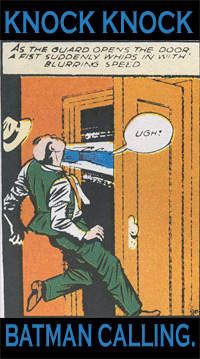
So knowing that the element of surprise is lost, Batman simply RAMS into the garage with the Batmobile! Batman and Robin brutally beat up the gangsters and capture Nick, who reveals Renaldo and Linda's location in Kentucky. The Dynamic Duo journey there in the Batplane, arriving at the Lewis cabin. Batman makes his entrance via the best knock-knock joke ever. (Image courtesy of Chris Sims).
Batman then proceeds to introduce Linda and her father to Nick, the man she "killed". But it's too late, Lewis has already told the crooks about the cave, and they're already on their way there!
Batman demands that Lewis take the Dynamic Duo to the cavern, so that they may stop the criminals. Rowing down the stream through the limestone cave, the Dark Knight and the Boy Wonder comment on the awesome solemnity of the place -- you can almost see the thought balloons of "gee, why don't we have a cave? These things are great!"
Meanwhile, the crooks have finished digging up into the vault, but are being spooked by bats from the cave. So of course, Batman steps out of the shadows and kicks their asses. The fight brings the National Guard down on them, who shoot all the criminals and offer Batman and Robin commendations for medals of bravery! The vigilante Batman refuses however, saying that "being Americans is enough of an award!" Wow. Well, I guess it is January, 1941.
My Thoughts: This is a fantastic story that really showcases a team working at the top of their game. Finger, Kane, Robinson, Roussos, they all deliver here. The tale itself is pretty standard comic book, but its the effort and care being put into the story that makes this a Batman comic not worth missing. The only thing about it that's a little odd is the US Soldiers offering Batman, a wanted vigilante, a medal. But pretty soon I guess I'm gonna have to get used to patriotic flag waving.
The Art: The art is GORGEOUS! It's the absolute BEST it's been since Detective Comics #38, I kid you not. It's got Robinson's detailed inking alongside Roussos' solid black swaths of shadows, and Kane's layouts are dynamic and engaging. It's seriously the artwork that elevates this story. You need to see it. Go out and buy "Batman Chronicles Vol. 3" right now, damnnit!
The Story: Finger's story is pretty good, but it's not his best. What's nice about it though is the pacing. Nothing feels especially rushed, like how most Golden Age stories feel. And given that it's gonna be another fifteen years or so until Ian Fleming writes Goldfinger, this is a pretty good "rob Fort Knox" scheme. What's great here is that there's beginning to be a distinction between the way Batman and Robin are written -- with the daredevil attitude and joke-y quips being Robin's forté and Batman being a brutal and determined avenger of crime. Good stuff.
Notes and Trivia: First time Batman's vehicle is referred to as the "Batmobile".
Apologies for the extreme lateness of this post. Directing a short film is not a conducive activity to blogging about comics.
Note that the Batman head in the title logo has now changed to resemble the shorter eared Batman of the Kane/Robinson team rather than the longer eared Batman of Kane/Moldoff team. The interior logos on the stories still featured long ear Batman though.
"The Case of the Joker's Crime Circus"
Writer: Bill Finger
Pencils: Bob Kane
Inks: Jerry Robinson and George Roussos
Synopsis: Last time we saw the Joker, Batman had knocked him over the railing of a ship at sea. As we begin this story the Joker is discovered by a passing yacht, who bring him aboard and take him ashore, remarking upon yet completely ignoring his bizarre appearance and in no way connecting it to the serial murder who has been terrorizing Gotham the last few months. The Joker wanders ashore and finds his way back to the abandoned mansion he was using as his lair in Batman #1, which locals believe is "haunted" and don't approach. Now's a good time to mention that I really appreciate the continuity in these early Joker stories, explaining how Joker survived the last story and how we've gotten to this one. In modern stories it seems the opening is always "Joker has escaped Arkham" regardless of how the previous story ended. Of course it helps that Bill Finger has written every Joker tale. Anyways, alive and well, Joker declares he shall get revenge upon the Batman!
Two months pass (aka the time between Batman #4 and Detective Comics #45), and Batman and Robin are on patrol in what is apparently a rich residential neighbourhood. They observe a burglary in progress, but the perps prove to be surprisingly acrobatic, evading Robin while a tall accented strong man takes out the Batman.
The next morning, Bruce and Dick discover this is the fifth robbery of a rich home in recent weeks. Dick hands Bruce a letter informing him he's invited to a party on Saturday night hosted by C.R. Darcey. Arriving at Darcey's luxurious home, the other guests remark on Bruce's reputation as as a lazy, stupid, spendthrift.
Darcey announces there is to be a unique entertainment at this party: a miniature circus act! The performers include acrobats, a strong man, and a clown whom Bruce finds oddly familiar.
Later that evening, the circus troupe arrives at the "haunted" house, revealing themselves as a new crime gang commanded by the Joker (wearing regular clown make-up over his bizarre clown-life face, hilariously).
Three days later, Bruce and Dick learn that the Darceys were robbed, and Bruce deducts that the circus act is actually casing the houses to be robbed later. The Morganbilts are the next to play host to the party and Bruce decides the Batman and Robin will be attending as well to prevent the crime! (Which is pretty pro-active for Golden Age Batman, who usually waits until the crime is committed, then beats up the crooks, helping nobody).
And so, in the middle of the Joker's act, Batman and Robin swing in through the window, and begin fighting the circus performers in a series of acrobatic death-defying stunts. Of course the rich snobs in the audience assume it's all part of the show, and just keep clapping like idiots.
This time, Batman defeats the strong man (punch to the jaw, and then he picks him up and throws him to the ground because he's BATMAN) and the Joker takes flight. The crowd realizes what's been going on, while Batman and Robin pursue Joker to the "haunted" house. Joker decides to set up some traps for the duo.
Upon arriving, Batman finds the door locked behind them. They are confronted by a ghost, but Batman tackles it and reveals it to be a thug in a costume. But it's a distraction, and Joker runs off with Robin (first instance of the Boy Hostage?). Batman gives chase, but ends up in a darkened room confronted only by the floating head of the Joker, growing ever larger and laughing wildly in an attempt to drive Batman mad. But of course the Dark Knight deduces it is merely a film projector and speakers, destroys them and moves on. Joker tries to gas the room, but Batman uses some vials from his belt to blow a hole in the wall, where he discovers Joker trying to drop Robin down a trapdoor. A fight ensues, but Batman succeeds in throwing Joker down the trap-door, which falls far down into the city's sewage system. This time, Batman actually expects Joker to return, rather than wonder if he will.
My Thoughts: This is sort've a grand return for the Joker, although it's the first story featuring the character where he doesn't kill anybody. That being said, it also makes a subtle transition from a Joker who was an unpredictable death dealer and jem thief, to a criminal who plans big, elaborate crimes with showmanship. In the previous Joker story, he betrayed his own men, continuing a theme of the Joker being unable to "play well with others", but here he assembles a gang of ex-circus performers who follow his orders willingly. Finally, while the Joker is defeated yet again in a manner that could have killed him, the story doesn't even really try to play that angle. The question is no longer "if" the Joker will return, but "when". That being said, Joker has not spent any time in jail save for two days between his stories in Batman #1. Otherwise his stories have all ended with Batman leaving Joker for dead -- which brings up something else interesting I've been meaning to address. Batman has not actually killed anyone since adding Robin to the mix, but in these confrontations with Joker he finds himself wondering if Joker is dead after punching him into the ocean or whatever -- meaning that the Dark Knight was probably intending to kill Joker, despite failing. So while we have a Batman who refuses to use guns (anymore) and does not kill (anymore), it's not quite the "one rule" Batman of today.
The Art: Great art in this story, especially in the final sequence at the Joker's haunted house, with the ghost and the projected Joker head. Spooky, exciting, macabre, with excellently prodigious use of shadow in the background courtesy of George Roussos -- entire rooms cloaked in black.
The Story: A pretty good Joker tale from Finger, it presages the kind of larger-than-life madcap capers the Joker will attempt in the years ahead, emphasizing the performance criminal aspect criminal over the serial killer -- a necessary step in making Joker viable as a returning villain, otherwise his actions would get so despicable as to make Batman seem a fool for letting him live (attention, modern Bat-writers!!). However, there are some hiccups -- notably the story spends two panels on introducing a dwarf in Joker's gang who never shows up again. Odd. But otherwise good.
Joker Body Count: 17
"Blackbeard's Crew and the Yacht Society"
Writer: Bill Finger
Pencils: Bob Kane
Inks: Jerry Robinson and George Roussos
Synopsis: Okay, so there's this Yacht Society. They're a bunch of rich yacht owners who once a year go on a long cruise on one of the member's yachts. They all bring a ton of jewels and fancy shit, but they don't worry about any of it being stolen because they're out at sea -- what, are a bunch of pirates gonna show up? Everyone knows there are no pirates in the 20th century! Right?
Of course, all the members of the yacht society have their own little personal problems: There's Mr. Horn, who brings along his secretary Stanley apparently just to boss him around; the young Elaine, who can't decide which of two playboy suitors to marry; and poor Cowden, who has recently gone bankrupt and is planning suicide.
So, of course, after a few days at sea a pirate ship shows up. A fully loaded, sails unfurled, 18th century pirate ship, launching small boats and boarding the yacht. The crew thinks it must be a masquerade party, but the pirates (all dressed in period costume) begin killing the crew with swords.
Their leader is Blackbeard, of course, whose plan is to hold the rich people for ransom. A communications officer on the yacht manages to get out a plaintive distress call before being killed by a pirate. Authorities on land dismiss the call as nonsense, but Batman and Robin intercept the message as well and decide to take the Batplane out to take a look.
They get out to sea and find the pirate ship (it's somewhat conspicuous) and it is here that the Batplane hits the water and transforms into the Batboat! Batman and Robin climb aboard the pirate ship and begin battling the rogues, but are overpowered and captured. Blackbeard is smarmy and condescending, but Batman doesn't believe he is the real Blackbeard and taunts him. Robin is thrown off the plank, but Batman jumps in after him and rescues him after fighting and stabbing a shark.
The pirates see the blood in the water and assume Batman and Robin are dead, but in fact it is the shark's blood from Batman shanking it, and soon the Dynamic Duo are up in the hold of the ship, rescuing the prisoners. But Batman needs help, and asks the Yacht Society for their assistance. One of Elaine's suitors, Henry, volunteers while the other dismisses the idea as too dangerous. Crowden also volunteers, having nothing to lose, while Mr. Horn calls the whole group crazy for trusting the masked criminal Batman. Which, of course, is the moment when Stanley the secretary has finally had enough and stands up to Horn, telling him to shut up or get a smack in the face.
With his team assembled, Batman and Robin move to take the ship, with an unprecedented FIVE-PAGE fight scene finale. The Dynamic Duo get some swords, but Batman reminds Robin to only use the flat of the sword as "we never kill with weapons of any kind".
After defeating "Blackbeard" in a duel, Batman removes his fake beard and hat Scooby-Doo style to reveal a gangster named Thatch, who Batman tells us is a descendant of the real Blackbeard. Thatch planned the scheme a year ago, buying the ship and teaching all his men how to duel. The plan was that no one would suspect the gangsters of being the pirates. Robin remarks that this is a pretty elaborately dramatic plan, but Batman reveals Thatch was also an actor before he became a gangster (okay??).
Meanwhile, Elaine chooses Henry because of his bravery, Crowden gains the courage to face his troubles instead of run away from them, and Horn was so impressed with Stanley's outburst he gives him a promotion!
My Thoughts: Well, clearly Finger and Kane were looking to stretch their legs a little bit and try out Batman in various genre pieces by this point. This pirate outing is a little bizarre and hackneyed, but ultimately a lot of fun. While I don't ordinarily like seeing Batman in stories like this, I can certainly understand the need to keep things fresh and try new things. There are also some notable firsts in this story, the most significant of which is Batman's statement about killing. As noted on this blog, Batman killed quite frequently in his early stories, but ceased these actions almost immediately after bringing Robin aboard. As early as Batman #1, he began speaking out against using guns, saying that gun users were cowards. But this is the first declarative statement from Batman about lethal methods, clarifying that the Dynamic Duo does not kill with weapons of any kind. No killing, no guns. Got it?
The Art: Another strong effort from the Kane Studio. Dramatic battle scenes, and an excellent use of light and shadow.
The Story: Okay, so here's the weak point. For one thing, it's got characters in the story literally laughing about the idea of pirates in the 20th century right before they show up, like Finger's saying "yes, I know this idea is ridiculous but who cares?", but then Finger still feels the need to justify and explain everything as making sense within Batman's world, which is where things fall apart. All of the exposition about Thatch, his gang, his backstory is delivered in three panels right at the end of the story. The only clue that Batman uses to come to his conclusion is that "Blackbeard" address him by name earlier. This is weak storytelling. Also weak is the contrivances to get Batman and Robin involved, namely intercepting a distress call that the police ignore. Bruce Wayne is a millionaire! He could've just as easily been a member of the Yacht Society and been involved that way. As is, the entire story is an excuse to see Batman and Robin fight pirates, which makes for a fun comic, but a bad story.
Notes and Trivia: First appearance of the Batboat, first use of the phrase "Dynamic Duo", Batman explains his "no guns, no kill" policy, first time Batman fights a shark.
"Public Enemy No. 1"
Writer: Bill Finger
Pencils: Bob Kane
Inks: Jerry Robinson and George Roussos
Synopsis: Ever seen the movie Scarface? The original, with Paul Muni? Or The Public Enemy, with James Cagney? Great. Picture that, now with Batman. That's what we're getting here, essentially.
We are told the life story of Jimmy McCoy, who dropped out of school and became a rum-running hoodlum in order to support his mother after his father died when he was young. Eventually Jimmy was arrested and sentenced to a year in Juvenile, his mother died of a heart attack from the shock of finding out her son was a criminal, but Jimmy blamed "the law" for her death. When released, he reoffended, was sentenced to prison, and there he fell in with hardened career criminals. He got out, and became a racketeer, working his way up to become "king of the rackets", the biggest mobster in town. Eventually he was brought down for income tax evasion (gee, this is sounding familiar?) and sentenced to ten years. Now it's 1941, and he's getting out.
Of course in the time he's been imprisoned, another mob boss has taken over the city. Big Costello knows that McCoy will come out gunning for him, trying to be the big shot he used to be, and orders a pre-emptive hit.
Hanging around in his old neighbourhood, McCoy is the target of a drive-by that gets a small girl killed. McCoy fires back, taking out the wheels of the car and killling all inside. And THAT'S when Batman shows up. He's been following McCoy to ensure he goes straight. I've always liked that Batman invests himself in the rehabilitation of criminals, but if he's been following McCoy the whole time why did he not rescue that girl?? Anyways, Batman chases McCoy across town, but ends up taking a bullet to the shoulder. The Dark Knight vows to get McCoy if its the last thing he does.
McCoy starts up a new gang, and it's at this point that we learn that McCoy is ultra-superstitious, always carrying around a lucky rabbit's foot and so on. Soon the city is split asunder by a gang way between McCoy and Costello, each attacking each other's territories for control of the protection racket.
After going undercover, Robin discovers that McCoy is going to hit the Penguin Club, a Costello establishment. Batman and Robin try to intervene, but the whole thing explodes in gunfire. After a really top notch two page fight scene, the cops arrive and the Dynamic Duo hightails it out've there. The Penguin Club is a wreck, Costello is arrested, but McCoy escapes. Upon hearing that Costello is being held at the courthouse, McCoy makes his way there to have his revenge, despite having lost his lucky rabbit foot (and running across a black cat and a dozen other unlucky things).
Batman and Robin head that way to try and prevent a showdown, but arrive too late. Costello gets out of the courthouse just as McCoy arrives, and in the middle of a torrential downpour they have a shootout, and both are killed, McCoy's body falling down the stairs and slumping down into the gutter.
In the denouement, Bruce Wayne TURNS RIGHT TO THE READER and tells them that CRIME DOES NOT PAY. Get it? Get it??
My Thoughts: So one thing to keep in mind about this story is Al Capone. Jimmy McCoy is basically a fictionalized Al Capone. Capone had been sentenced to eleven years in prison in 1932 for tax evasion, just like Jimmy McCoy, and had been released in 1939. There were fears that he would resume his criminal reign like Jimmy does here. Instead, Capone's mental state had deteriorated in his imprisonment and he came out babbling like a twelve year old.
Of course, many would've preferred Capone go out in a hail of bullets, so you have the thinly fictionalized movies like Scarface and Public Enemy, which both clearly inspired this comic. Finger adds the touch of having McCoy die where he "began" -- in the gutter.
The Art: The art is FANTASTIC! Especially the inking! Robinson and Roussos really deliver and elevate this story, giving it a dark, epic, film noir feel -- perfectly suited to the Warner Bros. crime dramas it seeks to emulate. This is the kind've art that gives Frank Miller boners. It's great. There's a lot of fantastic, impressionistic panels, superb cartooning, excellent use of shadows, as well as three-dimensional perspective, and background detailing. One of the best looking Batman stories so far by this team -- full kudos to Roussos' inking, as well as Robinson and Kane.
The Story: As great as this story is, it has its faults too. The biggest one is that Batman is barely involved. He's more or less a witness to McCoy's story, his involvement doesn't affect the outcome. Then there's the fact that this is just a comic book version of a bunch of movies that are a fictionalized version of a new story. In other words, Finger is riffing on guys who were already riffing on reality. There's nothing new. Granted, these are the days before people could just see those movies over and over again, and there's some timeliness in that Capone himself had recently been released, but this isn't even the first time Batman's fought a Capone pastiche. Finally, there's the moralizing -- for the most part the story is one of the better "moral driven" Batman stories, but the fact is that in the second last panel Bruce Wayne directly addresses the reader and delivers the crime does not pay moral, which is really hokey and has been done before in other Batman stories! However, there's plenty that works too -- I like that Finger shows us McCoy's entire rise to crime, and gives it realistic motivations, like poverty. It shows that one can start down a dark path from an understandable beginning, that good motivations aren't enough. It's an effective lesson for kids, and gives McCoy an interesting character -- a kid trying to be a big shot, as Batman says at the end. McCoy has a complete and dynamic character arc, giving the story a truly epic scope and feel. So despite its flaws, this is a good 'un.
"Victory for the Dynamic Duo!"
Writer: Bill Finger
Pencils: Bob Kane
Inks: Jerry Robinson and George Roussos
Synopsis: The Dynamic Duo come across a man being beaten up by a gang of thugs outside a Sport Shop. They fight the mob for a bit, but then a car drives by spitting machine gun fire. Batman shoves the target behind some (bullet-proof?) trash cans, and then picks up a gun that another thug dropped and takes aim at the attacking vehicle. He then fires and hits the machine gunner in the hand, causing him to drop the machine gun as they drive away. In the same panel there's an editor's note explaining that the Batman "never carries or kills with a gun!" So Whitney Ellsworth and Bill Finger seem oddly cross purposes here. Anyway, turns out they rescued Tim Bannon, coach of the Gotham City Panthers football team. Oh, by the way, these stories are set in Gotham City now! Yes, we were still established as in New York as late as the previous story in this issue, but now we've invented Gotham as Batman's fictional locale.
Anyways, Bannon was attacked because his team is set to play the Lions, a team owned by "Stacy the Gambler", who has bet a ton of money on his own team, and is of course a dangerous gangster. Then the police show up, and the crimefighters beat a hasty exit.
So we cut to Stacy's hideout. And it turns out Stacy the Gambler is the smartest Batman villain yet. Upon hearing that Batman rescued Bannon, Stacy decides that Batman must be killed before they can try doing anything else. At which point he announces that he knows how to get the Batman -- because he knows who the Batman is!
Follow me now through Stacy's brilliant train of thought -- rich playboy Bruce Wayne is always seen hanging around police headquarters with "friend" Commisioner Gordon, and what is he doing there? Perhaps the "bored playboy" routine is just an act and he really uses all that money to fight crime?
Brilliant, Stacy. Simply, brilliant. What the hell is billionaire playboy Bruce Wayne doing hanging around old Gordon at police headquarters? Finger has never bothered to explain why Wayne and Gordon are even friends. I figured that Gordon must've known or been friends with Thomas Wayne somehow, maybe. With the age difference and difference in interests, a natural friendship between Wayne and Gordon doesn't make much sense.
Anyways, Stacy's figured the same thing and deduced that Wayne is Batman. And that they should kill him. Good for you. I'm sure it will go swimmingly.
So Stacy concocts a plan. He phones Bruce Wayne, claiming to be someone under threat of death and telling Bruce he knows he's the Batman. He gives an address and a time and tells Bruce to hurry. Dick smells something fishy but Bruce thinks the only way to find out how they figured out he was Batman is to play along.
So late the next night, Batman and Robin arrive at the prescribed address, only to find Stacy and his gang waiting for them. So of course there's a two page fight scene, a pretty damn awesome one in fact, but the Dynamic Duo is outnumbered! Batman orders a hasty retreat, but the gangsters follow them all the way back to the abandoned barn near Wayne Manor. Of course when they arrive there is no one there.
Stacy meets up with some men he has stationed to watch Wayne Manor (damn, he's smart!), who report that they have not seen anyone leave or enter the home. Just then, Bruce Wayne emerges from the front door, asking the hoodlums to please leave his property. Convinced it must be some kind've trick, the gang watches Bruce as he walks back inside, following to watch him through the living room window, where he sits and reads a book.
And at that moment, Batman appears in the yard behind the gangsters. The Dark Knight gives chase, and the gangsters follow. It is at this point that Finger stops the narrative to explain Batman's tricks: First, that Robin and he escaped through the underground tunnel that connects the abandoned barn to Wayne Manor (first seen last issue), then the Wayne the crooks see reading in the living room is in fact Robin operating a Bruce Wayne dummy (a ploy last seen in Detective Comics #42). I like how clever this defense of the secret identity is. It relies on devices we've already seen Batman use, so it is consistent and believeable, unlike some later Silver Age takes on the topic.
But of course there's one last loose end, which Batman ties up himself when he dumps some expository dialogue on the crooks explaining that Batman knew of the call the crooks made to Bruce Wayne because he just happened to be spying on them at that moment, and acted accordingly! (Facepalm. Okay, so it's not all that clever).
The gangsters give up trying to chase after Batman, and return to resume their plot to ruin the big game between the Panthers and the Lions. The morning of the game, Batman and Robin pay a visit to the apartment of Stockton, the Panthers' star quarterback, to ensure Stacy hasn't tried anything. Of course, Stockton has been kidnapped. Which is when Batman gets the craziest idea ever. He sends Robin to rescue Stockton, but there's just no way he'll make the big game in time. So using his mastery of disguise, Batman makes his face over to look like Stockton so he can take his place in the game.
Robin follows Stacy from the stadium to his hideout, and there a two-page fight scene ends in the rescue of Stockton and the death of Stacy, killed in crossfire with one of his own men (a crossfire Robin totally causes, btw -- kind've straddling that "no kill" line if you ask me). Robin informs Stockton that Batman has taken his place -- Stockton exclaims that they must get back soon, since Batman is probably failing horribly.
Of course nothing could be further from the truth. The Dark Knight is practically winning the game single-handedly, while remarking that he hasn't done this "since my college days!" (Yet another of several recent mentions that Bruce Wayne did indeed attend college). In fact, Batman is playing better than the real Stockton! At the half, Batman and Stockton switch back, but luckily Stockton "plays like a man inspired" and proceeds to win the game! Hooray!
My Thoughts: Okay, so this story was awesome. And goofy. And awesomely goofy. I definitely enjoyed it. I'm finding as I get older that I'm able to enjoy these kinds of old-school, lighter, "fun" Batman stories far more. For a while I was definitely a "dark and gritty Batman only" kinda guy, but reading these old Golden Age stories and watching Batman: The Brave and the Bold has made me realize that Batman can be fun as well. And it's a blast to read.
The Art: Spectacular art! Not quite as good as the previous story in this issue, but still top-notch from this creative team. Enjoyed it all the way through.
The Story: There are basically two threads in this story, and they're both great. The first is Stacy's deduction that Bruce Wayne is Batman, and the resulting game of cat and mouse. This feels really clever, and is executed is a very exciting manner that genuinely kept me wondering how Bruce was going to get out of it. Making Stacy smart was a really great move on Finger's part, and added extra spice to an otherwise silly story about rigging a football game. Which of course is the second thread in this story, which is hilariously awesome mainly for the climax of Batman kicking ass on the field compared to professional footballers. Amazing. Another hidden talent of the Batman!
Notes and Trivia: First time the location of these adventures is described as "Gotham City"!
Overall, Batman #4 is probably the best issue since #1.
"Money Can't Buy Happiness"
Writer: Bill Finger
Pencils: Bob Kane
Inks: Jerry Robinson and George Roussos
Synopsis: Batman busts up a robbery, then returns home, with Finger elaborating on the trap door in the abandoned barn that leads to an underground tunnel that comes up in Wayne Manor. This takes about three pages, so I guess the initial story must've come up short?
The next morning Bruce leaves to meet with his banker, Hank Midas (har har). Midas' son, Roger, walks in and asks his dad if they are going to the football game, but Midas is too busy and refuses. Roger walks out upset but Midas explains to Bruce "business before pleasure, after all." Bruce agrees, but thinks to himself that he would never let his business interfere with his relationship with his son, which is an interesting attitude for Bruce to have. It says something about the kind of father Thomas Wayne must have been, and it also says something about Bruce's habit of drafting youth into his war on crime.
Bruce decides to spy on the Midas family as Batman, I guess just because the lack of a father-son relationship bothers him? It seems a little odd for Batman, a bit of a flimsy rationalization for why he's witness to the following events: Turns out Mama Midas is a bitch too, daughter Diane has a thing for Johnny Brown, a clerk in Midas' company, but mother believes he is too lower-class for Diane.
As Bruce, he journeys into nightclubs to follow Roger, who has a serious gambling problem on one hand, but a serious musical talent on the other. Bruce questions Roger about why he hasn't pursued this talent, but of course Midas would never approve of his son as an orchestra leader.
Soon thereafter, Diana Midas is married to a defunct European Count, the marriage having been arranged by her parents, the Count marrying her largely for the money.
Bruce reflects that these parents have done a swell job screwing up their children's lives, and essentially wishes he had an excuse to intervene as Batman. Which is kind've weird.
As the months pass, Roger's gambling debts lead him into bad company (implied to be loansharks and gangsters). One night as they are exiting a club the Batman confronts them and demands they let Roger go. They jump into their car and speed away, frightened by the Batman so much they don't look where they're going and hit a newspaperboy. The kid is dead, but Roger can't bear the thought of his dad finding out about the accident, and demands the crooks keep driving. So now Roger Midas is party to a hit and run, and if you think about it -- it's entirely Batman's fault. A Batman who was just recently waiting to have a reason to intervene and has now manufactured an event to allow him to do so. Yikes. And who says it wasn't until the Modern Age that comics started having morally ambigous heroes.
So of course the crooks demand blackmail payments from Midas so they won't leak the story to the press. Midas, concerned more with his image than morality, is prepared to pay, at which point THE BATMAN enters dramatically through the window. Batman, being a paragon of justice, advises Midas to take his punishment and bear the brunt of being slammed in the press. Nevermind that this whole situation wouldn't exist if it wasn't for Batman, it's still a good moral lesson about not giving into crooks. But Midas doesn't listen, and Batman accuses him of believing his money can solve all his problems when it can't. Which is a pretty hypocritical thing to say when you're waging a war on crime funded solely by your massive inheritance.
Meanwhile, Robin is spying on Diane and the Count -- because apparently both members of the Dynamic Duo have decided to devote themselves to butting in on other people's business this month. Anyways, Diane has decided to tell Count Alexis she doesn't love him and that's she's going to divorce him and leave him penniless (you go girl!). But since "European Count" is synonymous in early forties American English for "dastardly fiend", Alexis is immediately planning to "do as I did with my first wife!" Yeesh, Mama Midas sure can pick 'em, can't she?
So Robin follows Alexis and listens in as he hires two goons to steal the Midas family jewelry for him, splitting the take 50/50.
Robin meets back up with Batman, and we find out that the heist is planned to occur two hours before Midas is going to meet to pay the blackmailers. Batman and Robin make short work of the Count and his goons (one page fight) with Batman indulging in the groan-worthy "Looks like the Count is down for the Count!" Of course, the Midas parents walk in, and Batman explains that Alexis was going to steal all their shit. Midas thanks Batman, but still refuses to take Batman's advice about the blackmailers. Of course, it's not like Batman is really going to give him much of a choice.
Batman and Robin stow away on the roof of Midas' car, and then wait until the blackmailers arrive to meet with Midas and Roger, before bursting through the door, chasing the blackmailers out the window, up a fire escape, down another fire escape, into a car, and then crashing that car while of course not killing anybody. It's a great three-page fight scene. Oh, and during the commotion one of the blackmailers shot Roger. Sorry, I got swept up in the Bat-action.
Roger will bleed to death if something isn't done soon, so Midas takes him to his doctor (implied to be an expensive private doctor who is on Midas' payroll). The doctor operates, but tells Midas that his son's recovery is in the hands of a greater power, now. Batman takes the opportunity to gloat and tell Midas that all his money can't save his son now -- which is both hypocritical and somewhat untrue, given that Midas' money did hire a doctor who could arrive and operate on Roger immediately and well enough that there is some hope of recovery.
Anyways, Roger pulls through, and mans up and admits culpability in running over the newspaperboy. Who isn't dead, I guess, since it's mentioned that Roger uses his money to pay for the boy's operation as well as his future college education. Since, y'know, you can't solve all your problems with money? Oh, wait.
Sometime later, Hank Midas puts off a meeting with Bruce to go to a football game with his son, while Mrs. Midas admonishes Diane for being late to a date with Johnny Brown. Everything's worked out, because the parents have learned to be friends with their kids. Isn't that a great lesson, we think as Bruce stares accusingly at us through the fourth wall.
My Thoughts: Oh, jeez. I have really mixed feelings about this comic. I actually tend to like "message comics" more than most, for example I loved "Crime School for Boys" from Batman #3. But years of devotion to Steve Ditko and "Mr. A" comics has taught me: there are good message comics and bad message comics (and not much in between), and they can come from the same creators in the same series.
"Money Can't Buy Happiness" is all over the map, but it's main problem is that what it claims the moral to be isn't actually what the moral is, which is actually a pretty common problem when superhero comics get preachy. A writer decides to make a point, but then can't create a superhero plot out of that without creating contrived circumstances. So in this case, we have a comic that's trying to say that "money can't buy happiness", but in fact the real problem is "these parents are huuuuuge dicks". At the end of the day, Midas' money is why he's able to afford to take his son to football games, and get him a job as an orchestra leader, and is why Diane even meets Johnny Brown, and it's what saves Roger's life and enables him to make restitution to the kid who's run over.
And, as I pointed out above, using Batman to make a point about how money can't solve all your problems is a huge load of shit. At this point in the mythos, Bruce's parents' money pays for everything. The idea of a Wayne Enterprises, or that Bruce does any work at all, is far far away -- at this point his civillian identity is a layabout playboy and all of the money is going into fighting crime. So yeah, Bruce has a ton of money he hasn't earned and he's using it to solve everyone's problems. All of the problems in this issue? Solved, thanks to Bruce's money.
And then of course there's the bending-over-backwards to even get Batman involved, since "meddling in people's family relations" is hardly "warring on all criminals", and this narrative tomfoolery essentially turns Batman into a morally questionable figure, which is not what you want to do with your hero in a message comic. If your story has a moral message, you want your hero embodying the essence of good in your moral.
However, there's a lot to like in this story, which I'll get to in a bit.
The Art: The Kane Studio art team does their usual good job, having hit a nice stride that is producing some consistently good work, if not exactly as stylish as it can be at its heights. The best work in this story is the action scenes, which flow with a motion and excitement that has come along way since Kane's somewhat stiff offerings of a few years ago.
The Story: Okay, so there's some good and some bad here. Most of the bad comes from the slapdash moralizing throughout, which I already went over. Some of the bad comes from the pacing (those first three pages literally have nothing to do with the rest of the story, despite doing a nice job of elaborating on the whole barn/secret tunnel thing that Finger is developing).
So what works? Well, if you realize the message is "parents shouldn't be dicks" instead of the money thing, there's a lot to like here. I especially like the kids themselves. The way Roger slowly spirals down into gambling debt and then blackmail is really well done, and believable for a talented kid starved of attention. And I like Diane's chutzpah as she leaves the Count, who wants only her money, for her true love. I also like that Finger is trying to make scripts that mean something, that teach something to not only kids but (as is clear in this case) the parents who might be reading these comics with their kids. It also makes the stories more fun to read and write about from a critical perspective than another "Batman breaks up smuggling ring" kind've tale.
Notes and Trivia: There's an abandoned barn where the Batplane is kept with an underground tunnel that goes to Wayne Manor!