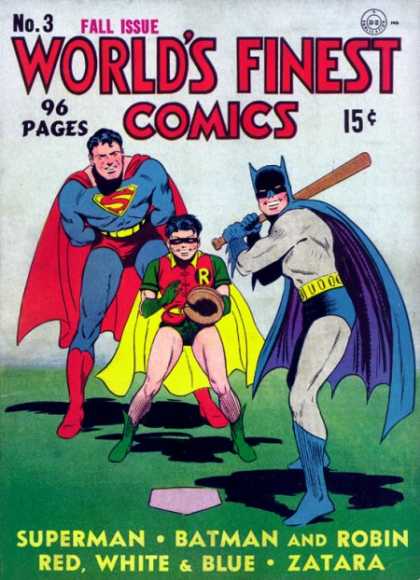
Showing posts with label World's Finest. Show all posts

Sunday, June 12, 2016

World's Finest Comics #11 (Fall, 1943)

I know, I know. It's been over a year since the last post. And I know I've promised no long breaks between posts before. Guess I shouldn't make promises I can't keep. But here we are again, in Fall of 1943. I am excited to be back, hope you'll join me again for Golden Age Batman goodness, because this one is excellent.

"A Thief in Time!"
Writer: Bill Finger
Penciller: Jerry Robinson
Inker: Fred Ray
Synopsis: Our story begins in the Gotham City of the late 21st century! Yes, it's the future, complete with rocketships and Flash Gordon looking fashion. A laboratory worker named (no shit) Rob Callender comes out of a Batman Museum, wishing he was in Batman's time, because then he could be a millionaire!
And then he's so absent minded about that at work, he accidentally mixes some chemicals and BOOM, space-time warp to 1943! It's just that easy. 

He realizes he's in Batman times, and promptly sets about getting some new old clothes, then "borrowing" (read: stealing) some vacuum tubes and other equipment to start assembling some future technology! Good thing he has the knowhow. If you sent me back to 1916 and told me to make an iPod with shit lying around, I'd have to just shrug.
Anyways, he manages to make a gun that shoots a light absorbing ray that creates an area of total darkness ahead of him, and with the aid of infrared goggles, he's totally ready to just straight up rob a bank. But, oddly, he makes a point of saying that if he's taken more money than he needs, he'll return the rest to the bank by mail... Weird.
Using the money he's stolen, he hires a bunch of criminal thugs, but makes a big point of there being absolutely no violence. They then proceed to dark-ray rob an elementary school for a third grade reader book, and an obscure woodworker for a random table lamp. The thug are understandably perplexed, but as long as he's paying, who cares right?
About this time Batman and Robin take an interest, because this weird shit is definitely up their alley. Luckily, Batman already has infrared goggles (he's used them before in the comic), so they're well prepared to fight these guys.
My favourite moment in this comic has to be when they head out in the Batplane, and two dudes spot them overhead and say "Here's where some gangsters get what's coming to them!" It's a great little moment showing normal people reacting to living in Gotham City.
Anyways, the crooks are robbing an unknown author who lives in a waterfront shack (jesus, I guess things could be worse for me), and steal an entire manuscriot from him.
Batmn and Robin show up for the fight scene, while Rob Callender exclaims "Dear, dear! This is so unnecessary and painful!"
Rob shoots the Dynamic Duo with a goddamn paralysis ray he whipped up somehow, but he won't kill them. Instead, he tosses them in a rowboat, rows them out to a derelict ship beached on a reef that heknew was here then dumped them in the hold, where the paralysis ray will wear off once the crooks are safely away. After all, he can't let anyone be killed... but he can leave clues, dude knows from going to a Batman musem how to be Batman villain afterall, and taunts the Dark Knight with a reference to "art in a textile mill".
However, once he's left, water begins pouring into the hold -- when the tide rises the ship goes under and fills with water through holes in the hull, ironically putting Batman and Robin in an unintentional death trap!
Batman figures how to get free of course -- the walls of the hold are covered in barnacles which they use to cut through the ropes -- but then the question is how to get back to shore! Luckily, the ship is a light ship, with it's own light tower! They light up the beacon, with Batman sticking a Bat symbol on the glass to form a makeshift Bat signal, which alerts the harbor police to come and rescue them.
Back on dry land, they ask the robbed author about the manuscript, who tells them it wasn't valuable, and in fact he was super dissatisfied with it and wanted to tear it up. The two look for clues, but all Robin finds is a penny... a penny minted in 2043!! (Goddamn it, America, you're really gonna hold on to pennies that long??)
The two hop back in the Batplane and head to the textile mill, where the night watchmen paints in his spare time, and of course Callender is there to steal the painting. Batman figures out that he's from the future, stealing seemingly worthless items that only become famous in a hundred years, after the unknown craftsmen become famous after their deaths. 
Callender reveals he got the idea from seeing all of the items in a collection of Batman's trophies in the Batman Museum, which is certainly a weird place to see them unless...
And then SWISH! The space-time warp closes, and Callender is back... to the FUTURE!
And then Batman and Robin are like "well, shit, what do we do with all this stuff?" None of the people who it was stolen from want it (despite now having certifiable knowledge it will be valuable one day?) So Batman and Robin put it in their growing trophy collection...
...and thus Rob Callender sees it in the Batman Museum over a hundred years in the future!
~~~~
My Thoughts: I love time travel stories, especially when they are simple enough not to be aggravating, but clever enough to actually make sense. I am delighted this is a Bill Finger time travel story. I'm sure I've mentioned this, but Finger was always collecting weird story ideas from stuff he'd read -- odd facts, interesting gimmicks, and this is a story that seems fueled by those. But the mention of stuff like "space/time warp" and the pretty good looped time travel logic really makes this a surprisingly good time travel story for a 1943 comic! Very enjoyable. Also, I just love that Callender refers to the 1940s as "Batman times". Like, fuck World War II, Batman is the thing about the 40s that will be most remembered.
The Art: It's Jerry Robinson. This is the good stuff, but Fred Ray's inking makes it even better, just solidifying the work a little more so it looses some of Robinson's loose scratchiness and looks nice and polished. But it's top notch Golden Age Batman, just a joy to be looking at again. The best single panel is on the first page, with Callender shaking his fist in triumph in an utterly classic villain pose. 
The Story: The fact that Callender won't let anyone be killed (he's not such a bad guy, and it would cause paradoxes), the trick of everything he's stealing not being worth anything in the present, the little clever details like the waterline in the hold alerting Batman to danger, using the barnacles to get out, and figuring out how to light the DIY Bat signal, these are all great clever details you expect from a class act Bill Finger script -- but the bit about how the reason those items are in the Batman museum for Callender to get the idea to go back in time and steal them is because they are from the case where he goes back in time to steal them? That's some A+ classic time travel storytelling there. Love it.


Up next on Bat to the Beginning? It's time to keep on with the Batman serial, guys!

Saturday, March 22, 2014

World's Finest Comics #10 (Summer, 1943)

An interesting cover here, with the different characters featured drawn by different artists rather than one unified penciller. Superman is by Fred Ray the Boy Commandos by Joe Simon, Green Arrow and the Star Spangled Kid are by Hal Sherman, and Batman and Robin are by an artist we will be seeing a lot more of in the future... the legendary Dick Sprang!
Sprang's art has yet to appear in this feature, for a variety of reasons, but once it does it's gonna change the whole ballgame.

"The Man With the Camera Eyes"
Writer: Bill Finger
Pencils: Jerry Robinson
Inks: George Roussos
Synopsis: Oliver Hunt is a man with a photographic memory (an eidetiker, which is something that probably doesn't exist). He works a vaudeville routine called "The Man with the Camera Eyes" where audience members pick a letter from the phone book and Hunt recites it all from memory (although how would they know his accuracy?)
Bruce and Dick are at the show, and Dick thinks the whole thing must be a fake. Bruce, however, vouches for Hunt's legitimacy, as he's been famous for his memory since he was a boy. Hunt instantly memorizes anything he reads, and scientists verified his abilities. Bruce claims Hunt left college with "every possible kind of degree", which shows a) a vast misunderstanding of how long it takes to get a degree, fantastic memory or no and b) the common misunderstanding of memorization of facts as being intelligence - just because Hunt can memorize a book doesn't necessarily means he can understand it. Either way, it does beg the question as to what the man is doing in a vaudeville show when he should be able to make a better living doing, like, anything else.
And it just so happens that the gangster Dude Fay (which is just might be the gayest name for a gangster possible in the 1940s) has realized this as well, and offers Hunt a job working for him. Hunt himself wishes to devote himself to psychological research, but can't afford it with the money from his vaudeville shows (again, if he has all of the degrees why can't he work for a university?). 
Anyways, Hunt is confused as to what use he'd be to criminals when his only skill is remembering things, but it turns out that Fay has hit on the brilliant idea of the value of intellectual property theft fifty-six years before Sean Parker ever did. 
So Fay's gang creates distractions and heists that allow Hunt to do things like get into the record rooms of music publishers and memorize the sheets for hit songs before they are recorded, then sell them to rival publishers. And there's no way to prove any theft because the "loot" is all in Hunt's mind. Soon the gang is "stealing" prosecutor's records and book manuscripts, making a killing selling them to the competitions. 
So of course one day Bruce and Dick happen to see the "Man with the Camera Eyes" coming out of a publisher's office and Bruce realizes that the connection in the recent rash of crimes is that what was stolen was ideas and then they see Hunt get into a car with Dude Fay's men and so on the next page we find Batman and Robin have swung into action and followed Dude's men to their hideout at a... carpenter's workshop? Huh. Guess all the good hideouts were taken. 
Anyways, fight scene time, but a page and a half later the crooks have gotten away, however the Dynamic Duo knows the name of their next target - a patent attorney named Arthur Medwick.
Sure enough the gang is at the patent office with Hunt memorizing blueprints for patents currently under review. Batman and Robin swoop in and try to reason with Hunt about how what he's doing is wrong and that stealing ideas violates individual rights and is the same if not worse than stealing property but Hunt takes them about as seriously as the average user of PirateBay. So Batman punches Hunt in the face and the heroes take him captive in the Batplane. Does anyone reading along not see where this is going?
So Hunt Vulcan Neck Pinches the Dynamic Duo (because he read an anatomy book once) then lands the Batplane and memorizes it's every detail of design (he read an aeronautics book once).
Returning to his criminal cohorts, Hunt gives them the plans to build their own Batplane, explaining that he did not kill the heroes because despite all the intellectual property theft he's still firmly against violence. Once the plane is built, the crooks are off to steal dress designs from Henri Longvieux (props to Finger for the faux-French name there).
What Hunt doesn't know is that Dude has made one alteration to the Batplane's design -- the addition of mounted machine guns to blast the real Batplane out of the sky when it comes after them. The crooks intentionally set off the burglar alarm to draw Batman and Robin into the trap, and soon the two Batplanes are engaged in an epic dogfight over Gotham!
In a somewhat confusing panel layout, the OG Batplane realises a smokescreen but the Faux-Batplane scores a few hits. Batman dives intentionally to trick the crooks into thinking they've finished them off, then pulls up and follows them to their next target.

It's a government weather station and Dude wants Hunt to memorize government weather reports so he can sell them to enemy U-boat commanders. Hunt refuses to participate in treason, and runs off when the Batman and Robin burst in and start pun-fighting the villains. They try to escape but Hunt has cut the feed line and set fire to the gas. Dude shoots Hunt and leaves him in the plane to die, but Batman rescues him just as it explodes.
Hunt believes he can never make up for his crimes against his country, but Batman offers him a chance at redemption by joining Military Intelligence! Yes, apparently a masked vigilante's word is good enough reference for Uncle Sam, and soon Hunt is helping the war effort stealing Nazi secrets!
~~~~
My Thoughts: Pretty clearly this another story from Bill Finger's Fact Files - which is to say that Finger probably read an article somewhere about photographic memory and figured it would make a unique ability for a villain. Finger was right, and the idea of stealing intellectual property rather than just jewels or money gives the story a unique flavour that is quite refereshing. Of course, while popular science and pop culture love discussing photographic memories and the possession of one is often an attribute of brilliant fictional detectives on TV, actual science posesses very minimal evidence that such a thing even exists.
The Art: Decent stuff from Robinson and Roussos this ish, with good facial caricatures on the various characters, but the standout sequence in terms of penmanship is the one-page dogfight between the Batplanes, which is gloriously dark and moody and atmospheric -- unfortunately it's just a chore to read because the panel layouts are hard to follow -- any time you're reading a Golden Age comic and the panels have to be numbered and feature arrows to guide you, the penciller has just flat-out failed at his job.
The Story: Despite some leaps of logic and some plot contrivances, I quite liked this one. I liked Hunt's attempt to straddle morality by agreeing to steal IP (since that's not really stealing, right Internet?) but refusing to do violence, murder or treason. It's great because the idea that intellectual property theft isn't a real crime and doesn't hurt anyone is one that has continued to this day and spread quite a bit, there are so many people who believe it's their right to steal from artists and creators because, after all, they're rich enough already right? However Hunt finds out that corruption is absolute - he can't just "sort've" be evil, once you've corrupted some principles you've corrupted them all, theft is theft and you can't just ignore the consequences of it. The redemption ending is predictable but still well done, and I liked it better than Hunt just simply dying to save Batman.

Monday, September 23, 2013

World's Finest Comics #9 (Spring 1943)

"Crime of the Month"
Writer: Bill Finger
Pencils: Jerry Robinson
Inks: George Roussos
Synopsis:  The top crime bosses in Gotham are all invited to a "literary tea" at Mystery Castle, the home of best-selling crime novelist  Bramwell B. Bramwell (wanna bet the middle initial stands for Bramwell?). For some reason despite being experienced criminals they all decide to go (I wonder myself how Bramwell got their addresses).

Arriving at Bramwell's Castle (I bet Stephen King wishes he lived in a Castle) Bramwell explains that for years he's been writing crime novels in which criminals outwit the police and he thinks he's so good at it that he himself can commit crimes with impunity. The criminals (rightfully) laugh at him, but Bramwell proposes a contest -- whomever can pull off the "smoothest" theft shall be declared the Crime of the Month, and win the loot from all the jobs!
For some reason the crooks agree to go along with this instead of just shooting Bramwell or walking away laughing, and so Gotham experiences a new spree of overly elaborate robberies (such as a gang that robs a bank under the guise of exterminators dealing with a rat problem -- that they caused!). Somehow Bruce, by listening to accounts of the thefts on the radio, deduces the entire "Crime of the Month" contest and which gangs are involved and thus that they must follow "Slim" Ryan's gang next.
In the Batplane, they tail the gang to a wooden bridge where the gang is setting up dynamite to blow the bridge and capture an amored car. Batman and Robin foil the attempt, butt Ryan escapes. Batman follows Ryan's car in the Batplane and leaves Robin to turn the rest of the gang to the police.
Of course Ryan drives back to Bramwell's castle and so Batman enters in, deducing that Bramwell is "obviously connected with the Crime of the Month in some way!" But Bramwell immediately drops Batman into a fiendish deathtrap (because of course the best-selling author's castle has built-in deathtraps). Batman is locked in a sealed room with an induction furnace, which melts his utility belt and it's gadgets -- luckily Batman has no metal fillings in his teeth or "they'd heat up to 3000 degrees and cook my brain!" I admit this is so far one of the most impressive death-traps I've seen.
Robin figures Batman must be in trouble because he hasn't checked in on the radio, and drives to Bramwell's castle in the Batmobile -- only to be immediately locked in his own death trap room where a dynamo is building up a ten million volt charge in a metal rod which will eventually strike Robin with a bolt of artificial lightning!
Batman has no way out of the furnace room, where he will slowly suffocate, until he pulls a suction cup out of his utility belt (wait - I thought the belt and it's gadgets melted??) and uses that to pull the door open. He hears Robin's cries for help and saves him by smashing the dynamo.
Bramwell escapes, but not before gloating that his Crime of the Month will be the "social event of the year" and involve the "most tedious movie ever made!"
So of course from those two vague phrases Batman figures out that Bramwell is planning to rob a War Relief Drive being put on by high society by hypnotizing the audience with an experimental hypnosis film (which honestly just looks like the kind of Stan Brakhage/Andy Warhol/Michael Snow films I had to watch in my Bachelor's program). 
Just before Bramwell robs the transfixed audience, Batman switches the film with some Batman & Robin newsreel footage which snaps the audience out of it because that shit is dope and then captures Bramwell in between panels because we've only got three of them left.
Turns out Batman had read the phrase "most tedious movie ever made" in a book of Bramwell's where a crook pulled off this exact same crime and figured the author was just egotistical enough to plagiarize himself. 
In jail, the crooks tease Bramwell by remarking that he ought to be used to pens. 
~~~~
My Thoughts: There's not much to say about this story except that I really like the deathtraps. They're very clever and deadly and a cut above what we've seen so far in the strip. Too bad Batman gets out of his through bad writing.
The Art: It's an interesting combo. Robinson's style shines through here, with his superior grasp of anatomy and slightly more realistic style than Kane's simplistic cartooning, but unlike in Detective #74 he's got Roussos inking him, which settles his linework down a bit and stabilizes things to look less "sketchy" and the faces look more on-model with Kane's style. It's still good art though, even if he can't decide from panel to panel whether Bramwell has glasses or not.
The Story: Safe to say I've missed Bill Finger -- we haven't seen a script of his since Detective #71 instead Don Cameron seems to have taken over the lion's share of Batman writing. Finger's story for this issue is very simplistic -- it follows his formula of coming up with a simple gimmick and then using that mostly as a wraparound springboard for over-the-top action scenes and setpieces. That being said, at least this time he sticks with the gimmick all the way through to the end, and man does he do deathtraps and action better than anyone else writing this book. I mean it's really fantastic the imagination he applies to this stuff. Unfortunately, Batman gets out of the trap by Finger just conveniently forgetting the melted utility belt from a couple of pages ago -- which I have to blame Whitney Ellsworth for as well since an editor's job is to catch shit like that. A bad point in an otherwise good story. 

Friday, September 6, 2013

World's Finest Comics #8 (Winter, 1943)

"Sink the Japanazis"? Did people really use the word Japanazi? Holy war propaganda, Batman. Yes, it's another gloriously jingoistic World's Finest cover courtesy of Jack Burnley.

"Brothers in Law!"
Writer: Jack Schiff
Pencils: Jack Burnley
Inks: Ray Burnley
Synopsis:  FBI agent John O'Brien is shot dead while pursuing "Little Nap" Boyd (aka the Little Corporal, the Corporal of Crime, Crime's General, the Little General, etc).
His two sons, Tim and Nick, mourn his death and swear vengeance on Boyd. Tim is a state trooper and Nick a private detective, but they refuse to work together because they are in a fight over a girl.
Tim gets a leave of absence from the Staties to go after Boyd (despite this he wears his uniform for the rest of the story while off-duty, which might be illegal?) and Nick closes down his agency for the same reason.
Meanwhile, "Little Nap" has planned his next robbery ("just like a general planning a campaign!" - he also has a painting of Napoleon on the wall in case we really didn't get it). 
Tim hears the police bulletin about a jewelry store robbery on the radio and heads to get Boyd - he joins a police chase already in progress that also includes the Batmobile! 
Boyd's men use a truck to block the roads and deter pursuers, but Tim's on a motorcycle so he's able to slip past and jump onto the car -- where he is promptly knocked out and captured. Turns out the jewelry store robbery was a decoy and Boyd is elsewhere!
However Nick figured that out and tracked Boyd to where he... oh, wait, he's been kidnapped to. Nevermind.
Batman threatens to beat the truck driver, who reveals Boyd's hiding place at the waterfront. The Dynamic Duo busts in and rescues the two brothers, but Boyd and his men escape (by a cunning plan of shutting the lights off and then running!) 
The brothers again refuse to work with each other, so Batman teams up with Tim and sends Robin off with Nick. Because one of Boyd's men mentioned retreating to the "trail of the lonesome pine" in the fight, Tim somehow realizes this is a reference to a trailer park along his old state trooper beat route as opposed to a reference to the John Fox novel or any of its film adaptations. 
Nick realizes the same thing by hassling one of his underworld contacts, and soon they all meet at the camp for a big fight. Unforunately park officials think our heroes are aggressors harassing innocent patrons and restrain them, allowing Boyd to escape again -- this despite Tim being a state trooper, in uniform, who would be known around here and Batman and Robin being nationally famous honourary policemen.
The foursome chase Boyd into the forest, where he uses a variety of diversions, traps and natural hazards to try and elude capture, but is finally brought down by both Nick and Tim in a moving display of brotherly teamwork.
With Boyd in jail (awaiting death by electric chair) and the brothers reconciled, our story comes to a close. (What about the girl they were fighting over?)
~~~~
My Thoughts: A pretty good story, even if it falls into the category of "Batman story that Batman is just a spectator", a category I've never really liked even if it comprises a lot of classic Bat-stories. My biggest annoyance with the story is the villain, who clearly has a "Napoleon" gimmick in his name and physical appearance, but is otherwise just a normal gangster -- Schiff can't even pick a consistent nickname, going from "the Little Corporal" to "Crime's General" to "Corporal of Crime" and more multiple times in the same paragraph. And why is he called this? Because he plans his crimes like a general? Then why Napoleon? Why "Corporal of Crime" when corporals take orders, they don't give them? It's annoying and a little dumb.
The Art: It's a Burnley bros. story so of course the art is excellent. Jack draws his heroes, the O'Brien brothers, like classic square-jawed men from the cover of a pulp men's magazine. The shadows rendered by Ray are deep and defining, the whole thing looks fantastic. The action scenes are very cool and creative. It elevates the story above it's own level into something more entertaining and stylish.
The Story: Nothing really special, although at least it's got a new gimmick to add to the "chase a crook around for 13 pages" formula. Although I do wonder why, when Boyd has killed an FBI agent, the feds aren't hounding him relentlessly and his capture is left up to two honourary municipal police, an off-duty state trooper and a private dick on sabbatical. Ah well, it makes for a good yarn.

Tuesday, May 28, 2013

World's Finest Comics #7 (Fall, 1942)

Robin looks pretty pleased with himself on this cover, which is fair I suppose with a cover that is in-no-way-phallic as this one is. I mean it's just three superheroes pointing their big guns right at you, y'know?

"The North Pole Crimes"
Writer: Bill Finger
Pencils: Bob Kane
Inks: Jerry Robinson
Synopsis: Gotham City gangster "Angles" Bigbee decides he's sick of the cops and the Batman always messing up his business, and moves his gang somewhere they can operate unhindered: the Arctic circle. Hoo, boy.
So yes, they move all the way up north to begin attacking "company trading posts" in Alaska, Greenland, Baffin Island, etc. They fly in to one of these small settlements that trade "skins and furs with the Eskimos", steal all the money, and leave behind a snowman as a calling card, earning the name "The Snowman Bandits". They establish an extremely elaborate (like, Bond villain lair elaborate) base in a hollowed-out glacier of all things (which I don't think is physically possible even if stealing from fur traders would give you enough money for such an engineering feat). 
Meanwhile, back in Gotham, Commissioner Gordon sends Batman and Robin to go deal with this criminals (isn't this a little bit out of everyone's jurisdiction??) because apparently the FBI is too busy dealing with spies and saboteurs to stop crooks in Alaska (what about the RCMP??)
Batman creates special cold-weather outfits for himself and Robin that work like electric blankets with wires running through the fabric to keep them warm rather than just wear parkas or something and while that kind've makes sense for Batman the fact is that it really shouldn't do anything for Robin considering his arms and legs are still bare. Either way they head up north by Batplane, arriving at a settlement just as the bandits strike.
After the customary two-page fight scene, the crooks get away in their plane. Afterwards, the Dynamic Duo meets Ray, a local photographer, and Cal Daly, a prospector. Cal plays checkers every night with his partner Curly over shortwave radio, but tonight Curly goes mysteriously silent midway through the game. Batman, Robin, Ray and Cal all hop in the Batplane to fly to Curly's and investigate, but of course the old-timer is found dead -- murdered!
However, Batman finds that the checkers on Curly's board are arranged oddly -- and by matching the number of the square to letters of the alphabet finds it spells... BIKOU! (Erm, okay Batman, great hunch...) However it turns out that Bikou is the name of a glacier in these parts. Batman figures Curly inadvertantly found the crooks' hideout and was killed for it. Ray offers to take the Dynamic Duo to the glacier, as he's familiar with these parts, and they set off in a dogsled (the Batplane's motor might warn the crooks of their approach, you see).
But then Ray turns out to be a crook (what a twist) and knocks out Batman and Robin, leaving them to die in the snow. When they awake, they're stranded and their only hope is to hike through the snow (I remind you Robin is dressed in a t-shirt and short-shorts). So naturally Robin begins to succumb to the cold first -- feeling warm and sleepy. Batman's method of saving his partner? He smacks him upside the head and calls him yellow! (See Batman #12 for more of Batman's dickery in this line) Anyways, it's just a blow to get Robin riled up and not succumb to the cold.
But as the sun rises, the light reflecting off the snow makes the heroes snow blind, and they're almost killed by a polar bear but they're saved by the crack shot of Cal Daly. The group returns to town, where Batman convinces the local population to fight the bandits. They get the Batplane ready for take off, and the gas fumes from the motor melts one of the snowmen left behind by the bandits. Inside, Batman finds a box of money -- yes the mystery of the snowmen is they contained Ray's payments, Ray who would scout out the towns, take pictures and report back to "Angles" when furs come in. Batman beats up Ray, he confesses.
Batman's "army" approaches the Bikou glacier by an ice boat fleet, and both heroes have dyed their suits white so they're harder to spot in the ice -- the first time the Dynamic Duo use special alternate costumes! (additionally Robin's hair is dyed white too, which is hilarious).
After a two-page battle, Batman has "Angles" cornered. They battle on the ice, when it cracks and swallows up "Angles" (and then the crack closes after he falls through it, which I am pretty sure is not how that works). Batman jokes that it's one angle he never counted on, then the Dynamic Duo plant a US flag at the North Pole (oh for cryin' out loud), and finally fly home.
~~~~

My Thoughts:  I'm from Canada, and I gotta say I found the idea that Batman and Robin, even in heated suits, could be going around fighting guys at a location near the North Pole is bullshit. It's also kind've bullshit that Canada itself is never mentioned, despite a shoutout to Baffin Island. There's an implication that this is all more or less happening in Alaska, but largely everything in the North (Alaska, the Yukon, Northwest Territories, Greenland) seems to have been conflated in this story into a similar area, easily traveled, and near enough to the North Pole. In reality of course these places are miles upon desolate miles distant, and even the northernmost settlement on Earth is 817km from the North Pole, which is of course not on land but in fact just water covered over with ice.
While Americans Frederick Cook, Robert Peary, and Richard Byrd all claimed to have reached the Pole (in 1908, 1909 and 1926 respectively), the fact of the matter is that all three were likely lying out of their asses, and the first credible over land attainment of the pole was in 1937 by the Soviet Union. There would not be a succesful US landing until 1952. 
The Art: Standard quality level from the Kane Studio. The art depicts the north much the way some East coast city slicker who would never have seen it other than in a movie would depict it. Everyone looks like an old-timey prospector, there's polar bears side by side with penguins (that's SOUTH POLE, guys! SOUTH!), and it's all perpetual winter. However, the snow-white costumes of Batman and Robin are distinctive, even if Robin's white hair is just hilarious (seriously, the goofy things this kid is up for in the name of crime-fighting).
The Story: I've never been one for stories that take Batman out of Gotham City, unless they have a good justification. And this story does not. Things are tough in Gotham so you decide to become an ice bandit in the Arctic Circle? That's fucking crazy. They have a hollowed-out glacier hideout? That's cool, but also fucking crazy. Batman and Robin leave Gotham to stop ice bandits in the Arctic Circle because the FBI is too busy? This is a fucking crazy comic book. Ultimately, it's just another "Batman and Robin in setting X" story, but I hate those stories and this one is pretty weak. And that ending? Ugh.
Notes and Trivia: Batman and Robin attain the North Pole (sheesh), first appearance of customized Batsuits (snowsuits in this occasion)

Sunday, May 19, 2013

World's Finest Comics #6 (Summer 1942)

Another patriotic wartime cover from Fred Ray. Since it's only 1942, it's pretty innocuous.

"The Secret of Bruce Wayne"
Writer: Joseph Greene
Artist: Jerry Robinson
Synopsis: Okay so we start with Batman smashing another crime ring but turns out it's actually a re-creation for a TV show! Yes, a TV show, which apparently is simulcast for radio as well, called "Racket-Smashers!" It's very popular (one viewer wonders why Batman doesn't have his own radio show, like Superman, another hint from the creative team which fell on deaf ears -- he was actually depicted as having one in previous issues in another such hint. The Caped Crusader would never have his own radio program).
Meanwhile, the editor of "View" magazine gives his top reporter Scoop Scanlon the assignment of finding out the true identity of Batman, promising Scoop a raise which he needs to get married. Meanwhile, an out of work actor named Loring asks the director of "Racket-Smashers", Mr. Rand, for a job but is turned down. Scoop asks Batman if he can accompany him and Robin on patrols to promote their works in a series of articles and Batman agrees. 
Batman and Robin chase down some bank robbers who manage to escape. Batman questions the bank guard and finds out that the robbers managed to commit the crime successfully by avoiding a mistake the criminals in the "Racket-Smashers" show made. Perhaps it's a conincedence? Meanwhile, a shadowy figure bursts into the "View" editor's office and begins making demands.
Scoop tells the editor that revealing Batman's identity would ruin his ability to fight crime effectively, but the editor keeps pushing, promising Scoop "help". Using the Bat-Signal, Scoop lures Batman into a trap in an old abandoned mill, but when the thugs have Batman down and out and Scoop wants him unmasked, the gangsters instead decide to kill him (why not do both? It's seriously no effort). Scoop objects, so they decide to kill him too. And of course rather than just shoot them they tie them up in the grinding millstones. But Robin shows up to rescue them, of course. 
Batman questions one of the thugs who says their boss shook down the editor and made him hire them. So Batman questions the editor who confirms this but says the mystery guy was masked. Scoop basically says no hard feelings and that he'll keep trying to find Batman's identity and the Dark Knight wishes him good luck (I thought Scoop didn't want to find it and only was motivated by his editor's pushing??)
Mystery dude gives a "new script" to some other shadowy figures and tells them to watch out for Batman. Another episode of "Racket-Smashers" airs where the crooks are found out by a mistake they made, then another crime is committed without said mistake. Batman questions the writer who says he gets his ideas from case files from a source in the police department. Batman then questions the director who says the scripts are written a week in advance because TV actors can't read the scripts live like radio actors. Then Loring shows up to beg for a job again, doesn't get one, and Batman takes pity and gives him a wad of dough. Loring promises to return the favour.

Scoop meanwhile, is examing the case files at the police department of crimes Batman solved and notes that society playboy Bruce Wayne is always hanging around crime scenes and that is really suspicious behaviour for a society playboy. (True, except Commissioner Gordon is always the one inviting him and a better question maybe why the police commissioner is always inviting civillian friends to crime scenes, and a better question than that is why the police commissioner keeps visiting crime scenes personally, which is totally bizarre.) Anyways, from this Scoop concludes that Bruce Wayne and Batman are the same dude, which, while true, is a bit of a stretch.
Batman shows up and gives Mr. Rand a script for this week's show, insisting that they do his story, at the end of which Batman will reveal the identity of the criminal -- an ending not printed in the script -- and that he'll play himself. For some reason he allows this to be publicized in the paper and mystery dude sees it. 
When the show begins, however, Scoop rushes in (how did he get on the set? They're live!) and proclaims Bruce Wayne and Batman to be one and the same on (not-really-national-at-all) live TV! Batman promises to reveal the truth at the end of the episode.
At the end of the episode, a bunch of gangsters show up to try and kill Batman for real, but Loring shows up out of fucking NOWHERE and takes a bullet meant for Batman. Batman reveals that the mystery criminal is... Graves, the announcer! (What.) See, Graves had been losing heavily in the stock market, yet could afford to live beyond his means (since... when?) and while Batman suspected him, he had no definite proof until now (What?). Graves is taken into police custody and the broadcast ends (notably with no resolution to the Batman identity question).
Scoop demands Batman answer, and then Robin faints "from the excitement." Batman takes him into a back room, where of course it's reveal Robin faked it to stall for time. Then Loring comes in, still bleeding out (wouldn't the police who took Graves have taken Loring to a hospital?) -- apparently Loring came there to die alone. Batman offers him "the role of a lifetime". Batman walks out of the back room hand in hand with Bruce Wayne, proving to Scoop they're different people (wouldn't Scoop notice that Batman and Loring went in, and Batman and Bruce Wayne came out??).
Anyways, it's Loring in the Batman outfit, and he dies. Bruce remarks that he played the greatest role of all... a man! (What??) And Robin basically says that dying to protect Batman's secret is a noble death (what... the... ?) The End.
~~~~

My Thoughts: First up, the TV thing legitimately threw me for a loop. I had no idea there were real, programmed TV broadcasts in 1942. Turns out there were about 5,000 sets in the US at the time, mostly owned by rich people on the east coast. There were no networks or anything, just individual stations. However, in 1942 TV production was halted by government order because of the war, those resources being needed for less frivolous shit, and didn't pick up again until after the war, with no real broadcasts in that time, hence why we mostly think of TV as a post-war thing. Still, threw me for a loop. The comic's presentation of TV production is... questionable at best of course. I'm sure the creative team had never seen a TV studio, TV being produced, or probably even a TV broadcast themselves, so I'll let it go. Still, it's a cool sign of how rich Bruce Wayne is that he's depicted as having one. Probably would have looked something like this. That's a nine-inch screen, by the way. 
Anyways, this comic really demonstrates the limitations of the 13-page Golden Age story. It's crazy how rushed it all is, with whole scenes either being one-panel long or taking place between panels. It happens so fast, with so many new characters and plot twists coming in all the time that you really get whiplash reading it. Maybe it seemed exciting and action-packed to a kid in 1942, but to a modern reader it really seems shallow and slipshod, the whole thing is spread so thin.
The Art: First up, I think it's hilarious that Scoop is drawn like a skinny, older, Dick Tracy, complete with yellow fedora and overcoat. I wonder if that was on purpose, since Tracy was such an obvious inspiration for the Batman comics and their crazy rogues gallery. The art, technically, is okay, but with so much happening in so few panels on every page, you really lose narrative clarity. Especially because a lot of pages are wasted on fight scenes. In my summaries I almost never give details on fight scenes, because they're very rote. Batman and Robin using props in the room to knock out bad guys while making puns. And you can tell from my synopsis how much shit goes down in the story, even though I tried to simplify as much as possible. But to give you an idea, chasing the bank robbers is two pages, the rescue from the mill is a page and a half, and the final fight is a page. There's also an entire half-page near the start on people listening/watching "Racket Smashers". And everything else is squeezed into the remaining eight pages. It's fucking crazy. Bang for your dime, I guess. And I will say that Jerry Robinson, on his own, does a really good job. You don't miss Bob Kane at all.
The Story: This shit is fucking ridiculous. I give Greene props for doing something new, although this "reporter tries to uncover Batman's identity" plot is gonna get real old real fast once Vicki Vale shows up. There are so many leaps of logic here that it feels really "DC Silver Age" in style. I mean, the reveal of the mystery crook is probably the worst part. Oh, it's a minor previously unnamed character who we knew NOTHING about and had no clues?? That's the worst kind of mystery writing, making something an "unexpected" plot twist by making it impossible for the audience to recognize it beforehand. And wait -- radio announcer loses money on the stock market so he becomes a gang lord? And why was he pressuring "View" to reveal Batman's identity/kill him? Yeah it gets him out of the way, but until they moved on him Batman didn't even suspect anything -- and wouldn't defeating Batman get rid of material for the scripts? Scoop's character changes motivations halfway through the story for no reason. Loring is in there for no reason other than to provide an out for Bruce -- and I'm sorry but getting shot for Batman and then dying to save his secret identity is a really lame ending for a character who really only appears in like two panels before that. And even if Scoop recanted his views in an article, the idea that Bruce and Batman are the same has been planted in public imagination anyway. It's just... really the issue is that Greene tried to pack what would be like a six-issue arc in today's comics into 13 measly pages. As you can perhaps tell from my synopsis, a lot of shit happens way too fast without a lot of details. It really shows the weakness of the Golden Age form. The thing is a total mess, but it could've been better with space to breath. As it is it's a bunch of events in a row that rush by way too fast and don't make a lot of sense if you put any thought into them. But then, maybe the 5-10 year olds reading didn't put a lot of thought into it either, but that, to my mind, doesn't excuse the 28 year old writing it -- Greene gets an "A" for ambition and a "D" for execution.
Notes and Trivia: Batman's true identity is reveal to a TV/radio audience, but recanted. Loring becomes the third (I think?) person to learn Batman's true identity, but he dies. 

Saturday, March 16, 2013

World's Finest Comics #5 (Spring 1942)

So yes, we're definitely into wartime DC mode here. This cover is actually fairly innocuous in its patriotism, but just you wait -- it's gonna get a whole lot worse in issues to come.

"Crime Takes a Holiday"
Writer: Bill Finger
Pencils: Bob Kane
Inks: Jerry Robinson
Synopsis: Gangster "Brains" Kelly arranges a meeting with fellow mob bosses "Dude" Davis and "Big John" Waller. He has a clever plan -- starting at midnight the next day, there shall be no more crime in Gotham City! And so, no more hold-ups, robberies, and all the crooks in town start following the letter of the law! Police can go home early, and Bruce and Dick are left with nothing to do. Dick suggests retiring, but Bruce points out that there is still plenty of crime in other cities and perhaps they could move there. Because the Batman has sworn on a War on Crime, not just crime in Gotham.
And Bruce is right, in Detroit, Chicago and St. Louis crime continues, but in Gotham all the crooks retreat behind their respectable fronts and become profitable businessmen! Rather than celebrate this great victory, however, Bruce is suspicious and decides to disguise himself and start committing his own crimes to get to the bottom of things! 

So Bruce busts in through the window of Big John's gambling house and sticks the place up! He allows himself to be captured and introduces himself as the Gold Coast Kid. Big John is impressed and offers the Kid a place in the gang. Despite the crime holiday in Gotham City, Big John is planning a job to rob the Curtis Silk Warehouse in Philadelphia. Bruce contacts Dick via wireless radio and tells him to alert the police.
Bruce wonders how the gang plans on pulling the job in Philly without being recognized, and discovers the plot on arrival. Big John's gang wear disguises to appear like the local Quaker City Mob. They commit the crime and hightail it across state lines back to Gotham, with the local mob taking the heat. 
However, after breaking into the warehouse, they are met by Robin and the local police! A two-page fight scene ends with Big John escaping and making it back to Gotham, but he's followed by the Dynamic Duo. Another two page fight scene ends with the Duo cornered by tommy guns. One of the gangsters asks why don't they just kill the heroes there and then, but the boss reminds him that there is no crime in Gotham City!
Instead, Batman and Robin are tied up and locked in the back of a truck which is then pushed off the pier and into the harbour! However, the river is shallow at that point, and the truck lands with it's nose on the bottom and the doors sticking out the top. Batman and Robin balance some boxes to climb to the top and then a saw from Batman's utility belt to cut through the lock and escape. Gotta love that utility belt. And of course the near-death experience has reinvigorated the Dark Knight -- now he has a plan!
Over the coming days, the Hooded Gunmen gang from St. Louis starts robbing the front businesses of crime in Gotham City, as revenge for framing the Gunmen in St Louis. The gangsters are furious, of course, and so the holiday is called off as they track the Gunmen to their hide-out in a fruit market. But of course, the Gunment were actually Batman and Robin in disguise, luring the crooks into a trap! After a fight with some food, the crooks are rounded up and arrested by the police, who suggest that perhaps Batman is the one who deserves a holiday!

~~~~
My Thoughts: A neat and interesting idea, and a different kind of story for Batman and Robin. Overall not much to say about it, except that I think it's important to note that when crime seems to be over in Gotham, Batman has two reactions: pack up and move to a new city, and then that something must be wrong. He doesn't even consider retiring. There's no moment of celebration. I like that. Batman's mission is a War on Crime, all Crime, he just happens to be based in Gotham City. The fact that he goes off to commit a crime in the absence of any speaks so much to his obsession. 
The Art: Pretty good, throughout. Good actions scenes, good layouts, use of shadows, faces, etc. Standard good quality from Kane/Robinson. I like it when the fight scenes get creative and use props, like in the gym and the fruit market.
The Story: Ultimately the problem with this story is that once Bruce figures out the secret behind crime's holiday, the story is really just spinning its wheels for page-count -- fight scene in a warehouse, followed immediately by fight scene in a gym, followed by a capture, an escape, topped off with a fight scene in a fruit market. It's just some action filler til we get to the foregone conclusion. Still the idea is good, and so is the execution for the most part, and it's an enjoyable read.

Saturday, September 22, 2012

World's Finest Comics #4 (Winter 1941)

"The Ghost Gang Goes West!"
Writer: Bill Finger
Pencils: Bob Kane
Inks: Jerry Robinson

Synopsis: We open in medias res with Batman about to be lynched by a bunch of people in an old Western town in Old West clothes, accused of murder. One man shouts his innocence, and Batman fights for his freedom, but it is no use. Why is he being lynched? Who is he accused of killing? Why is everyone acting like its the 1870s? The story promises to answer these questions.
We flashback a few hours to Bruce and Dick on a train, on vacation, and while I get that crime-fighting is a really intense occupation for a millionaire and a ten-year-old, this is seriously like the fourth vacation they've been in the past two years. Anyway, Bruce is taking Dick to see a dude ranch and Dick is excited about hanging around cowboys and I'm trying not to read any homoerotic subtext into any of this. 
Bruce gets a few words into saying how the West is all civilized now and isn't like Western movies when a bunch of bandits on horseback show up and rob the train. The conductor explains that this is the Ghost Gang, called such because they travel from crime to crime with such speed that they must be supernatural. Bruce and Dick show up in town and the ghost gang have gotten there ahead of the train, and are robbing the bank. The town and all the people in it look like an Old West town -- no explanation. Batman and Robin fight the Ghost Gang and chase after them but the townsfolk mistake the Dynamic Duo for bandit leaders (because... ?) Batman decides to turn himself in and reason with him, and uppercuts Robin upside the head for "his own good" to ensure the kid stays out of trouble.
The townsfolk capture Batman, won't listen when he explains he's the goddamned Batman, and put him in a noose. Notice that none of this really matches the scene at the start of the comic. Batman basically says "look at my damn costume! I'm Batman!" and the townsfolk realize that, "hey he is Batman!" and let him go. The owner of the dude ranch offers to let Batman and Robin bunk at his place, Batman acccepts. 
Batman apologizes to Robin for hitting him and explains that he made their stay at the dude ranch public to make themselves into bait for the gang. While they are sleeping, a snake is placed in Batman's bed, but Robin charms it with a harmonica like an Indian snake charmer (despite the fact that this is not how "snake charming" works). Turns out the head of the Ghost Gang is the owner of the dude ranch. 
The next day, several more attempts are made on Batman and Robin's life, but they srvive them all. When they return to the ranch, Batman notices that the owner seems overly surprised to see them. He also notices cans of white paint outside the building, despite nothing inside being painted white. The Duo sets up a watch outside the ranch at night, and see the white horses of the Ghost Gang being loaded into an autogiro -- this is how the gang is transported so quickly. 
Batman beats up the leader and the gang is captured by the sheriff.
My Thoughts: This is another "let's put Batman in another genre!" story, and perhaps the worst one so far. In many ways its similar to the pirate story in Batman #4, in that it visibly strains in attempting to justify the central conceit of "Batman in the Wild West". Ultimately, despite what the beginning of the story promises, there's no explanation for why this town looks like an Old Western, or what's up with the Ghost Gang beyond explaining their methods. Why does a successful dude ranch owner rich enough to afford an autogiro large enough to carry a gang of men on horseback need to steal things? The story spends most of its effort on action setpieces and wraps up much too quickly and suddenly, with Batman deciding on hardly any clues that the dude ranch owner is the gang leader and beating him up. The End!
The Art: No real complaints on the art front, its more or less the same great work from the Kane Studio. Great blacks and shadows, as usual, and some really fun and evocative colouring choices for the western town. It feels, at least, visually different from the city-based Batman and  there's obviously some fun being had drawing saloons and horseback bandits and such.
The Story: Finger's script is such a failure, especially the totally unnecessary flashback opening which in no way matches the actual story -- there's no murder, Batman willingly surrenders himself, there's no one defending him, even the idea of Batman being lynched is rididulous and poorly justified and given up. It's like Finger came up with the "wild west" premise and "Batman being lynched" hook and just had no clue what to do with them. It's a lifeless, poorly plotted affair. Which is probably why it got stuck in World's Finest.

Friday, August 31, 2012

World's Finest Comics #3 (Fall 1941)

"Riddle of the Human Scarecrow"
Writer: Bill Finger
Pencils: Bob Kane
Inks: Jerry Robinson and George Roussos
Synopsis: We start with a young boy, Jonathan Crane, who as a child enjoyed frightening birds. As a grown man, Crane has become a professor of psychology at Gotham University, teaching a class on the psychology of fear. During class he pulls out a gun, pointing it first at the students, then firing it at a vase, to demonstrate its destructive power and the fear it creates in others.

After class, Crane overhears some of the other professors mocking his shabby clothes and odd appearance. Crane spends all of his money on old, rare books rather than on his appearance. Alone at home, Crane decides that most people judge others by money, and that if he had more money he would be more respected, and could buy more books as well. As he continues to teach his course on fear, Crane decides he can use fear to gain money, using methods similar to the gangster's protection racket. Crane decides to use the mocking words of others in his favour, to adopt a disguise as a scarecrow, "a symbol of poverty and fear combined!"
Several nights later, the Scarecrow appears in the office of a businessman named Frank Kendrick. The Scarecrow is aware that Kendrick's business partner, Paul Herold, is suing him, and tells Kendrick to hire his services to scare Herold into dropping the suit. Kendrick agrees, and that very night the Scarecrow appears to Herold. The Scarecrow shoots Herold, non-fatally, but declares that next time it will be in the heart if Herold does not drop the suit. However, Batman and Robin (remember them?) hear the gunshot on their nightly patrol, and spot the Scarecrow fleeing the building. They take off after him, but the Scarecrow is nimble and quick and able to evade the Dynamic Duo easily, even taking a few shots at Batman (missing).
The police investigate Kendrick, but are unable to pin anything on him. Meanwhile, the Scarecrow once again appears to Herold and kills him, declaring that "The Scarecrow warns only once!" The police know the Scarecrow did it because he leaves loose straw behind as a calling card (?) and Kendrick is aghast but the Scarecrow demands his payment as he has successfully stopped Herold's suit.
At the University, Professor Jonathan Crane is dismissed from the staff by the president for his fanatical teaching methods (that whole bringing a loaded gun into class thing didn't go over well), but Crane doesn't even care. He waves a handful of money in the president's face and declares that he doesn't need anybody anymore now that he has money!
And so the Scarecrow's reign of terror continues, as Crane sinks deeper and deeper into his persona, feeding off the thrill of terrifying others. But of course Bruce Wayne is an old friend of the university president, and in a casual conversation he mentions the odd Crane, his resemblance to a scarecrow, and his sudden craziness and money waving, also mentioning Crane's collection of old books. Bruce begins to put some pieces together...
The Scarecrow bursts in on another prospective client, Richard Dodge. Dodge runs a failing department store, and Scarecrow offers to scare customers away from his rival, Fenton's store. Dodge agrees, and so the next day Scarecrow shows up at Fenton's and begins throwing smoke bombs into the crowd of innocents outside the store, causing mass panic. 
Batman and Robin head over to the store, and begin a two-page fight with Scarecrow in the store, using all kinds of department store props, including a cool bit where Robin fires an arrow at a bomb Scarecrow tosses at Batman and explodes it in mid-air before it can hit the Dark Knight. But ultimately Scarecrow escapes, no thanks to cops who show up to quell the riot and end up trying to arrest Batman and Robin. 
Batman discovers that Scarecrow stole two rare books from the department store, and this convinces him that Crane is the Scarecrow. He disguises himself as a man in need of a phone (his car broke down!) and gains entrance to Crane's apartment. He spots the two stolen books in Crane's collection. Outside, he changes back to Batman and explains to Robin that he's going to call on Dodge. But Crane spots them from his window and overhears the conversation, deciding to get to Dodge first and kill him. He leaves the building as Scarecrow, but is ambushed by Batman, as the entire set-up was Batman's plan all along!
Scarecrow attempts to flee into a playground, where he is primarily defeated by Robin, who hits Crane with a swing and a teeter totter before he can shoot the Batman. K-O'd by the Dark Knight's uppercut, the Dynamic Duo literallly drag Crane to jail, where he arrogantly declares that one day he will escape!
My Thoughts: All right, here comes the Scarecrow, our first real and lasting addition to Batman's Rogues Gallery since Clayface. And this story really is a great introduction to him, setting up his origin, personality, motivations, modus operandi and really doing a good job of saying "Hey! Here's a new, lasting villain for y'all!" Finger even remembers to put him in jail instead of killing him. But oddly enough, after an appearance in Detective Comics #73 two years from now, Crane will disappear from Bat-comics until the Silver Age, a hiatus of twenty-four years! The Scarecrow seen here is pretty different from the modern concept, most notably lacking in any way the character's Fear Gas. Fear Dust had been used by Hugo Strange in Detective #46, but the Scarecrow here frightens people with threats, with guns, with bombs, with his bizarre appearance. He's a terrorist for hire. The weirdest part about this introductory story is that while Scarecrow is obviously meant to be a major new villain, and the tale itself is exceptionally well told, it was published in the pages of World's Finest, probably the least read of the three Batman series and therefore probably why readers weren't all that familiar with the character. A story like this really should've been in Batman, as it's the best Bat-tale in World's Finest by a long shot until Batman starts teaming up with Superman in 1954.
The Art: Really great art from Kane and his team here. Crane has a wonderful character design, with a memorable face, clearly inspired by the description of his namesake, Ichabod Crane, in Washington Irving's The Legend of Sleepy Hollow. There are a lot of great visual motifs as well, such as Scarecrow's poses, and the constant fog surrounding him. All in all it's a treat for the eyes as the art is not only dynamic, dramatic, and moody, but also very clear and easy to follow and understand. It's great stuff.
The Story: Finger's doing a lot of great, interesting things here that really show an intelligent storyteller at work, putting effort into his tale. Crane is obviously inspired by Ichabod, but he's not a carbon copy of that character. He's mean and spiteful, a teacher only because it's an intellectual position he can make money at. He delights in scaring and tormenting people because it means he's more powerful than them, he likes the thrill and the authority it gives him. He's the ultimate nerd-turned-bully, and I love that in this version of his story he doesn't even care when the University fires him because he's too high on the thrill of being the Scarecrow. It's great writing and you can really tell that the guy is totally, utterly, crazy in a very believeable way. We know he's been screwed up ever since those days spent scaring birds as a child. And what's amazing is how Batman just swoops in, beats him up and locks him up without ever really knowing any of this side of the story that Finger not only lets us in on, but actually opens with. It makes the story about Crane, about this man who falls into supervillainry and it paints a sympathetic and yet tragic picture. It's really good writing and definite formula that will be followed by later Batman villains.
Notes and Trivia: First appearance of the Scarecrow
Scarecrow Body Count: 1, at least 

Friday, August 10, 2012

World's Finest Comics #2 (Summer 1941)

The title has been changed from World's Best Comics, after DC received a cease and desist letter from Better Publications, which had a series called Best Comics. The early days of comicbook publishing were very cutthroat, with a lot of back and forth litigation.

"The Man Who Couldn't Remember"
Writer: Bill Finger
Artist: Bob Kane
Synopsis: Gotham has been engulfed in a gang war for two months. With innocent citizens being gunned down in the crossfire, the governor himself appoints a new special prosecutor, William Kendrick, to clean up Gotham City, ousting the previous D.A., Graves, who of course was corrupt and in the pocket of Big Tim Bannon, political boss of the city.
The leaders of the East and West side mobs, run by Trig Cooler and Mitch Mason respectively, make death threats against Kendrick. These threats are countered by the support of citizens' groups such as the one led by wealthy businessman Ambrose Taylor, which support Kendrick. Kendrick himself attacks the racketeers with a vengeance, wriring down every face and connection in his little black book. At a lunch with Bruce Wayne, Wayne points out that Kendrick seems to have signed his own death warrant by mentioning the existence of the little black book publicly, but Kendrick isn't swayed. He invites Bruce to dinner at his place, mentioning that it's the servants night off and he'll be all alone.
A waiter at the restaurant reports up to Bannon and Graves, who agree that it seems like the perfect opportunity to get rid of Kendrick. So do the mobs. But Kendrick also invites Taylor up to his place that night to speak about the citizens' committee and its support. Bruce decides that Kendrick might be in danger and instead of attending as himself, goes out into the night as the Batman. 
Arriving at Kendrick's apartment, Batman recognizes Bannon's car parked in front. Heading up the fire escape he bursts into Kendrick's room to discover a batch of gangsters standing over a shot Kendrick and Taylor. Batman attacks, but the gangsters get away. Taylor is alive, the bullet having merely creased his scalp. Kendrick is not soon for this world however, his last words to Batman are "home... black book... devil's dungeon..." Batman spots Graves' face at the window, but the ex-DA is away before Batman can pursue. Grabbing Taylor's body and leaving, Batman wonders about the presence of Bannon and Graves, wonders who shot Kendrick, and knows that he'll only get an answer when Taylor wakes up, as he is the only surviving witness. 
Batman brings Taylor to Linda Page, society girl turned nurse and current love interest of Bruce Wayne. Linda manages to get Taylor conscious, but the wound has given him amnesia, he has no memory of who shot who in Kendrick's apartment. Aggravated that his one witness has amnesia, Batman turns to trying to solve the riddle of Kendrick's last words. He thinks he has the answer, but isn't sure whether Graves overheard them at the window.
He did. Reporting to Bannon and Trig Cooler, the mobsters determine that whatever "devil's dungeon" means, the black book is somewhere in Kendrick's house and that they have to get it before Batman does. Cooler also vows to finish off Taylor. 
Batman and Robin take off for Kendrick's in the Batmobile. Batman decides to take Taylor along in case he regains his memory, and Linda insists on coming too to look after Taylor. But Bannon and his men are right on their tail. Bannon knows a short cut, and gets ahead, setting up a trap by barricading a tight corner with their cars so as to crash the Batmobile. With no way to slow down or stop in time, Batman decides to ram straight through the barricade. Since the Batmobile is reinforced steel and has a giant battering ram at the front, it smashes through the mobsters' cars undamaged, while they are left as nothing more than scrap metal.
The group makes to Kendrick's and Batman soon locates the famous painting Devil's Dungeon, behind which is of course hidden the black book. Bannon and his men arrive, and split up to find the book. Robin goes after one group, while Batman goes after the other. Losing their way in the large, dark house, the gangsters are attacked by Batman, who sees them easily using his infrared goggles. Rounding up Bannon and Graves, Batman goes to assist Linda, who has been discovered by a third group of mobsters. Batman and Robin attack, but not before Taylor is pistol whipped in the head. His memory returning, Taylor announces that in fact HE KILLED KENDRICK! Producing a gun from his jacket, Taylor sturggles with Batman, who punches him off a second floor balcony railing.
Bannon and Cooler reveal that Taylor was, in fact, the real leader of the West Side mob, Mitch Mason was only his lieutenant. Kendrick had discovered this, with the evidence in the black book. Taylor shot Kendrick, then Cooler's men shot Taylor as he was from the rival mob. Cooler was working with Bannon for political protection. The mobsters couldn't squeal on Taylor or he could've revealed a lot about them in plea bargaining. Batman and Robin call the police to come and arrest everybody, heading home with Linda. Batman feels the fool for having the murderer in his custody the whole time and never suspecting it, asking Robin to remind him of this case if he ever becomes too overconfident of himself.

My Thoughts: This is a pretty great Batman tale with a lot of unique elements. The mob war and it's resulting political effects in Gotham is a perfect backdrop for a Batman story, and really ups the stakes. We have a lot of elements here that are going to pop up again and again in later stories: a crusading DA trying to clean up the city, a corrupt DA working with the mob, warring mobsters, a single boss who has political protection, etc. Probably the most notable thing here is that Batman doesn't have the answer to the central murder mystery, he's just as shocked as the reader when it's revealed as Taylor. It's a rare moment of failure for the Golden Age Batman.
The Art: This is all Bob Kane here, including inks, for the first time since Detective Comics #29, and it actually looks pretty great. It looks like a lot like George Roussos inkjob, in fact, and shows that perhaps Kane had learned a lot from the young artists in his employ. It's dark, moody and noirish, and the Batman looks great in it. Also worth mentioning is the attention paid to giving all the civillian characters unique and distinctive faces, which helps a lot towards recognizing who's who as the tale goes on.
The Story: It's a really good story from Finger, and certainly a tale suited to Batman and his world. Perhaps the only complaint I may have is that from a murder mystery standpoint it doesn't really play fair, as there aren't a lot of clues towards Taylor's identity, besides Cooler mentioning his specific desire to finish Taylor off. But that's really immaterial. What's effective is the crime drama elements and the twist ending of Batman's failure. 

Wednesday, April 4, 2012

World's Best Comics #1 (Spring 1941)

So the New York World's Fair comics of the previous two summers had been very successful in promoting DC's characters because they offered (poor) children the opportunity to pick up Superman, Batman, Zatara and other popular heroes in one book for simply fifteen cents. So the comic continued the next year as World's Best Comics, soon to be retitled as World's Finest Comics with issue 2. Kids could get Superman and Batman in the same issue (although not the same story, at least not for another decade or so). 

"The Witch and the Manuscript of Doom"
Writer:
Bill Finger
Pencils: Bob Kane
Inks: George Roussos
Synopsis: On a dark and stormy night (sigh), a writer named Erik Dorne is alone in his study finishing the manuscript for his new book when a witch enters through the window and murders him, making off with the manuscript. The butler calls the police, and soon Commissioner Gordon and his friend Bruce Wayne are on the scene examining the murder. Because the commissioner of police and his layabout playboy buddy are always personally investigating murder scenes in this city for some reason.
The butler testifies that the murderer was dressed as a witch and stole Dorne's manuscript, which was to be a book about a witch, based on a true story. Gordon and Bruce deduce that the witch must have killed Dorne in order to avoid being revealed. At that moment, a man named Joshua Grimm (oy!) walks in. He is an author of books on witches and demonology, and a rival of Dorne's. Then another man bursts in, this is Mr. Wright, Dorne's publisher who was heading to the house to pick up the completed manuscript. 
Gordon takes Bruce along to interview the other suspects. One is Dorne's aunt, an impoverished old woman with two big strong sons who looks like a witch and resents Dorne for never giving her any of his money. Then there's Dorne's fianceƩ Jane Ware, an actress currently starring as a witch in a play (of course), and who was seeking to divorce Dorne so she could marry someone else.
Arriving home at Wayne Manor, Bruce asks Dick to get him a sample of hair Jane Ware's stage wig, to compare with a bit of hair he found at the murder scene. Robin heads out to get the hair, managing to do so despite a run-in with stage security. Meanwhile, Batman heads off to search the home of Dorne's aunt to find the manuscript, and has to fight off her two sons. Finding nothing, he escapes.
Reunited, the Dynamic Duo set to work examining the hair. Finally, Bruce announces that he has deduced the identity of the witch and is going to prove his theory. He makes a phone call to an unidentified person and tells them there is a duplicate manuscript hidden in Dorne's room. The trap set, Batman and Robin head out to meet the witch.
Ambushing the witch at Dorne's home, the witch attempts to escape in a car, but the Dynamic Duo make chase. Soon, they follow the witch into a secluded house, but fall through a trap door in the yard and pass out! When they awake, they are tied up and in the basement of the house, surrounded by what appears to be a printing press. It turns out (stay with me on this one) that the witch is in fact a Nazi fifth columnist, publishing subservise literature! As a Nazi agent, the identity of the witch was adopted to ensure complete secrecy, even from the men working under the agent. (So... why a witch? That's sort've... ridiculous). Batman manages to get free and soon the heroes are fighting the Nazi agents. After defeating the witch, Batman unmasks the Nazi as Mr. Wright, Dorne's publisher! Batman explains that only Dorne knew about the manuscript before the murder, and so was the only possible suspect for its theft. Dorne had discovered that Wright was publishing Nazi propaganda, and was going to expose him in his book.
My Thoughts: What is this story? At first it seems to be promising to pit Batman against a supernatural foe, a witch. Then it turns into a whodunnit murder mystery, similar to the run of Detective #40-43. Then it turns out we've been fighting Nazis all along. While fighting Nazis certainly brings realworld events into the comics, the whole effort feels slapdashed and put together from spare parts to make it into this first issue of World's Best.
The Art: The art for the most part is nothing to write home about. The best panels are during the chase scene, which takes place during a heavy rainstorm. Otherwise it's just under par, mostly due to a quick and dirty ink job.
The Story: The writing here is awful. This is truly "comic book logic". Why would an American publisher working as a Nazi agent disguise himself as a witch? Why does he even need such a disguise? If Dorne had uncovered him, why write an entire book about the witch for publication (when he'd need to publish it THROUGH the man he's exposing?) Why not just call up the FBI and say "hey, this guy's a Nazi!"? This is definitely an inferior effort from Finger, cooked up from a bunch of half-baked formula plots to meet a deadline.

Saturday, December 17, 2011

New York World's Fair Comics (1940 Issue)

It could be safe to say that the 1939/40 New York World's Fair is probably one of the most continually inspirational cultural events in American history. Created to inspire a country in the throes of the Great Depression, the Fair held a theme of "The World of Tomorrow", showcasing the potential of science and industry to transform our lives for the better. One of the most popular exhibits was Futurama, a GM exhibit demonstrating the "City of Tomorrow".
But the World's Fair wasn't without its share of problems. Launched as an international event in 1939, the timing wasn't exactly great for promoting international co-operation. The pavillions for Poland and Czechslovakia did not reopen for the 1940 season, for one thing.
The World's Fair was also a great opportunity for promotion. Many of the exhibits and events were corporate sponsored, and National Publications (aka DC Comics) was quick to take advantage. DC released two special length comics, one for each season, showcasing their most popular characters. The 1940 issue has the distinction of being the first comic to feature both Superman and Batman, although they figure in seperate stories. But the cover of the book certainly demonstrates how popular Robin had become in the very short time since his introduction, sharing the cover with Superman and Batman, his byline "and Robin" already becoming an almost mandatory addition to Batman's.

The format of these World's Fair comics, longer issues featuring a cross-section of DC's most popular characters, was popular, and ended up informing the format of the long-running World's Finest Comics.

"Batman and Robin Visit the 1940 New York World's Fair"
aka "The Man Who Turns Steel Into Dust"
Writer: Bill Finger
Pencils: Bob Kane
Inks: George Roussos
Synopsis: Bruce and Dick are out visiting the World's Fair, remarking on the notable attractions. Meanwhile, the "great West River Bridge" has suddenly melted away, collapsing into the sea. Hearing about it on the radio, Bruce orders Dick to scout over by the bridge, while he visits Commissioner Gordon.
At this point I'd like to stop and ask a question I haven't really thought about when reading these Golden Age Batman comics -- why are Gordon and Bruce friends? At this point, Gordon has never met Batman, has no alliance with him, no uneasy truce -- it seems more like that while Batman is a criminal in the eyes of the police, Gordon sort've turns a blind eye because he knows Batman is on the side of justice. As for Bruce? In this story alone Gordon remarks on how lazy and useless Bruce is, and Gordon is clearly far older than Bruce, drawn as a man in his fifties or sixties compared to Bruce's late twenties. So why the hell are they friends?
Anyways, at Gordon's office, Bruce confirms that the bridge has melted away. Just then, the head of an engineering firm bursts in, revealing a ransom note he has received threatening construction on a new bridge. Gordon tells him that it's probably a crackpot cashing in on the recent disaster, and blames the first bridge on the steel being faulty. Bruce isn't too sure, however.
Meanwhile, Dick discovers two men at the site of the destroyed bridge trying to rough up a girl. He beats up the two men, and the girl gets away, but the men claim to be detectives trying to arrest the girl. This doesn't sit well with Dick, who reports back to Bruce.
Bruce thinks the best course of action is to wait and see what happens to the bridge that was threatened. Because in case you haven't noticed, waiting around and seeing how things play out is Golden Age Batman's favourite method of crime fighting. It's less about preventing horrific crimes than it is letting them occur so he knows where and when to beat up the criminals.
Anyways, the bridge collapses and soon enough another bridge is threatened. So NOW Batman and Robin spring into action.They arrive at the "Flavin Bridge" and there is a standard two page fight scene in and around the bridge, from which Batman and Robin recover a strange device. The girl Dick saved earlier suddenly appears and announces se knows what the device is. Turns out her uncle, Dr. Hugo Vreekill (what a name!), is a mad scientist who invented a machine that melts steal with short waves! Naturally, he wishes to use this machine to extort men and become a "king of crime!" Ambitious, ain't he?
Anyways, the niece reveals her uncle's plan is to use the device to break a bunch of crooks out of prison and form a kind of criminal army. Okaaay. Anyways, Batman and Robin arrive in the Batplane at the State Penitentiary just as the breakout is occurring. They stun all the prisoners with gas bombs, beat them up, tie them up, and hop back in the Batplane before the police can arrive and arrest them.
Batman and Robin then fly in the Batplane to the under construction "Monarch Building" where Vreekill's men are attempting more sabotage. A patented two-page "Batman and Robin fight gangsters on girders" fight scene occurs, then they hop back in the Batplane and fly to Vreekill's laboratory. Batman punches Vreekill, who falls back into some equipment and ends up electrocuting himself. Batman's response? "He saved the State the job!" Yes, Golden Age Batman. He won't kill you, but he won't save you, and has no compunctions about someone else killing you either.
Dick hopes nothing else happens to interrupt checking out the World's Fair and Bruce breask the fourth wall to recommend it to the readers.
My Thoughts: So it's pretty clear to me that this is a standard Finger/Kane Batman story that was hastily repackaged into being placed in the World's Fair comic, given that the only references to the Fair are at the beginning and end of the tale. And that's somewhat unfortunate. It would have been great if the story was actually set at the Fair, especially given the somewhat unique position the Fair holds as an influence on Batman art. The oversized props and exhibits at the Fair would inspire fictional settings for Batman's adventures for decades to come, perhaps reaching a zenith under the team of Finger and Dick Sprang in the 1950s. Meanwhile, the specific art deco style of the World of Tomorrow and Futurama exhibits would prove a major influence on the look of the 1992-1999 Batman animated series, to such a point that the 1993 film Batman: Mask of the Phantasm would include significant scenes set at a "Gotham World's Fair" as a direct homage.
Instead, we get a really standard Golden Age Batman story with a hokey mad scientist villain and repetitive fight scenes.
The Art: Kane's art here is really, really weak and clearly rushed, and Roussos just doesn't do a good enough job with his inks to cover up Kane's hurried pencils. The whole thing looks rather amateurish. That being said, some of the ideas for the scenes are creative enough that it still works, but most are ideas we've seen already in the strip, and they look nowhere near as good as when Kane and Moldoff or Kane and Robinson were doing them.
The Story: A pretty paint-by-numbers affair for Finger, the villain seems like something more out of Superman than Batman, but given that this was essentially a throwaway piece for a promotional comic, I'll let it slide. The most interesting thing here is that with locations such as the "West River Bridge" and the "Monarch Building", Finger is taking his first steps towards fictionalizing Batman's hitherto New York location.
Notes and Trivia: First shared Batman and Superman cover.