Well, our cover isn't as memorable as last month, but it does feature Police Chief Hitler throttling a Tommy Gun wielding Clark Gable.
Bad jokes aside, we continue with the Batman's pursuit of the mysterious Monk in the wilds of Hungary...
"Batman Versus the Vampire, Part Two"
Writer: Gardner Fox
Pencils: Bob Kane
Inks: Sheldon Moldoff
Synopsis: We begin with a spectacular drawing of the Batman by Bob Kane. It's mysterious and brooding and memorable, sure to influence the look of Batman in the works of artists such as Neal Adams and Bruce Timm. The Batman is tracking a carriage through the wilds of Hungary. (Editor's Note: By the time this story was written, Transylvania was located in Romania, but for years the home of Dracula had been within Hungarian borders). The Batman gases the occupant of the carriage, only to find it is a mysterious woman. He brings her back to the hotel where he is keeping Julie Madison. He keeps both in the same room, standing watch, but in the middle of the night the woman, Dala, awakes, sleepwalking, and knocks the Batman out with an Academy Award before escaping. When he awakes the Batman examines Julie to find two small marks on her throat -- the sign of the vampire!! Luckily, Dala hasn't gotten far (the yard of the hotel) and the Batman swoops down and captures her. He comes to the conclusion that Dala and the Monk are vampires and must be destroyed, but Dala pleads with the Batman that she is but a pawn and will help him to destroy the Monk.
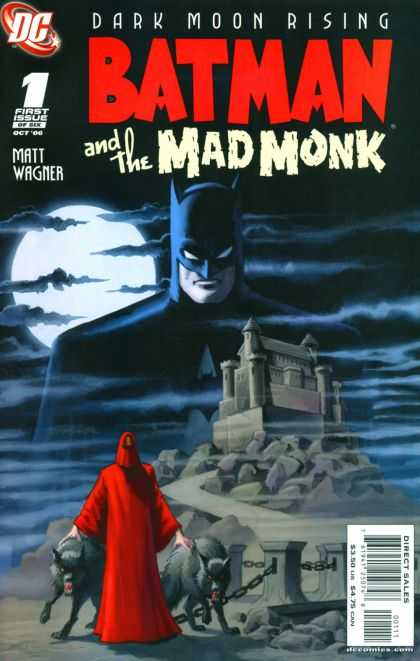
The Batman leaves Julie behind and departs with Dala for the Monk's lair in the Bat-gyro, which is now called the Batplane, although it is still drawn as an autogyro. However, the Batplane is caught by a large silver net and pulled to the ground, as Dala has betrayed our hero to the Monk. The mad Monk puts the Batman under his mind control and leads him to the castle seen on last month's cover. He also telepathically wills Julie to them (they must not have been far away because she walks the whole way!). Julie sees the Batman under the Monk's control and exclaims "His eyes are suffering, but he cannot move!", which is actually pretty horrifying. The Monk threatens to put Batman into the Den of Wolves, and exclaims that soon Julie will be a werewolf like him and Dala.
But... I thought they were vampires???
Nuts to that, because the Monk transforms into a wolf before the eyes of Batman and calls a pack of wolves to a pit that he has placed the Batman in. However, the Batman gases the wolves and escapes by attaching his silk cord to his Baterang and roping a column above the pit and climbing out.
He finds Julie safe asleep, and then makes himself silver bullets by melting down a silver statue. In most stories, silver bullets are what kills werewolves, but occasionaly they kill vampires as well. Here they are said to kill vampires, but then the story seems to be confused on which Dala and the Monk are.
The Batman finds the vampires' tombs and shoots them with the silver bullets, killing both. Julie declares herself forever grateful to the Batman and they fly back to America.
My Thoughts: Part two continues on from last month in similar fashion, although the structure is more linear and less confused than in part one. Things flow logically forward, and we get more and better interaction between Batman and the Monk, although there is still no direct confrontation between Batman and one of his enemies. The introduction of the Dala character allows for a nice betrayal moment, but like with the Dr. Death story the climax is much too fast and sudden. Still, it's a fine, neat wrap-up to Batman's first two-part tale.
The Art: Once again Kane and Moldoff deliver very good work. Kane's become very good at delivering the Batman in spectacular poses, using his cape for good dramatic effect, while Moldoff's inks create the spooky, moody atmosphere necessary for both the Batman and this story in particular. The page illustrating the Batman's fall into the wolf pit is particularly well done and a great example of sequential art.
The Story: Gardner Fox's writing is certainly a lot better than the last three months, but the main nitpick this time is that he can't seem to decide if the Monk is a vampire or a werewolf or if both are the same thing. Certainly there has always been some overlap in the legends -- sometimes silver bullets kill vampires, and Dracula was said to be able to transform into a wolf -- but the confusion really causes the story to lose harmony. At the end of the day its a pastiche of old horror movies with Batman added, and would've been more than exciting for the children reading, who would not have cared about such distinctions. Also, Fox is to be praised for delivering the first really memorable Batman villain, a large improvement over Dr. Death -- although like Dr. Death the Monk would not reappear until a 1982 Gerry Conway story.
Notes and Trivia: First time Batman is seen to use a gun, first mention of the "Batplane", final Golden Age appearance of the Mad Monk
Batman Body Count: 6, if you count the destruction of the undead as a kill
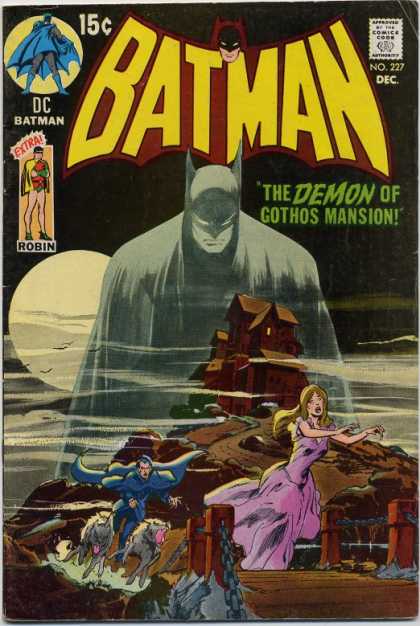
 Okay, I have to open by saying this is a bloody magnificent cover. The combination of moody etherealness and iconic imagery makes it memorable and dynamic, and has led to it being copied at least twice. Inside this cover, we'll find the first part of DC's very first multi-part story - a story which resonates so well that it has been retold in both the Bronze and Modern Ages. The story of...
"Batman Versus The Vampire, Part One"
Writer: Gardner Fox
Pencils: Bob Kane
Inks: Sheldon Moldoff
Synopsis: The story begins with moody, iconic imagery of the Batman patrolling the rooftops of New York (not yet Gotham) City. He spots a young woman about to attack an older man, apparently under the orders of "the Master Monk." The Batman saves the man, and discovers the young woman to be none other than Bruce Wayne's fiancée, Julie Madison. He takes her back to her apartment, and the next day Bruce takes her to a doctor. The doctor believes Julie was hypnotized, and recommends an ocean voyage to Paris as treatment (???) and later to Hungary, land of "history and werewolves!" The doc has an odd look on his face, as if he too is hypnotized - the reader can almost imagine his shifty eyes. Bruce buys Julie the ticket, but then decides to follow her as the Batman. For this purpose he has two new inventions, the Bat-gyro (a plane with the rotors of a helicopter, look it up kids), and the Baterang, which is described as being specifically designed after the Boomerang. The Batman then follows Julie's ocean liner in the Bat-gyro over the Atlantic. He leaves the Bat-gyro hovering above the ship, climbs down a rope ladder to speak to Julie, and they get attacked by a mysterious figure in a red rope with a somewhat KKK-looking hood -- it's the mysterious Monk! His hypnotic glare seems to paralyse the Batman, but he manages to throw a baterang at him, which breaks his concentration. The Batman then jumps onto the rope ladder and back into the Batgyro. Which... I suppose leaves Julie helpless to the Monk, who is still down there???
Ignoring that, the Batman soon reaches Paris, where he then searches all over town looking for clues to Julie's whereabouts, which I assume is a lot easier than just following her? And presumably much, much easier than if he'd just come with her on this trip as Bruce Wayne?? Nevertheless, he tracks her to her hotel room and jumps in through the window whereupon a GIANT GORILLA IS WAITING TO KILL HIM! Batman sidesteps the gorilla, but in doing so he somehow manages to fall down a trap door and into a giant net!
He is now suddenly in the lair of the Monk, who taunts the Batman and flips a lever to lower him into a pit of snakes. But the Batman throws his baterang, which smashs an overhead chandelier, and the Batman uses the shattered glass to cut through the ropes and out of the death trap. He runs after the monk, but is again trapped in a giant cage which also holds the GIANT GORILLA! However, Batman manages to escape by climbing up the rope that lowered the gorilla into the cage, and he proceeds to escape the building and get back into the Bat-gyro.
He then pursues a car speeding away from the building, throws gas pellets at it, and then after it crashes into a tree, recovers Julie from it and gets back into the Bat-gyro. He then sets a course for Hungary, land of werewolves and vampires. Part two next month!
My Thoughts: This is one of the all-time classic Batman stories. The first time I read it was in the first edition of The Greatest Batman Stories Ever Told TPB. Yet, it really shouldn't be. It continues Gardner Fox's habit of gaping plotholes and leaps of logic, and really doesn't hold up well as a tale by itself. But there is just so much excitement and iconic action and suspense and mystery and macbre, weird details that the whole thing seems far more fantastic and exciting then a Batman comic has ever been. The fact that the tale ends with the Monk still out there, and Batman continuing to track him was a unique and unheard-of ending in comics at the time, and has the reader waiting with baited breath for next month's issue.
The Art: The art is what really sells this story. While the actual plot borders somewhat on nonsensical, Kane and Moldoff create moody, dynamic, exciting action and suspense images. The Batman looks great in these panels, with a long, swooping cape, long ears, and now longer, extended gloves. The visual design of the Monk is unique -- instead of the stereotypical Dracula look, he wears a red cloak and hood, and upon the hood a yellow skull and crossbones on the forehead. All in all it is Kane's artwork here and in part two that contributes to this story being well-remembered, and shows a definite move forward in the quality and style of the art for the Batman feature.
The Story: While Gardner Fox does deliver on his promise to introduce a foe worthy of Batman's mettle, and gives us the first truly fantastic Batman tale, his actual plotwork is shoddy at best. If Julie was being hypnotized into attacking people, why didn't the police get involved? If the doctor was obviously shifty, why take his advice to travel to Paris? What kind of prescription is that anyway? Why did the Batman not take the Monk down when he (somehow) appeared on Julie's ocean liner, instead of leaving him there to commit further evil? Luckily, Bob Kane's artwork sweeps us along the story so well that we don't really ask these questions while we're reading, happy as we are to just keep going with the story. An interesting note is how the character of Julie Madison is introduced into the strip with no introduction or development -- she's just suddenly Bruce Wayne's before-now unseen fiancee and is already the damsel in distress focus for the plot. That's the Golden Age for you. Julie will be the first of many attempts to introduce a regular love interest character into the Batman stories.
Notes and Trivia: First appearance of Julie Madison, first appearance of the "baterang" and "Bat-gyro", first appearance of the Mad Monk, first death-trap and death-trap escape, first multi-part story in comics, first unresolved ending,
 Oh God, my face! Why are you blowtorching my face??
*ahem* Pre-Code covers aside, this month we get the second Gardner Fox Batman story. Last month he teased us with the possibility that the despicable Dr. Death may be still alive! And why would he tease us if that wasn't the case? And why would he start off this month's story with a recap of last month's ending (Batman watching Dr. Death burn to, erm, death) if that wasn't the case? And if that wasn't the case, why would this month's title be...
"The Return of Doctor Death"
Writer: Gardner Fox
Pencils: Bob Kane
Inker: Sheldon Moldoff
Synopsis: After briefly recapping how "about a week ago", the Batman watched Dr. Death "burn to ashes", we look in on Bruce Wayne reading a newspaper item about a man who dies of a disease that turns him purple. Wayne concludes "Only Dr. Death could be at the bottom of this." Um, what? Excuse me, but I think you need to go back to detective school Wayne, if your first reaction to a news item about a man dying of illness is that it MUST be the work of a dead madman. "Yet, he is dead," continues Wayne. Wow, really brilliant. Okay, puzzle it out, Wayne... "It's strange, this hunch of mine that he is still alive." Bruce Wayne is like one of those crazy people who insist on very little evidence that Elvis is still alive. Except Elvis is a mad scientist. And Bruce is right.
So Bruce goes off to visit the dead man's widow, and is admitted by their maid. Mrs. Jones says that her husband was killed because he refused to pay half a million dollars to Dr. Death. She then goes on to say that they have no money and lost it all in the Depression. So... why did Dr. Death pick them to extort then? And how can she still afford that maid?? Turns out, however, the Joneses have some diamonds.It was apparently Mr. Jones' "hobby" to collect them! Expensive hobby during the Depression! "I must get them out," says Mrs. Jones absent-mindedly, "for I need some money." Wow. That only took you ten years, lady.
Bruce goes back to his mansion to change into the Batman (he gets the costume out of a chest in a living room), and then zooms off in his "specially built, high powered" red car to the Joneses, where he proceeds to break in and start stealing the diamonds from the wall safe. Okay, Batman... far be it from me to question your crime fighting techniques, but, what the fuck?
"Meanwhile, Doctor Death still lives!" announces Mr. Fox, as a heavily bandaged figure instructs a large Jabah-like man to go to the Joneses and steal the diamonds and bring them to a fence named Herd. Dr. Death explains he escaped the fire through a trap door in the floor. His new henchman is a large man in a fez who is referred to as Mikhail, which makes him Russian, I guess. Do Russians wear fezes?
Mikhail breaks into the house and the Batman hides and watches him take the diamonds from the already-opened safe. Mrs. Jones enters the room, prompting the Batman to tackle Mikhail and punch him out the window. The Batman then proceeds to give the unconscious Mikhail the diamonds, reasoning that the only way Mikhail will lead him to Dr. Death is with the diamonds (okay...). Batman follows Mikhail to Ivan Herd's pawn shop, and then follows him to an apartment building, reasoning that Dr. Death is living low after losing everything in the fire. Batman breaks in and discovers... it's actually just Mikhail's apartment. He searches the room for any clues to Dr. Deaths whereabouts and finds... nothing. Was the real Batman on holiday this week? Who's this incompetent boon, Jean-Paul Valley?
Anyways, Mikhail (whose been sleeping) wakes up and shoots Batman at point blank range and misses. Did everyone take stupid pills this morning? Batman dives out the window. Mikhail sticks his head out to shoot after him -- AND BATMAN SWINGS DOWN ON HIS ROPE AND KICKS HIM IN THE HEAD, SNAPPING HIS NECK. Yep, Jean-Paul Valley for sure.
The Batman calls the police and tells them that Mrs. Jones' diamonds are at Ivan Herd's pawn shop and to go there. Batman then drops in on Mr Herd and starts intimidating him about Dr. Death. Herd runs off, and Batman ropes him in, only to discover that beneath the old man mask, Herd is really... DR. DEATH!! Turns out the Doc's face was horribly disfigured in the fire, and now he looks like the Phantom of the Opera with green skin and a goatee. Batman leaves Dr. Death for the police along with a card saying to give the diamonds back to Mrs. Jones.
My Thoughts: This issue is just bad. Dr. Death made a pretty weak first impression last month, and this follow up is just awful. Two bad appearances in a row contribute to this character disappearing off the radar for a whole forty-three years, before being brought back by Gerry Conway. Batman is really out of character in this appearance, and the whole story just feels sloppy and unrewarding, especially since we don't even see Dr. Death until the second-last panel and there is no real battle or confrontation between our hero and his enemy.
The Art: Okay, a few notes on the art this issue. First off, THANK YOU Bob Kane for getting an inker! Sheldon Moldoff brings a much needed sense of shadow, depth, and dimension to Kane's pencils, giving us a moodier feature more closely in line with the visual look of the pulp inspirations to Kane's creation. Another note is that the look of the Batman begins to change, as the ears on his cowl have become much taller and thinner here, and the cape is much longer and voluminous. This long-eared look will last for another five months, and be the longest the ears will ever be until Neal Adams comes on in 1969.
The Story: Okay, Gardner Fox isn't even trying with this one. The story is full of holes and coincedences and flat-out nonsensical sections even for a ten page feature in a Golden Age comic meant for children. Nothing makes much sense, from Batman's lack of detective skill, to the diamonds, to the fact that Dr. Death orders his henchmen to bring the jewels to a fence who IS Dr. Death! The whole thing feels completely slapped together and second-rate.
Notes and Trivia: Final Golden Age appearance of Dr. Death.
Batman Body Count: 4
 Bob Kane's caped detective, the Bat-Man, had lasted two issues of Detective Comics, but still had yet to truly make a lasting impression. He was unique in his oddly dark and macabre costume and his grim and determined method of crime fighting, but had so far fought only the likes of jewel thieves and murderers. To succeed, he would need a foe worthy of his mettle, someone as weird and morbid as himself.
Meanwhile, DC Editor Whitney Ellsworth had grown annoyed by the tendency of writer Bill Finger to turn in his scripts at the last minute, or late. In the Golden Age there was no such thing as a star writer and publishers didn't let writers take three year breaks between issues. (Yes, I'm still looking at you, Kevin Smith.) So Ellsworth dismissed Finger from the Bat-Man feature until he could get his act together, and Gardner Fox was brought in as the new writer. Fox is probably the most prolific writer of the Golden and Silver Ages of Comics, and is responsible for creations like the Golden and Silver Age Hawkmen, the Golden Age Flash, the Justice Society of America, and the Justice League of America. His first stint on the Bat-Man would prove to be influential as well, and in Detective Comics #29 he would create the very first member of what would become the infamous Batman Rogues Gallery. Who is this fiend? The Joker? The Scarecrow? Ra's al Ghul? Dr. Daka?? No, it is the insidious.... DR. DEATH!!! "Who," you ask? Read on, my friend, for the tale of how...
"The Batman Meets Doctor Death" (gosh, I love Golden Age titles)
Writer: Gardner Fox
Artist: Bob Kane
Synopsis: First off, he's no longer The Bat-Man. Just, The Batman. No hyphen. Not sure if that was Gardner Fox, or Bob Kane, or Ellsworth, or whoever the letterer was this month, but thank Zod. "The Bat-Man" just looks awkward. Like filler. The Batman can stand next to Superman and feel like he's just as cool. But is he? Maybe when Gardner Fox is done with him. Which brings us to this month's story.
We begin in the study of Doctor Karl Hellfern, who, deciding that name isn't ominous enough, will go by the moniker of Doctor Death for the remainder of the story. He's wearing the same monocle/goatee combo as Frenchy Blake from last month, but also sporting some wicked pointed ears and a tuxedo. Clearly he's independantly wealthy, and he promptly summons his servant, Jabah. Jabah turns out to be a massive hulking Sikh (judging by the turban), which is never really explained. This is the Golden Age. Turns out the good Doc has finished his experiments on deadly pollens and decided that the best way to use this knowledge is to demand the wealthy of the world pay tribute to him or else die. And if I were a doctor who just discovered flower love juice that kills people, that would be my immediate plan, too, I think. What else would you do, really?
However, Dr. Death realises that the Batman would naturally try to stop him, and thus must be destroyed. Which is actually a very proactive attitude for a supervillain. "Hey, I live in a city with a superhero. Let's kill the hero first, and then commit evil!" So Dr. Death lures the Batman into a trap the only way he knows how -- by placing an ad in a newspaper. A massive ad addressed directly to Batman. Anyone else feeling our good Doctor was dropped on the head as a child?
Bruce Wayne reads the notice (why is a billionaire reading the classifieds??), which directs him to pick up a letter at the post office addressed to John Jones. Luckily for Wayne, the Martian Manhunter won't show up in Gotham for another 14 years, so the letter is all his. Not wearing any kind of disguise, Bruce shows up at the post office and asks for the letter which anyone who reads a newspaper would know is meant for Batman. Way to protect the ol' secret identity there, Batman. The letter tells Batman where Dr. Death means to plan a murder, so off goes the Batman in his red sedan to stop the fiend! I can't wait for a Batmobile, the sight of Batman driving around in a ditzy little car is just too comical. Gardner Fox, meanwhile, gives the Batman his first utility belt gadgets -- exploding gas pellets (classic) and suction cups (lame).
The Batman scales the building he's been sent to with the suction cups (lame) and comes in through some unlocked French doors. Bob Kane must've liked this panel because he would improve and reuse it several times throughout the Golden Age. Of course, it's a trap, and our hero is attacked by two gunmen who he soundly defeats. He demands to know who sent them, but they say he'll kill them if they talk. Our hero replies that he'll kill them if they don't. Luckily, wholesale murder isn't necessary as Jabah shows up and announces they are working for Dr. Death before promptly shooting the Batman! In the arm! He's even shown bleeding and everything! Call Dr. Werthram! Luckily, he has the sense of mind to throw the gas pellets at Jabah and jump through the window to escape. After changing back to Bruce Wayne, he pays the Daily Globe to put a message from Batman to Dr. Death in their paper. I wonder what the average Gothamite thinks reading these things?
Then comes one of those great "only in the Golden Age" moments. To get that nasty bullet wound healed up, Bruce goes to, and I quote, his "family doctor", since his shoulder is "beginning to ache". The Doc asks Bruce how he managed to shoot himself, especially since there are no powder marks on the flesh. Has he known Bruce long enough that the obvious question, "Why did you shoot yourself?" not seem necessary? Bruce tells the doc that he does "funny things sometimes" and that one day he'll tell him all about it. Who is this Doctor? Whatever happened to him? In a Modern Age comic this guy could get his own spin-off series, Bruce Wayne's Family Doctor. Run at least 25 issues.
Meanwhile, Dr. Death yells at his minions for failing to kill the Batman, and proceeds to order Jabah to kill John P. Van Smith with the deadly pollen (to which Jabah is immune) because he refuses to pay tribute. Waitasecond, Doc -- wasn't the whole idea to wait until the Batman was dead before committing murder, for fear he'd interfere? Oh well. I guess Mr. Van Smith's rejection letter must've been particularly harsh.
Jabah sneaks up behind Van Smith and sprays pollen at him. Truly the height of villainy right there. Luckily, Bruce Wayne just happens to be driving by and quickly grabs Van Smith and gags him. Van Smith is visibly confused, but Wayne (who must be in the same social circles) just brushes him off with a quick "no time for questions, now!" and goes after Jabah.
Upon learning the location of Dr. Death's home, the Batman breaks in and discovers the Doctor and Jabah in the laboratory. After promptly strangling Jabah to death, he chases after Dr. Death, who believes the best way out of this is to cackle wildly holding dangerous chemicals. The Batman tosses a fire extinguisher at him, which knocks the chemicals to the ground and starts a blazing inferno, ironically enough. Way to go, Batman. Way to go. As the walls burn down around him Dr. Death laughs maniacally. The Batman observes, "He has gone mad." Great detective skills. Then he calmly stands there, watching the inferno, quipping "Death...to Dr. Death!" What a guy.
But Garnder Fox insists...is it really death to the arch fiend? Well, you showed us Batman watching him die, so I say yes. But you asked me the question in the ad box for next month, so I guess no?
My Thoughts: So the best Gardner Fox could come with for a Batman villain was a mad scientist, which even by 1939 was considered a hackneyed stereotype. And while he has a cool character design, and a memorable (if racist) minion, Dr. Death has lousy motivation (shits and giggles) and a pretty lame MO (blow flower dust on people until they die. Hopefully the wind blows the right way). Both the Doc and Batman act kind've like stunned pigeons in this issue, circling around each other making weird decisions until they finally meet and one of them dies.
The Art: I would say that Bob Kane is again improving, and while his rendition of Dr. Death is quite good, it's clear from his mishapen attempt at Jabah that he has never seen a turban or a person of East Indian descent outside of pictures or books. He tries throwing Batman in some iconic poses, but his art-style is still too flat and simplistic to make anything pop, and its hard to make your character blend in with the shadows when you refuse to have an inker come in and draw those shadows.
The Story: Fox's first Bat-story is hackneyed and cliche even by Golden Age standards. The comic book medium was only four years old at this point but already mad scientists and Hindu servants were pretty old hat. Bruce Wayne practically hands out his secret identity three times in the story and Dr. Death basically does nothing but sit in a chair the whole story. We're up from six pages to ten pages this month, and yet Fox's story has actually less plot than Finger's from last month. Fox never really makes Dr. Death a threat, and wastes this introductory story, presumably assuming he has all the time in the world to make an impression with the character in the next story. But there's a reason the emphasis gets placed on first impressions, Gardner.
Notes and Trivia: First appearance of the utility belt, first appearance of Dr. Death, first time Batman fights a "supervillain".
Batman Body Count: 4...?
 No Robin. No Batmobile. No Batcave. No Alfred. No Love Interest. No Rogues Gallery. Hunted by the police. Bob Kane's dark avenger, The Bat-Man, has appeared in just one story. But already he's a regular feature in Detective Comics, if not yet the lead feature, or even (gasp!) the only feature. There are several other stories in Detective Comics #28, but we're only looking at one -- the second Bat-Man story --
"Frenchy Blake's Jewel Gang"
Writer: Bill Finger
Artist: Bob Kane
Synopsis: The first panel reminds us that the Bat-Man is a mysterious figure whose identity remains unknown (and by unknown what we mean is that he's bored young socialite, Bruce Wayne). Which raises the question, why is bored young socialite Bruce Wayne risking his life as a costumed vigilante? Is it just because he's bored? Well, the answers to these questions are not coming in this story because this is the Golden Age and we've only got six pages to tell an exciting story, so nuts to character development!
Our story starts with a series of high stakes jewel robberies being committed. By impersonating the voice of Commissioner Gordon, Bruce Wayne learns over the phone from a stool pigeon that the man behind the robberies is Frenchy Blake. That night, as two of Frenchy's goons are finishing a robbery, they are attacked by the Bat-Man, who throws one of them over the edge of the building and beats up the other. As the police arrive, the Bat-Man makes it seem as though he was one of the gang, before escaping in the first use of his "silken rope". The papers publish that Batman is the leader of the jewel theives. Frenchy Blake reads this paper, and is revealed to us as a dapper man in a monocle and goatee (late-thirties for "villain"). Believing that now no one will be looking for him, he plans his next robbery. But the Bat-Man, who was hoping for just such carelessness, is listening outside the window, and attacks the next band of robbers as well. After beating them both senseless, he "phones" [sic] Commissioner Gordon and lets him know where to pick him up -- this is the first time the two ever interact. Then he speeds off in his red sedan to Frenchy Blake's place, surprising him. He ties Blake up and hangs him out a window, demanding a written confession -- which will become a classic Batman maneuver once Denny O'Neil restores his darker personality in the 1970s. Frenchy writes the confession, but attacks Bat-Man in a last ditch effort. The Bat-Man beats him til he can't take it anymore, and then ties him up and leaves him at police headquarters with a note. We are promised more intriguing adventures next month.
My Thoughts: This story is very pedestrian, like another day's work for the Bat-Man. It's interesting seeing the strip take its formative steps forward though, but it's also clear why the second Bat-Man story isn't exactly an oft-reprinted classic. The problem was that the Bat-Man was a weird avenger of the night, a caped vigilante leaping from roof to roof, yet so far all he's fought are hired thugs, white collar crooks, and jewel thieves. What the feature needed to thrive was to give the hero an adversary as weird and unique as him. Finger and Kane would make their first attempt in the next issue.
The Art: Bob Kane's art is already a lot better here than last month. It's stetchier, and the characters seem less flat -- but there's still very little inkwork. The appearance of the Bat-Man has changed slightly from the last story -- his cape is more like a cape and less like two big wings, and he now lacks gloves entirely. However, there's something oddly appealing to the appearance of this early Batman -- something raw and real. He looks less like a comic book superhero and more like the "weird creature of the night" he's described as. Kane puts him in all kinds of weird, yet distinctive and memorable poses, many of which would inspire artist Paul Pope's Batman work. I also think that Bill Finger might've started taking Kane to see old silent movies. Finger was a big fan of silent and foreign movies and German expressionism, and I can see he's trying to impress some of that on Kane -- there's a panel near the end when the Bat-Man breaks in on Frenchy Blake that is absolutely brilliant and reminds of the classic German horror film Nosferatu (1922).
The Story: Bill Finger's really not doing anything special here. The Bat-Man rounds up some jewel thieves. Like last month, it's a story that could appear in any strip in Detective or Adventure Comics. Frankly, there are elements in the six-pages that don't make sense. If the Bat-Man finds out in the third panel that Frenchy Blake is behind the jewel gang, why not go after him immediately? Why go to the trouble of implication himself with the thieves when he ends up finding out Frenchy's plans by listening outside his window, which he could've done anyway? However, we do get some new elements to the Bat-Man legend here, like Bruce Wayne's ability to disguise his voice, and the very first time the Bat-Man is shown helping the police, even though he is still clearly outside the law and hunted by the cops.
Notes and Trivia: First appearance of Bat-Man's silken rope, first time the Bat-Man delivers crooks to the police, first time the Bat-Man talks to Commissioner Gordon
Batman Body Count: 2
 Well, our cover isn't as memorable as last month, but it does feature Police Chief Hitler throttling a Tommy Gun wielding Clark Gable.