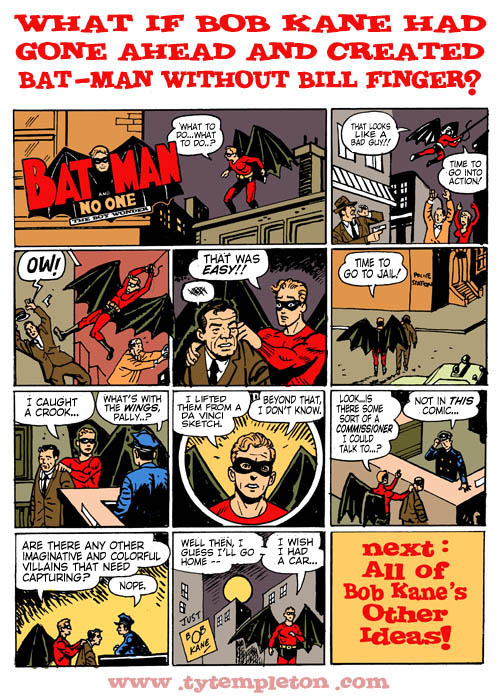
But not Bob Kane. Fuck that guy.
February 8th is Bill Finger's birthday, and it's about damn time he got some modicum of recognition.
I admit I don't go into a lot of detail on this in my reviews. In my coverage of Detective Comics #27, I tried to be as fair and unbiased as possible as to who created what in regards to Batman, but the fact of the matter is this: Bob Kane was hired by National Publications to create a hero to go with Superman. Bob came up with the name "Bat-Man", inspired by the silent film "The Bat", he decided to give him no powers to contrast with Superman, and he gave him this stiff Bat-wing cape inspired by the art of Leonardo da Vinci. And then he ripped off a lot of stuff from Zorro (foppish secret identity mostly) and a lot of stuff from The Shadow (the plot of "Case of the Criminal Syndicate" is basically plagiarized from "Partners of Peril" and Kane swiped a lot of the art too). Kane's original look for Batman was a domino mask, red tights and those stiff Bat wings.
Bill Finger, the writer of that and the lion's share of Batman stories thereafter, came up with the cape, the cowl, the colour scheme, whiting out his eyes to make him more mysterious, the name Bruce Wayne, Comissioner Gordon, Gotham City, Robin, the Joker, and most importantly the origin story.
Each time I review an issue I give proper credit to it's writer (usually Finger), and it's artists (usually Kane and Robinson) and when I give Kane credit for pencils I should say that's with a pretty big asterisk, because after he hired Robinson and Roussos as inkers most of what Kane did was rough layouts, although he always penciled Batman and Robin himself he often left out backgrounds and sometimes whole characters, to be finished by his assistants.
Now, none of this is particularly out of the ordinary for the time period these comics were created, but what is bullshit is that on every single comic I've reviewed on this site, all the original issues said for credit was "by Bob Kane", and that's all they ever said until around 1964.
And to this day, every single Batman comic, movie, TV show, or video game has had a "Batman created by Bob Kane" credit on it.
Because Kane was essentially an evil genius. Kane, you see, was hired by DC directly, and then Kane hired out to Finger and Robinson and the others. So as far as DC knew for a very long time, Kane was doing it all. And even after the deceit came to light, Kane had an ironclad contract with DC that granted him credit in perpetuity on all the Batman comics. Even today, DC is legally unable to credit Bill Finger in his proper role as co-creator of the character, although at least on reprints of old comics they are able to credit him and the many other tireless creators who worked "with" and "for" Bob Kane on those issues where they were never originally credited.
And to almost the very end Kane denied Bill or any of his assistants and ghosts did anything, always claiming he was the sole creator of almost thirty years of Batman comics. Finally, after Bill had died and soon before Kane died, he said that he might consider letting Bill put his name on it. On Kane's tombstone, he does in fact share credit for Batman -- with God, for divine inspiration.
So join the petition to give Bill Finger a Google Doodle on his birthday and celebrate the man without whom we would NOT have the Batman we enjoy today. It's Batman's 75th anniversary after all.
Write to proposals@google.com.
"The Batman's Biographer"
Writer: Don Cameron
Pencils: Bob Kane
Inks: Jerry Robinson and George Roussos
Synopsis: B. Boswell Browne is a little old man who is nonetheless very popular with the children of Gotham City as he is a veritable font of knowledge about Batman and Robin!
Bruce and Dick overhear him entertaining some children in the park with tales of the Dynamic Duo, and Browne ends up inviting the two to his home where he has assembled a collection of facts and artifacts about Batman, in hopes of one day writing a definitive biography of the hero. However Browne feels he can never properly complete the book unless he actually meets and talks to Batman and Robin. Bruce and Dick feel like this could happen sooner than the old man thinks, *wink* *wink*!
Meanwhile, Batman and Robin have been tracking a criminal called "The Conjurer", who uses tricks and illusions to distract potential witnesses while he commits robberies. However Batman sees through their tricks and so the Conjurer and his gang are forced to abandon their loot.
The Conjurer realizes he must find a way to outsmart the Batman, and having heard of Browne he decides to press him into his service -- knowing so much about the Batman he must know of a way to defeat him.
Pretending to be a reporter for the "Evening News", the Conjurer milks Browne's knowledge of Batman's cases for ideas on how to outwit and capture the Dynamic Duo. At his next robbery, the Conjurer manages to outwit Batman into targeting the wrong building and then as they escape the crooks delay Batman and Robin with nets made of chicken wire!
However Batman recognizes this as an old tactic of the Penguin's and realizes the Conjurer has been doing some research. Our heroes decide to pay a visit to their "biographer", who realizes his has accidentally aided a criminal against his idols and falls into a deep attack of guilt.
After Batman and Robin leave, the Conjurer returns and now threatens to kill Browne unless he continues to help the criminals. Browne doesn't want to betray his heroes, but at the end of the day he's just a regular old man who doesn't want to die.
Browne helps the Conjurer develop an ingenious plot to steal a collection of art treasures from an auction (a plot so ingenious that it requires the comic to stop and post a diagram for the readers to understand it!) Browne's contribution to the plan is the idea to put an unlocked parked car with the engine running right by the villains' getaway that Batman and Robin will commandeer to chase after them, but rig the engine with a bomb.
However, when the crooks make their actual getaway, Browne himself gets in the rigged car, and uses it to run the crooks' getaway trucks off the road so that Batman and Robin can catch up and arrest them. Browne keeps driving the car until it's far enough away to not hurt anyone, intending to sacrifice his life heroically to make up for his past misdeeds, but Batman rescues him from the car just before it explodes.
Days later, Browne finishes his biography of Batman, which Batman himself writes the preface for -- and everyone lives happily ever after. (Except the Conjurer presumably)
~~~~
My Thoughts: A decent enough little story that is definitely in the "stories about other people featuring Batman" genre. It reminds me of the story about the druggist from Batman #14 in that it's also about crooks taking advantage of a kind hearted old man.
The Art: The full Kane Studio team of Kane/Robinson/Roussos is on this one and as such the art looks very polished. There are the usual bevy of swiped poses of course but nothing to complain about.
The Story: In a more modern context it may be interesting to compare the fictional character of "Batman's Biographer" with his real world biographers of Bill Finger and Bob Kane, but there really is no subtext or metaphor in the story to allow for any such metatextual analysis. What is fun is the number of accurate continuity references the Browne character makes to actual past Batman adventures. That kind of attention to detail is always appreciated, particularly in a Golden Age comic.
"The Penguin Goes A-Hunting!"
Writer: Don Cameron
Pencils: Jack Burnley
Inks: Ray Burnley
Synopsis: The last time we saw the Penguin, Batman had finally captured him and he had been sentenced to death for double homicide. As this story opens we suddenly learn that Penguin escaped from prison a month ago, in some awkward expositional dialogue as Bruce and Dick attend a lecture from prison Warden Keyes on criminology. As it so happens, the Penguin's immense ego and vanity persuades him to attend the same lecture!
Keyes describes Joker, Scarecrow, and Catwoman as topping the city's most wanted list, causing Penguin to become incensed and ask what the warden thinks of him, who replies that he feels the Penguin has no imagination and is a one-trick gimmick who relies too much on his umbrellas.
However the Penguin is recognized by some police officers in the audience who move to arrest him, but the crafty crook beats a hasty escape and manages to make it out alive, but with his dignity bruised. He decides to rob a sports equipment store and begin using some new techniques to replace his umbrellas to prove he's not a one-trick criminal.
And so the next day, almost a million dollars in bills and bonds are stolen out of various windows in the Gotham financial district by the Penguin using a fishing rod out the window of his penthouse hideout!
In the Penguin's next crime, he robs a mansion full of rich folk by shooting a gas pellet into the living room using a big game rifle! When the Dynamic Duo attempt to track the fiend down, his men overpower and capture them, and they awake tied up in the Penguin's penthouse.
The Penguin proceeds to unleash a pair of vicious trained hunting dogs on the two crimefighters and then leave to go rob a hunters convention rather than wait two minutes to make sure the dogs kill them.
Batman manages to stop the dogs' vicious behaviour by appealing to the innate bond between all dogs and men by using a gentle persuasive voice to break through the Penguin's abuse of the animals.
The Penguin arrives at the hunting convention riding trained show jumping horses allowing them to break in and out quickly despite obstacles and traffic jams. However Batman and Robin show up, take out two of Penguin's men (leaving them for the police) and follow Penguin himself down the streets of Gotham in a horse chase with the abused dogs now chasing Penguin and leading the Dynamic Duo!
They end up cornering Penguin at an outdoor cafe, where Batman knocks over all the open table umbrellas, trapping the fiendish criminal. Thus, after abandoning umbrellas, the Penguin is done in by them!
As the Penguin is arrested and sent back to prison, it is revealed that the Batman told the warden to badmouth the crook in his lectures, in order to goad the Penguin into overreaching himself, as the Dark Knight knows his enemy's greatest weakness is his vanity!
~~~~
My Thoughts: This is a fantastic Penguin story by Don Cameron, an amazing examination of the villain's character considering the age of this comic. Nowadays the Penguin is often reduced to being a joke Batman villains, mocked for his cheap and corny gimmicks, so it's incredible to see a comic addressing this mockery head on in 1943, in the character's sixth story!
And unlike a modern comic which might, upon deciding the Penguin is corny and needs reinventing, this issue doesn't completely throw the character under the bus or misunderstand him. Instead, it turns out to be a near-perfect analysis of his character and what makes him tick! Fantastic.
The Art: The Burnley bros really deliver here, with smooth clean linework, excellent blacks and shading, fluid action, and good expression. It's fun to see the Penguin in alternate costumes (fisherman, big game hunter, English gentleman, etc) but perhaps the coolest visual of all is Batman and Robin riding horses through Gotham traffic -- although maybe that's just because of my fanboy brain associating it with The Dark Knight Returns.
The Story: Really topnotch writing from Don Cameron, in managing to balance telling an action packed and typically wacky Golden Age superhero story with a simple premise -- Penguin trades his umbrella gimmick in for a sports equipment gimmick - and yet still have something new and unique to say about this character, keep things true to the established personalities and yet also comment on the Penguin and his place as a member of Batman's Rogues Gallery. (And hey, I'd be incensed too if I was ranked below the Scarecrow -- dude's only appeared in two stories!)
"Rogue's Pageant"
Writer: Don Cameron
Pencils: Jack Burnley
Inks: Ray Burnley
Synopsis: Alfred has insisted that Bruce and Dick take a vacation, and forbids them from bringing their Batman and Robin outfits -- this has Bruce and Dick incensed, but they still promise Alfred.
After hopping in the car, Bruce and Dick both reveal to each other they've been wearing extra suits under their clothes, because after all the whole point of this "vacation" is actually to do some crimefighting in Santo Pablo, "one of the oldest cities in the Southwest."
Flashback time: On a previous night, the Dynamic Duo foiled a bank robbery by "Ducky" Mallard's gang. However, the gang managed to escape and it's only by interrogating a stool pigeon that Batman and Robin learn they are headed for Santo Pablo, hence the vacation!
Arriving in the town, they discover it is celebrating the occasion of its 300th birthday!
The townsfolk are all dressed up in period costumes and the museum is displaying gold nuggets from the finds that made the town's fortune in the early days. So of course the gold is stolen.
With all the commotion in town it would have been easy for the crooks to escape, but Bruce is convinced they are still in Santo Pablo, and so the two take a look around the next day. At the city bank, the festivities continue with a reinactment of an old fashioned bank robbery. However, when the "actors" playing the crooks show up, it turns out they're real crooks and they rob the bank, escaping easily because the cops think it's all part of the show!
By this point Batman has determined the crooks are indeed Ducky Mallard's crew and also decided that the natural egotism of the criminal means that they won't leave early with their swag but instead stick around until that evening - the height of the festivities! With this in mind, Batman hatches a plan with the Santo Pable Police Department.
That evening is the big parade (an evening parade?) with everyone dressed up as "Indians", Spanish conquistadors, pioneers, etc. and Batman and Robin hiding in a belltower observing everything.
At this moment Ducky's gang sets off a series of dynamite explosions in several buildings around the parade area, in order to cause a panic big enough to distract everyone from their robberies. Because as Die Hard movies have taught us, acts of terrorism are always the best cover to larceny.
What the crooks didn't count on, however, is that the police department is wise to their plan and surrounding them dressed in parade costumes! Using special flashlight Bat-signals Batman has given them, they signal for the heroes in the trouble spots, and a quick fight scene later the crooks are in jail and the town is giving Batman and Robin their own spot in the parade!
When they return to Wayne Manor, Bruce and Dick think they have Alfred fooled, but news travels fast and the butler has already read of their exploits in the newspaper (which isn't surprising considering that would be a two-day trip with no breaks by car). Alfred simply demands that they take him with them the next time they leave on a crime-fighting trip!
~~~~
My Thoughts: This is yet another "Batman and Robin go somewhere, not Gotham" type story, and like so many of them it focuses on a town with a "pioneer" theme. I don't really like these stories, I don't see the appeal of putting Batman in these small towns that are always drawn like Wild West movie backlot sets regardless of where they are supposed to be or how modern.
The most uncomfortable aspect of this story for a modern reader is the glorification and nostalgic view of America's genocidal past. The town's parades paints pioneers and conquistadors alike as romantic heroes, and while a lot of time is also given to the "Indians", they are equally painted with a romanticized view that ignores the crimes done to their people.
Granted, none of this comes across as malicious in the comic, it's very much "of the time", it's just a little cringe inducing from a modern standpoint.
The Art: Another Burnley Bros. story here, but the art's only just okay. Nothing stands out about it, indeed it's all very generic. The "Indians" of Santo Pablo are drawn like Iroquois warriors instead of a more Southwestern tribe like the Kumeyaay. The town itself looks exceptionally generic and blocky, instead of appearing with interesting local architecture like one might find in San Diego or Los Angeles. Honestly it all renders the story itself kind've forgettable and almost negates the point of taking Batman and Robin to a different locale.
The Story: It's a real yawner, too. There are crooks, they're stealing stuff. They dress up to fool us, we dress up to fool them. They're caught. The end. What should have made this generic plot special is the unique setting, but it really ends up adding nothing at all. You could plop anybody into this story and it'd have the same exact feel.
"The Adventure of the Vitamin Vandals!"
Writer: Joe Greene
Pencils: Bob Kane
Inks: Jerry Robinson
Synopsis: Jenny Jones is a fishing vessel off the California coast on the hunt for soupfin sharks, also known as school sharks, because their livers are rich in vitamin A and is thus in desperate need by the United States Army for supply to soldiers fighting overseas (and this is entirely true). The sharks bring in $1,500 a ton (about $19,600 today) so this is good fishing -- but there's a problem.
A gang of crooks called the Phantom Raiders have been attacking fishing boats. When the fog rises up they appear out of nowhere, not having boarded the ships or stowed aboard. But regardless of where they come from the result is the same - the sharks are stolen and the sailors left with nothing, and the Raiders gone as mysteriously as they arrived.
Luckily, Bruce Wayne and Dick Grayson are in the area, vacationing at Malibu Beach! (Wait, weren't they just on vacation? In, like, the same area?)
Anyways, they hear about the mysteries Raiders and decide the best plan of action is to join the crew of the Jenny as seamen! Meanwhile, the fish brokers are now offering $2,000 a ton for soupfin sharks because of the shortage!
After some decent hard shark-catching labour for Bruce and Dick, the Raiders appear again - with Batman noticing that a crewman named Lefty seemed to signal something with his lantern before they did.
A customary fight with the crooks leads Batman to discover a rope ladder leading up into the clouds. Climbing it reveals -- a blimp! That's how the Raiders get in and out unseen! However a fight on the blimp results in the Dynamic Duo being thrown out of the blimp and falling a fatal distance into the water of the Pacific, where they of course survive because this is a comic book.
So having fallen into the Pacific there is only one possible outcome now, which if of course that Batman fights a shark. He stabs it with a knife until it's dead, as is his standard method for dealing with sharks.
Rescued by a passing patrol ship thanks to a portable Bat-signal, the Duo beat the Jenny to port, where they follow Lefty to the crooks' hideout - a large abandoned warehouse by the docks (y'know, like every other comic book hood).
Turns out the blimp docks in the warehouse and the roof opens up every night when the fog lifts. Batman and Robin stow away on the blimp and then spring into action when it attacks the Jenny... AGAIN (seriously, the same ship every time?) This time fish broker Gibbons is onboard to ensure a safe haul, but the Raiders attack anyway.
So of course Batman tackles Gibbons, who is of course behind the Raiders. The deal was to steal the fish and cause a crisis to drive prices up, then sell the fish to the government himself without having to pay back any of the fishermen. Pure fraud and war profiteering at its finest.
With the case closed, Bruce and Dick return to their lazy beach vacation.
~~~~
My Thoughts: "Adventure of the Vitamin Vandals" is kind've a lousy title for this story when something like "Case of the Phantom Raiders" would be so much more evocative. Other than that this is a much better example of "travelling Batman" than the previous story, and I am kinda perplexed that they put two stories of Batman going to the West Coast and fighting bad guys right next to each other in the same issue, especially when one is so lame and the other at least has cool blimp and shark stuff in it.
The Art: Decent work from Kane and Robinson. Nothing too special, but the shadows are really moody and the stuff with the blimp and the shark looks cool and the crooks are appropriately shady looking.
The Story: This story falls into the category of those inspired by the writer reading some odd fact somewhere. Bill Finger came up with a lot of his tales by basing them around little bits of trivia, but it's Joe Greene delivering this story. It is in fact true that soupfin sharks were harvasted for their vitamin A rich livers during WWII for supply to the US Army -- in fact the sharks were overhunted and today remain a vulnerable species.
The gag with the blimp is actually really clever because until that point it really is a total mystery as to how the Phantom Raiders operate, but once the blimp is introduced it seems so plausible. And of course there's the eternal cool factors of blimps. The ideal Golden Age Batman story for me features blimps, fights with sharks, an urban noir setting and shady crooks -- this story hits at least 3/4.
Number of Times Batman Has Fought a Shark: 2
"Slay 'Em With Flowers"
Writer: Horace L. Gold
Artist: Jerry Robinson
Synopsis: The Joker and his men have taken over an old florists' shop, using it as a front for buglarizing wealthy patrons. The flowers are delivered, release a gas which knocks out the guards and inhabitants of the building, and then Joker and his men bust in wearing gas masks and steal the loot.
The cops can't figure how it's being done, so the Bat-Signal calls the Dynamic Duo to police headquarters, and the next day Bruce Wayne is taking Dick to a "flower show" based on a hunch from the case.
Of course the Joker and his men are robbing the place and so Batman and Robin appear for the fight -- but the gas gets them, and once unconscious the Joker's men place them in an elevator car and cut the cables (rather than just, y'know, shooting them).
The masked manhunters manage to wake up and hit the emergency stop lever in time, and escape. Batman recognizes there must be a connection between the gas and the flowers and does some detective work. Batman and Robin stake out the Florist shop, and then follow millionaire Percy Fillmore from the shop to his penthouse apartment.
They arrive in time to find the Joker's men robbing the place, but Joker shoots them in the face with gas. The crooks stick our heroes in a closet and run gas from the kitchen into the room to suffocate them. Once again they wake up in time, and bust out. Robin suggests raiding the flower shop, but Batman feels the Joker is keeping the loot at a second location.
So Bruce Wayne goes to the flower shop to set himself up as bait. Upon delivery of the flowers to Wayne Manor Bruce notes that the soil is rigged to release a spray of chloroform on a timer.
Alfred suggests fighting the Joker's men when they arrive, but Bruce explains that they must pretend they've been drugged otherwise the Joker and his men would surely kill them. Alfred, an upper crust British guy in 1943, doesn't understand a policy of non-resistance. Oh-ho, contemporary events joke!
After the Joker's gang robs Wayne Manor, the Batmobile follows them to a greenhouse on the outskirts of town, where our climatic fight scene begins. Joker holds up in the greenhouse, but Batman instructs Robin to wet their capes and wear them as gas masks while the Dark Knight pumps chloroform into the greenhouse air intake!
And so with the villains heavily drugged, the police are called and everyone sent to jail.
~~~~
My Thoughts: This is a basic Batman tale. Boilerplate stuff. Joker has a scheme involving robbing folks. He does it once successfully, once again fighting Batman, then the third time is the bait and switch ending with a chase and a climatic fight. This is formula. But "Slay 'Em With Flowers" is still a good read for a few reasons, even if as a Joker story it is uninspired.
The Art: The absolute best thing about this story is the art. Jerry Robinson hits it out of the park here, drawing in a dark, rough style that really feels noirish and pulpy. People's suits and baggy and get wrinkled. Joker is thin and wiry and his hair get messed up. Batman has a chin so big and square that it makes the art of George Freeman looked restrained. It's really lovely to look at and it's a big element making the story feel better than it is. For a long time Robinson was an unsung hero of Golden Age Batman (just like most everyone else), and it was great that before his death he finally got some recognition, even if it was usually accompanied by an exaggerated "creator of the Joker" title. Still more than anything Bill Finger got when he was alive.
The Story: That the story is so formulaic is mildly disappointing considering who is writing it -- H.L. Gold, the classic Golden Age science fiction author who transformed the genre with his magazine Galaxy Science Fiction in 1949. However those days of innovation are a few years away and in 1943 Gold was simply another stuggling sci-fi author making ends meet by slumming it in comics. That being said, Gold slums it quite well, following the formula, constructing the tale in a coherent manner, and wrapping it up nicely. It does the job and does it expertly, even if there's no real innovation on display here.
"The Robber Baron!"
Writer: Don Cameron
Pencils: Bob Kane
Inks: George Roussos
Synopsis: The Robber Baron is the leader of a group of thieves dressed like a nineteenth century aristocrat (top hat, monocle, white tie tuxedo and cape). His gang is based in an abadoned factory that is also a tall skyscraper and sports a medieval style tower on top with a cannon that launches a grappling hook! Then they travel by zipline to the building they shot the hook at! And somehow the cannon is powerful enough, the hook strong enough and the line long enough that it can stretch across several city blocks to it's target (somehow not hitting other buildings along the way, implying this abandoned factory is very tall).
So they do the zipline, rob places, zip back and somehow the GCPD is completely "baffled" and can't discover how these guys are getting in and out despite the fact that a huge skyscraper topped with a stone tower shooting grappling lines across city blocks that dudes are zipping around on is totally something you'd think someone would notice!
Meanwhile, at Wayne Manor, new butler Alfred is bringing lunch to Batman and Robin as they work out the problem of the Robber Baron in their criminology lab. Batman has figured out that they're using grappling hooks from marks left on the edge of the rooftops of the buildings robbed, and then drawn straight lines from the sites of the robberies and found the intersecting point - an abandoned brass factory by the waterfront (and the crooks' footprints had brass filings in them at the crime scenes!) Detective work, folks! See, was that so hard, Gotham Police?
The Batplane brings our heroes to the factory, where they surprise the Robber Baron and his men. Using the grappling hook they zip over to a nearby suspension bridge. Robin recklessly zips over, despite Batman's warning, and the crooks cut the line! The Boy Wonder falls into the Gotham River, and presumably drowns. So, now Batman's pissed.
So he flies over the to bridge with the Batplane and just starts decking dudes off the bridge into the river, presumably intending to kill them. But the Robber Baron proves his intelligence by just shooting Batman, who then also falls into the river.
The Robber Baron then climbs down to a speedboat he had waiting there just in case this happened, which he uses to pick up his men who are all not dead, as well as the Batman who is also not dead. The Baron plans to kill Batman in a more dramatic fashion.
Meanwhile, Alfred's been reading his "How to Be a Detective" book and decides to seek out suspicious persons down at the riverfront. He happens upon the Robber Baron's boat just as it comes ashore, of course, and notices they have the Batman prisoner, so the crooks take him prisoner too.
Back at their tower hideout, the Baron's plan is to fire the grappling hook at police headquarters, then hang the Batman from the line and zip his corpse right to the Commissioner! Gruesome!
However, Robin didn't die when he fell into the river (gee, really?) and when he came out of the drink he found the abandoned Batplane and flies it over to the Tower. He freaks the crooks into thinking that the police have surrounded them by speaking over the two-way radio link to Batman and with them distracted he pounces on them.
Freeing Batman and Alfred, the three of them beat up the crooks, and then send them tied up to Gordon over the zip-line!
~~~~
My Thoughts: The second story to feature Alfred, it's clear that it's going to take a bit of work to get his inclusion to feel natural, although for now it's just fun to have a new regular character around -- even if his "written" British accent is a little overbearing to read. "Pardon me, Mawster Bruce, but it is pawst your luncheon" and so on.
The Art: Not Jack Burnley's best, perhaps because Roussos is inking instead of his brother? It's still very good, but Roussos keeps it looking more like Kane Studio standard than the high quality Burnley can reach when let loose.
The Story: It's all right. The Robber Baron is basically a generic gangster type in fancy clothes, but seeing Batman do some detective work is great, and even if the "death of Robin" moment is an obvious cheat it's still cool to see the Dark Knight go to town on the crooks in his rage. Alfred gets to have some part in the story, even if he gets involved entirely through contrived coincedence. Honestly my biggest problem is the whole "grappling hook launched across city blocks" thing. I mean, it's sorta awesome on one hand, but I really have a hard time believing that none of the GCPD detectives figured that shit out or noticed it. It kinda strains credulity.
Okay, so this cover. It's our first "homage" to Jack Burnley's classic cover to Batman #9 that forms the background of this blog. And by "homage" I mostly mean "swipe" -- Jerry Robinson has just taken that image, flipped it (although at least he remembered to reposition Robin's "R") and then added this menacing shadowy figure.
Secondly, the text on the cover tells us that someone in this issue is going to discover the secret identities of Batman and Robin, the implication heavily being that it's this tough thug looking guy. Which is completely false, placing this as I believe our first cover to fall under the category of "patently misleading", a type of cover that DC would become masters of during the Silver Age. Covers that imply or promise stories that are not what the issue is really about.
"The Joker Reforms"
Writer: Don Cameron
Pencils: Bob Kane
Inks: Jerry Robinson and George Roussos
Synopsis: Our story begins in the small town of Farr Corners, in the Ozark Mountains, which Bob Kane draws as one of these Old West towns that he and Bill Finger seemed convinced still existed in America anywhere west of the East Coast.
A mysterious, shadowed individual stumbles into town, finding his way to the Constable, where he produces a valise of precious jewels that were stolen in Gotham City. He wants to ensure they are returned to their proper owners, and gives his name as Ed Smith. The twist? Ed Smith is... THE JOKER!
Flashback to the night before, as Batman and Robin are swooping in to stop a robbery by the Joker and his men of a jewelry store. However the crooks get away when the Joker throws an ammonia bomb, and soon they're in a plane headed west to pick up the other stash of jewels the Joker hid during their crime spree.
However the plane's engines fail and so the gang parachutes out to avoid a horrible death. Joker figures he can still land the thing and thus claim all the stolen goods for himself. Unfortunately Joker is a better criminal than aviator and crashes in the Ozarks.
He's thrown clear of the wreck, wakes up with amnesia, finds the jewels, heads to town, and thus we're back at the beginning.
Back in Gotham, Bruce and Dick are trying to figure out the Joker's next move. Bruce thinks he has a lead with a scrap of paper he found at the scene referencing "Joe Kerswag, Farr Corners", and even though Bruce is somehow too dull to figure out the clue, they decide to head to Farr Corners anyway to investigate the lead.
Of course, the crooks who jumped off the plane are also headed to Farr Corners, where they find the town holding a celebration in honor of town hero Ed Smith, which... waitasecond, you're telling me none of the townsfolk recognize him as the Joker? A renowned federal criminal? The comic gives the rationale that they haven't seen pictures of the Joker this far out, but the townsfolk have clearly heard of Batman and the Joker, presumably through newspapers, so why do newspapers in the Ozarks not print pictures? And even if you didn't know what the Joker looked like, wouldn't a pale-white faced man with ruby red lips and green hair in a purple suit strike you as a little... odd?
Batman and Robin show up and are instantly recognized by a young boy in town who reads Batman comics -- wait, so this town gets Batman comics whose existence is confusing enough in a world where Batman is real and yet they don't get newspaper pics of the Joker? And this kid didn't recognize the Joker either? Are people in the Ozarks just really stupid?
 Anyways, the constable introduces the Dynamic Duo to the town hero Ed Smith and Batman of course does a massive double take. He decides however to follow the Joker and observe him rather than immediately arrest him, in order to see what his game is.
The Joker's goons thus of course see their leader paling with the Batman and assume the worst.
They attack, but when they shoot at Batman the Joker actually saves him! The crooks run off, and Batman and Robin continue to be baffled by the Joker's behaviour. Robin believes it must be a trick, as it'd be impossible for the Joker to have reformed, while Batman believes they must keep following him until they find out where the cache of stolen jewels is hidden.
"Ed Smith", meanwhile, has been having a series of terrible nightmares, images of hidden jewels placed in the railroad express office. He isn't sure why he's having these visions, but decides to check the office and see if there isn't more good he can do by returning more stolen goods to their owners.
The crooks spot him and assume he's going to the cache, so they follow. Batman finally figures out the "Joe Kerswag" clue and also heads to the express office. Batman and Robin manage to tie up all the crooks, but Joker gets knocked on the head and regains his "sanity".
Threatening the Dynamic Duo with two pistols, they are only saved when Robin knocks a column of boxes over onto the Joker, which end up spilling out all the crook's ill-gotten gains.
Batman reveals the obvious clue ("Joe Kerswag" = "Joker Swag") and the Clown Prince of Crime is locked up and sent to prison once again.
~~~~
My Thoughts: One of the toughest things about reading and writing about these old Batman comics can be the monotony. The stories, which are very simplistic and formulaic by nature, can become very repetitive read one after another at a rapid pace. So to get a story like this, which even if it strains credulity at times, features the characters in different situations and settings, can read like a breath of fresh air. In terms of the development of Joker's character, it's interesting that when he loses his amnesia and becomes "himself" again, it's explicitly written as the Joker regaining his "sanity", especially since the madness of the character has become such an explicitly large element of how he is written today.
The Art: One thing I haven't mentioned that much when talking about Bob Kane's art is his excessive habit of swiping. In the early days of the Batman comic he excessively swiped many panels and poses from other sources, usually pulp magazine illustrations. Once he had built up a good number of Batman and Robin poses, his swiping mostly became about swiping from himself -- using the same poses and angles over and over when depicting those two characters, almost like the comic book equivalent of a Filmation "limited animation" series from the 1970s. Usually these aren't too obtrusive -- while he may use the same pose everytime he draws Batman putting on his cape, that pose only occurs once an issue usually and ultimately it's a pretty standard pose so you don't mention the repetition.
I mention all this because in this story Kane draws a very distinctive panel of the "Good" Joker talking to Batman, Batman doing a hilarious double take, and Robin reacting. And then two pages later he REPLICATES IT EXACTLY. Yep, even with uncredited writers assistants, ghosts and other help -- Bob Kane was still incredibly lazy.
That being said, the biggest joy of the art in this story is seeing the Joker being drawn as a good guy, having innocent expressions on his face, or really just any expression other than grinning evilly. It's a unique sight that makes up a lot of the fun of the story.
The Story: I've really got to hand it to Don Cameron for really delivering a fun and unique story. "The Joker goes good", even if it's just amnesia, is very different and really brought a smile to my face as being a unique and imaginative premise. Pretty much my only issue with it is the fact that I just don't buy that everyone else treats Joker as normal. He's a dude with green hair! That's a little bizarre.
Other than that I think this one was a lot of fun and it was just great to get a new kind of story -- even if the clue was really really obvious.
"The Grade A Crimes!"
Writer: Ruth "Bunny Lyons" Kaufman
Pencils: Jack Burnley
Inks: Ray Burnley
Synopsis: In the early hours of the day, as the milkman makes his rounds, a daring robbery is committed - the Van Dorn jewels stolen and their servant shot. The jewels are brought back to a mysterious ringleader who conceals his identity behind a domino mask, and sends his men out again and again dressed in black robes and cowls, committing a series of "early bird" robberies in the hours of the morning when only the milkman is active.
Late one evening, millionaire Bruce Wayne and his ward Dick Grayson are leaving a high society party at the Morgon Mansion, when they hear a gunshot -- the guard shot in the back! They quickly change into Batman and Robin and begin fighting the eerie cultist looking burglars. However they manage to overpower the two and escape -- the only man on the scene once again the milkman, who didn't see anything.
Searching the mansion for clues, they discover a white button ripped from a white shirt -- odd, since the crooks were wearing black mantles.
It's the next morning at the breakfast table when Bruce finally puts it all together - the early morning robberies, they're always the morning after a party, only jewels are stolen while other valuables are left untouched, the white button, the milkman -- obviously someone at the party is the inside man, they case the joint and perhaps lift the keys, and then the milkman is their getaway driver whom no one would ever suspect.
I for one am simply amazed that a Batman mystery was "fair play" for once and that Bruce figured out the clues at about the same time the reader would.
The next big society party is being held by Winthrop, treasurer of the Purity Milk Co. and a renowned gem collector. Batman figures that by spying on Winthrop's party they'll discover the ringleader of the crooks, since it must be someone high up in the milk industry! Waiting around for the party to end, Batman finds Winthrop's guards have been drugged -- just in time for the milkman's arrival!
One of the cloaked burglars enters and prepares to shoot the guards for appearance's sake -- but Batman charges in to battle -- but when the crooks escape he intentionally lets them go as Robin has coated their getaway vehicle with infrared paint of the kind we've seen Batman use before to follow people.
They follow the gang to a diary farm hideout, where of course a battle breaks out amid the cows and milking machines and so on. Batman fights the masked leader of the group, whom he deduces is Winthrop himself - Winthrop was the inside man, drugged his own guards, and of course he's the jewel collector.
After a few more fight scene pages, Batman and Robin deliver the thieves to Commissioner Gordon, revealing that Winthrop had gambled with his company's money, and had to resort to thievery, in addition to wanting more jewels for his own collection.
~~~~
My Thoughts: Sometimes all you really want is a standard story, well told -- or told well above the average level of quality. "Grade A Crimes" features no supervillain, introduces no new elements, it simply does a standard Batman robbery/mystery plot, but does it with style, panache and very well plotted storytelling. I enjoyed reading it -- on paper it's nothing special, but here it's all in the execution.
The Art: The Burnley Bros. deliver gorgeous artwork in this story. Go and get yourself a reprint of it somehow and see this stuff. It's looks like an episode of the hallowed Animated Series, it's dark and stylish and just lovely to look at. The touch of dressing up the crooks in cultist looking outfits adds a delicious extra element of macabre mysterioso that is perfect for Batman and feels like it's been missing from the strip for a while. It just instantly makes it cooler than just more gangsters in three-piece suits.
The Story: This story is written by Ruth Kaufman, and usually when a new writer appears I try to do some research to find out who they were. But all I can find out about Ruth is the somewhat self-evident info that she was one of the very first female comics writers. Apparently she wrote a couple more scripts for DC that appeared in their other books around this same time, and that was that. I have no idea what happened to her.
Which is a damn shame, because this is a really, really well written story for a rookie writer. It's solid and confident, it understands the characters and the world of the strip, it remembers that Batman is a detective and remembers his methodologies from past stories. It gives us a mystery with clues that we can figure out along with the Batman, and it's exciting and interesting. It's a standard kind of story, but it's done well, with excellent art and very competent plotting, and that puts it a cut above.
Anyways, the constable introduces the Dynamic Duo to the town hero Ed Smith and Batman of course does a massive double take. He decides however to follow the Joker and observe him rather than immediately arrest him, in order to see what his game is.
The Joker's goons thus of course see their leader paling with the Batman and assume the worst.
They attack, but when they shoot at Batman the Joker actually saves him! The crooks run off, and Batman and Robin continue to be baffled by the Joker's behaviour. Robin believes it must be a trick, as it'd be impossible for the Joker to have reformed, while Batman believes they must keep following him until they find out where the cache of stolen jewels is hidden.
"Ed Smith", meanwhile, has been having a series of terrible nightmares, images of hidden jewels placed in the railroad express office. He isn't sure why he's having these visions, but decides to check the office and see if there isn't more good he can do by returning more stolen goods to their owners.
The crooks spot him and assume he's going to the cache, so they follow. Batman finally figures out the "Joe Kerswag" clue and also heads to the express office. Batman and Robin manage to tie up all the crooks, but Joker gets knocked on the head and regains his "sanity".
Threatening the Dynamic Duo with two pistols, they are only saved when Robin knocks a column of boxes over onto the Joker, which end up spilling out all the crook's ill-gotten gains.
Batman reveals the obvious clue ("Joe Kerswag" = "Joker Swag") and the Clown Prince of Crime is locked up and sent to prison once again.
~~~~
My Thoughts: One of the toughest things about reading and writing about these old Batman comics can be the monotony. The stories, which are very simplistic and formulaic by nature, can become very repetitive read one after another at a rapid pace. So to get a story like this, which even if it strains credulity at times, features the characters in different situations and settings, can read like a breath of fresh air. In terms of the development of Joker's character, it's interesting that when he loses his amnesia and becomes "himself" again, it's explicitly written as the Joker regaining his "sanity", especially since the madness of the character has become such an explicitly large element of how he is written today.
The Art: One thing I haven't mentioned that much when talking about Bob Kane's art is his excessive habit of swiping. In the early days of the Batman comic he excessively swiped many panels and poses from other sources, usually pulp magazine illustrations. Once he had built up a good number of Batman and Robin poses, his swiping mostly became about swiping from himself -- using the same poses and angles over and over when depicting those two characters, almost like the comic book equivalent of a Filmation "limited animation" series from the 1970s. Usually these aren't too obtrusive -- while he may use the same pose everytime he draws Batman putting on his cape, that pose only occurs once an issue usually and ultimately it's a pretty standard pose so you don't mention the repetition.
I mention all this because in this story Kane draws a very distinctive panel of the "Good" Joker talking to Batman, Batman doing a hilarious double take, and Robin reacting. And then two pages later he REPLICATES IT EXACTLY. Yep, even with uncredited writers assistants, ghosts and other help -- Bob Kane was still incredibly lazy.
That being said, the biggest joy of the art in this story is seeing the Joker being drawn as a good guy, having innocent expressions on his face, or really just any expression other than grinning evilly. It's a unique sight that makes up a lot of the fun of the story.
The Story: I've really got to hand it to Don Cameron for really delivering a fun and unique story. "The Joker goes good", even if it's just amnesia, is very different and really brought a smile to my face as being a unique and imaginative premise. Pretty much my only issue with it is the fact that I just don't buy that everyone else treats Joker as normal. He's a dude with green hair! That's a little bizarre.
Other than that I think this one was a lot of fun and it was just great to get a new kind of story -- even if the clue was really really obvious.
"The Grade A Crimes!"
Writer: Ruth "Bunny Lyons" Kaufman
Pencils: Jack Burnley
Inks: Ray Burnley
Synopsis: In the early hours of the day, as the milkman makes his rounds, a daring robbery is committed - the Van Dorn jewels stolen and their servant shot. The jewels are brought back to a mysterious ringleader who conceals his identity behind a domino mask, and sends his men out again and again dressed in black robes and cowls, committing a series of "early bird" robberies in the hours of the morning when only the milkman is active.
Late one evening, millionaire Bruce Wayne and his ward Dick Grayson are leaving a high society party at the Morgon Mansion, when they hear a gunshot -- the guard shot in the back! They quickly change into Batman and Robin and begin fighting the eerie cultist looking burglars. However they manage to overpower the two and escape -- the only man on the scene once again the milkman, who didn't see anything.
Searching the mansion for clues, they discover a white button ripped from a white shirt -- odd, since the crooks were wearing black mantles.
It's the next morning at the breakfast table when Bruce finally puts it all together - the early morning robberies, they're always the morning after a party, only jewels are stolen while other valuables are left untouched, the white button, the milkman -- obviously someone at the party is the inside man, they case the joint and perhaps lift the keys, and then the milkman is their getaway driver whom no one would ever suspect.
I for one am simply amazed that a Batman mystery was "fair play" for once and that Bruce figured out the clues at about the same time the reader would.
The next big society party is being held by Winthrop, treasurer of the Purity Milk Co. and a renowned gem collector. Batman figures that by spying on Winthrop's party they'll discover the ringleader of the crooks, since it must be someone high up in the milk industry! Waiting around for the party to end, Batman finds Winthrop's guards have been drugged -- just in time for the milkman's arrival!
One of the cloaked burglars enters and prepares to shoot the guards for appearance's sake -- but Batman charges in to battle -- but when the crooks escape he intentionally lets them go as Robin has coated their getaway vehicle with infrared paint of the kind we've seen Batman use before to follow people.
They follow the gang to a diary farm hideout, where of course a battle breaks out amid the cows and milking machines and so on. Batman fights the masked leader of the group, whom he deduces is Winthrop himself - Winthrop was the inside man, drugged his own guards, and of course he's the jewel collector.
After a few more fight scene pages, Batman and Robin deliver the thieves to Commissioner Gordon, revealing that Winthrop had gambled with his company's money, and had to resort to thievery, in addition to wanting more jewels for his own collection.
~~~~
My Thoughts: Sometimes all you really want is a standard story, well told -- or told well above the average level of quality. "Grade A Crimes" features no supervillain, introduces no new elements, it simply does a standard Batman robbery/mystery plot, but does it with style, panache and very well plotted storytelling. I enjoyed reading it -- on paper it's nothing special, but here it's all in the execution.
The Art: The Burnley Bros. deliver gorgeous artwork in this story. Go and get yourself a reprint of it somehow and see this stuff. It's looks like an episode of the hallowed Animated Series, it's dark and stylish and just lovely to look at. The touch of dressing up the crooks in cultist looking outfits adds a delicious extra element of macabre mysterioso that is perfect for Batman and feels like it's been missing from the strip for a while. It just instantly makes it cooler than just more gangsters in three-piece suits.
The Story: This story is written by Ruth Kaufman, and usually when a new writer appears I try to do some research to find out who they were. But all I can find out about Ruth is the somewhat self-evident info that she was one of the very first female comics writers. Apparently she wrote a couple more scripts for DC that appeared in their other books around this same time, and that was that. I have no idea what happened to her.
Which is a damn shame, because this is a really, really well written story for a rookie writer. It's solid and confident, it understands the characters and the world of the strip, it remembers that Batman is a detective and remembers his methodologies from past stories. It gives us a mystery with clues that we can figure out along with the Batman, and it's exciting and interesting. It's a standard kind of story, but it's done well, with excellent art and very competent plotting, and that puts it a cut above.
"The Adventures of the Branded Tree"
Writer: Don Cameron
Pencils: Jack Burnley
Inks: Ray Burnley
Synopsis: Scotty and Olaf are two highly exaggerated racial stereotypes working as lumberjacks in the "north woods" when they come across a tree with the image of a dagger cut into it. Oh well, there's choppin' to be done, so they get to it -- which of course is when a bunch of Gotham City gangsters who are looking for just that tree happen across them!
Olaf eats a bullet, but Scotty is saved by the timely intervention of Batman and Robin -- lucky for him Bruce Wayne and Dick Grayson were taking a fishing trip in these very same woods! The Dynamic Duo drive off the Gotham gangsters, saving Scotty -- but they still have no idea why they wanted that dagger tree.
However, an exaggerated French stereotype lumberjack informs Batman that the tree is now heading down river on its way to the mill, and there's no way to find it out of all the thousands of logs in the river.
So, of course, the gangsters beat up a bunch of employees at the mill, rendering them unable to work and creating job openings that the gangsters themselves take, because somehow this is the easiest way to get into the mill to look for the log.
Batman and Robin arrive in town and question the local police, leading them to the suspicious happenings at the mill. The ensuing fight that breaks out of course ends up with Batman and Robin unconscious on the conveyor belt headed for the buzzsaw!
Batman manages to wake up in time to see Robin heading for some sawing, and saves the Boy Wonder by throwing logs into the saw to jam it!
However by this time the crooks have found the log with the dagger cut in it, and retrieved from it a small cylinder. Seeing that the tide of the battle is turning, the gang leader Bull Beaton stuffs the cylinder within a large roll of newly made paper and retreats.
Two days later Bruce and Dick are back in Gotham and just happen to be walking past a printing plant as paper from that mill just happens to be getting delivered and of course the gangsters just happen to be there at that exact moment to get their cylinder.
So we get our third fight scene of the story, this time in a printing press (lots of "stop the presses" puns) and finally the Dynamic Duo are victorious and retrieve the cylinder -- which holds industrial diamonds stolen weeks ago and hidden by Beaton and his gang in the tree. Well, those diamonds are of course badly needed for the war effort and so these crooks are branded traitors (a capital crime), and tied up for the police.
~~~~
My Thoughts: It's hard to get this across in the synopsis but the gimmick of this story is that it's being narrated by the paper you're reading it on, and is supposedly the story of how it was made -- tree, cut down to a log, sent to a mill, pulped into paper, printed into a Batman comic. As such it's an educational story as well as a Batman adventure -- although the idea that Batman exists in the same world as his comic is one that keeps cropping up and gives me a headache each time.
The Art: Good stuff from the Burnleys -- not as good as the previous tale but still high quality. As the story consists mostly of fight scenes what makes all the difference here is the way Burnley takes advantages of the three setpieces the characters are dropped into -- forest, mill, printing press. It's well rendered, dramatic and exciting.
The Story: There's nothing too-too bad with this story, aside from it's heavy reliance on coincedence, but ultimately it's just some fight scenes in some neat locations tied together with a simple gimmick and capped with a rather non sequitorous ending -- why was such a big mystery made of what was in the cylinder? It was stuff the crooks stole, okay, anyone could've guess that! Frankly, while it's well done, it's also highly forgettable.
"Here Comes Alfred!"
Writer: Don Cameron
Pencils: Bob Kane
Inks: Jerry Robinson and George Roussos
 Synopsis: A passenger liner pulls into Gotham pier after a dangerous wartime Atlantic crossing, and two gentlemen disembark. One is a mysterious fellow named Gaston LeDuc, the other a loquacious, heavyset Englishman with a thick posh accent who fancies himself an amatuer detective.
However, the new arrivals are being watched by a gang of (Mexican?) criminals led by Manuel Stiletti - who are themselves being watched by the Batman and Robin! The crooks attack the Englishman, as they are apparently after his valise. Batman and Robin rescue the gentleman, who offers to assist them in their cases as an amateur criminologist in return -- our heroes brush off the offer and retreat into the night.
But later that evening, at Wayne Manor, Bruce and Dick get a surprise when the doorbell rings and its none other than their English friend! Has he somehow discerned their secret identities? Is he a better detective than they thought?
Nope! He's Alfred the butler, arrived from England to serve "Mawster Bruce"! He had meant to be here two years ago, but because of the war he had to wait a year for a ship from England and then the one he did take took a very circuitous route, and then it was torpedoed and so was the next one and so on so that he didn't arrive until now. But of course, Bruce is still rather confused as he never sent for a butler and hadn't had one for years! Well, turns out that Alfred is the son of Jarvis -- who was Bruce's father's butler! Jarvis had wanted Alfred to carry on their family's service to the Waynes and succeed him as butler but Alfred wanted to be an actor in a music hall and so disappointed his father by staying in England and becoming an actor.
However, on Jarvis' death Alfred promised to return to America and take up the call of duty as the Wayne family butler, but has been delayed getting there on account of the war.
Well, this puts Bruce and Dick in quite a pickle -- what if he discovers their secret identity? Bruce can't think of any reason to send him away however, and so Alfred begins his duties.
But Manuel's gang has followed Alfred to Wayne Manor, and begin prowling around the house, tripping a burglar alarm that wakes up Bruce and Dick but which Alfred somehow doesn't notice. What he does notice is an old newspaper lying around about the "Duke of Dorian" fleeing the Nazi invasion of his country, and Alfred recognizes the Duke as "Gaston LeDuc", the man from the boat!
The crooks burst in and once again demand Alfred's valise, threatening to kill him. The butler gives it over to them and they begin cutting the labels off the valise, but Batman and Robin burst in, having intentionally delayed themselves so as not to get the crooks wise to the fact that they are the residents of the house. The crooks take off with the Dynamic Duo in hot pursuit, leaving Alfred alone.
Which of course prompts Alfred to check in on "Mawster Bruce" and "Mawster Dick", only to discover they aren't in the house! That's when a crook whom Batman and Robin simply left unconscious in the house (quite sloppy!) wakes up and attacks Alfred! Alfred knocks him into a wall, knocking him out again but also jarring a concealed trigger, opening up a secret passage!
Alfred follows the passage to a hidden criminological laboratory, and then through another tunnel to an underground hangar containing the Batplane! And thus Alfred comes to the obvious conclusion! Yes, the scary looking shadowy dude on the cover who discovers the secret identity of Batman and Robin is ALFRED!
Meanwhile, the Dynamic Duo has pursued Manuel and his gang to an abandoned theatre, and since we've reached that point in the story, they're captured and tied up -- hung from the catwalks high above the stage, but left alive because Manuel thinks its better to do "all our killing at once" because he's a really stupid criminal.
Turns out they needed the labels on the valise to learn the identity and address of their intended victim (huh?) who is of course Gaston LeDuc aka the Duke of Dorian!
Meanwhile Alfred has followed the crook left behind at Wayne Manor to the theatre, where he finds and rescues Batman and Robin. The crooks break into the Duke's hotel where they proceed to steal the crown jewels of his country -- which he had brought to America to establish credit for his government-in-exile.
Stealing the jewels and kidnapping the Duke, they return to the theatre -- where they fall right into the trap of Batman and Robin! The crooks rounded up, Alfred returns the jewels to the Duke, revealing his identity and purpose to the Dynamic Duo.
Back at Wayne Manor, Alfred explains how he solved the case to Bruce and Dick, and they realize he learned all the information by accident, and thus isn't a master detective after all. Dick is just through declaring him "not very bright" when he enters the room with their capes and cowls in his arms, pressed and ready since the Bat-Signal is calling them to police headquarters!
Alfred reveals he discovered their identities the night before (but doesn't mention how) and so Batman and Robin are off again into the night, but now they have Alfred at home taking care of them!
~~~~
My Thoughts: So this is clearly a very significat story in the Batman canon, perhaps the most significant since the introduction of the Penguin or Batman joining the police force. Today, Alfred is considered such an essential element of the Batman mythos, even more so than Commissioner Gordon or Robin, that it's bizarre to realize that the character had been around for four years before Alfred was introduced!
Of course, then there's the odd fact that when you're reading these early Batman stories, you don't really miss him. Part of that is the length of these stories mean there really isn't time for character development and interaction, just plot, so the things that Alfred contributes to stories today don't really factor in -- much the same reason that Gordon has barely appeared in the past four years of stories.
However, it is strange that millionaire Bruce Wayne hasn't had anyone working for him at Wayne Manor this whole time -- granted, Golden Age Wayne Manor is drawn much smaller and more modestly than it's mammoth Modern Age counterpart. But that doesn't really explain why, after four years without him, the creators decided to add a butler character.
It's even weirder because the Alfred that appears in this story is nothing like our modern conception of the character. He's overweight, clean-shaven, and most significantly something of a bumbling fool who considers himsef an amateur detective. He arrives from overseas and then accidentally discovers Batman's identity. He's basically the exact opposite of the supremely cool, tough Alfred of today who has served as Bruce's conscience and father figure since his parents died. Indeed, even the way Alfred is worked into the story is somewhat awkward -- the whole backstory that he's carrying on his father's legacy but couldn't make it until now because of the war and so on.
The explanation for this seemingly strange comedic addition is quite simple, however. The Batman movie serial. Although it's premiere was still several months away, production had begun on the first live-action Hollywood adaptation of Batman into a theatrical serial from Columbia Pictures, and it's screenwriters had decided that a rich guy should have a butler and that the butler could be a great source of comic relief in the serial. Thus, Alfred.
Bob Kane had been invited to serve as a creative consultant on the serial in LA and decided that the character should be brought into the comics ahead of time to familiarize readers with the character. However, lead times on comic books are actually quite long, and so in order to get Alfred in the comics before the serial, they had to produce the stories before an actor had even been cast.
Once the serial debuted (with William Austin as Alfred), the character was altered to resemble the actor (more on that when we get there!) resulting in the thin, moustached Alfred we know today!
So until then we will have this bizarre proto-Alfred, who is significantly different than how we're used to thinking of him.
The Art: Since we're introducing a significant new character, Bob Kane is on pencils, and while Jerry and George do a decent job cleaning him up, there are a few panels in here that really look quite bad -- characters drawn very far away and small in the panel and thus lacking detail, becoming vague smudges. Alfred's a decently designed character, drawn fat and goofy looking to match his bumbling personality. It's decent stuff, a little below par.
The Story: So aside from doing some creative gymnastics to justify Alfred's existence and inclusion, Don Cameron also has to provide some kind of action story for Batman and Robin to fight some criminals. And so we get a really weak story about this foreign politician and crown jewels that is mostly interesting solely in how it ties into the real-life war. Of course "Duke of Dorian" makes no sense - a Dorian is an ethnicity in Greece, which was conquered by the Nazis and had a government-in-exile, but there's no Duke.
Anyways, what I don't get is why they need labels off Alfred's valise to find the Duke. For a while I thought they were after Alfred because they got him and the Duke mixed up at the pier, or maybe Alfred's bags where switched with the Dukes, but there's nothing in the story that indicates that. Maybe I'm just unaware as to how 1940s US bag-tagging works? Seems odd that the name and address of someone else on the same boat as me gets tagged on my bag?
Oh well, here comes Alfred!
Notes and Trivia: First appearance of Alfred!
Synopsis: A passenger liner pulls into Gotham pier after a dangerous wartime Atlantic crossing, and two gentlemen disembark. One is a mysterious fellow named Gaston LeDuc, the other a loquacious, heavyset Englishman with a thick posh accent who fancies himself an amatuer detective.
However, the new arrivals are being watched by a gang of (Mexican?) criminals led by Manuel Stiletti - who are themselves being watched by the Batman and Robin! The crooks attack the Englishman, as they are apparently after his valise. Batman and Robin rescue the gentleman, who offers to assist them in their cases as an amateur criminologist in return -- our heroes brush off the offer and retreat into the night.
But later that evening, at Wayne Manor, Bruce and Dick get a surprise when the doorbell rings and its none other than their English friend! Has he somehow discerned their secret identities? Is he a better detective than they thought?
Nope! He's Alfred the butler, arrived from England to serve "Mawster Bruce"! He had meant to be here two years ago, but because of the war he had to wait a year for a ship from England and then the one he did take took a very circuitous route, and then it was torpedoed and so was the next one and so on so that he didn't arrive until now. But of course, Bruce is still rather confused as he never sent for a butler and hadn't had one for years! Well, turns out that Alfred is the son of Jarvis -- who was Bruce's father's butler! Jarvis had wanted Alfred to carry on their family's service to the Waynes and succeed him as butler but Alfred wanted to be an actor in a music hall and so disappointed his father by staying in England and becoming an actor.
However, on Jarvis' death Alfred promised to return to America and take up the call of duty as the Wayne family butler, but has been delayed getting there on account of the war.
Well, this puts Bruce and Dick in quite a pickle -- what if he discovers their secret identity? Bruce can't think of any reason to send him away however, and so Alfred begins his duties.
But Manuel's gang has followed Alfred to Wayne Manor, and begin prowling around the house, tripping a burglar alarm that wakes up Bruce and Dick but which Alfred somehow doesn't notice. What he does notice is an old newspaper lying around about the "Duke of Dorian" fleeing the Nazi invasion of his country, and Alfred recognizes the Duke as "Gaston LeDuc", the man from the boat!
The crooks burst in and once again demand Alfred's valise, threatening to kill him. The butler gives it over to them and they begin cutting the labels off the valise, but Batman and Robin burst in, having intentionally delayed themselves so as not to get the crooks wise to the fact that they are the residents of the house. The crooks take off with the Dynamic Duo in hot pursuit, leaving Alfred alone.
Which of course prompts Alfred to check in on "Mawster Bruce" and "Mawster Dick", only to discover they aren't in the house! That's when a crook whom Batman and Robin simply left unconscious in the house (quite sloppy!) wakes up and attacks Alfred! Alfred knocks him into a wall, knocking him out again but also jarring a concealed trigger, opening up a secret passage!
Alfred follows the passage to a hidden criminological laboratory, and then through another tunnel to an underground hangar containing the Batplane! And thus Alfred comes to the obvious conclusion! Yes, the scary looking shadowy dude on the cover who discovers the secret identity of Batman and Robin is ALFRED!
Meanwhile, the Dynamic Duo has pursued Manuel and his gang to an abandoned theatre, and since we've reached that point in the story, they're captured and tied up -- hung from the catwalks high above the stage, but left alive because Manuel thinks its better to do "all our killing at once" because he's a really stupid criminal.
Turns out they needed the labels on the valise to learn the identity and address of their intended victim (huh?) who is of course Gaston LeDuc aka the Duke of Dorian!
Meanwhile Alfred has followed the crook left behind at Wayne Manor to the theatre, where he finds and rescues Batman and Robin. The crooks break into the Duke's hotel where they proceed to steal the crown jewels of his country -- which he had brought to America to establish credit for his government-in-exile.
Stealing the jewels and kidnapping the Duke, they return to the theatre -- where they fall right into the trap of Batman and Robin! The crooks rounded up, Alfred returns the jewels to the Duke, revealing his identity and purpose to the Dynamic Duo.
Back at Wayne Manor, Alfred explains how he solved the case to Bruce and Dick, and they realize he learned all the information by accident, and thus isn't a master detective after all. Dick is just through declaring him "not very bright" when he enters the room with their capes and cowls in his arms, pressed and ready since the Bat-Signal is calling them to police headquarters!
Alfred reveals he discovered their identities the night before (but doesn't mention how) and so Batman and Robin are off again into the night, but now they have Alfred at home taking care of them!
~~~~
My Thoughts: So this is clearly a very significat story in the Batman canon, perhaps the most significant since the introduction of the Penguin or Batman joining the police force. Today, Alfred is considered such an essential element of the Batman mythos, even more so than Commissioner Gordon or Robin, that it's bizarre to realize that the character had been around for four years before Alfred was introduced!
Of course, then there's the odd fact that when you're reading these early Batman stories, you don't really miss him. Part of that is the length of these stories mean there really isn't time for character development and interaction, just plot, so the things that Alfred contributes to stories today don't really factor in -- much the same reason that Gordon has barely appeared in the past four years of stories.
However, it is strange that millionaire Bruce Wayne hasn't had anyone working for him at Wayne Manor this whole time -- granted, Golden Age Wayne Manor is drawn much smaller and more modestly than it's mammoth Modern Age counterpart. But that doesn't really explain why, after four years without him, the creators decided to add a butler character.
It's even weirder because the Alfred that appears in this story is nothing like our modern conception of the character. He's overweight, clean-shaven, and most significantly something of a bumbling fool who considers himsef an amateur detective. He arrives from overseas and then accidentally discovers Batman's identity. He's basically the exact opposite of the supremely cool, tough Alfred of today who has served as Bruce's conscience and father figure since his parents died. Indeed, even the way Alfred is worked into the story is somewhat awkward -- the whole backstory that he's carrying on his father's legacy but couldn't make it until now because of the war and so on.
The explanation for this seemingly strange comedic addition is quite simple, however. The Batman movie serial. Although it's premiere was still several months away, production had begun on the first live-action Hollywood adaptation of Batman into a theatrical serial from Columbia Pictures, and it's screenwriters had decided that a rich guy should have a butler and that the butler could be a great source of comic relief in the serial. Thus, Alfred.
Bob Kane had been invited to serve as a creative consultant on the serial in LA and decided that the character should be brought into the comics ahead of time to familiarize readers with the character. However, lead times on comic books are actually quite long, and so in order to get Alfred in the comics before the serial, they had to produce the stories before an actor had even been cast.
Once the serial debuted (with William Austin as Alfred), the character was altered to resemble the actor (more on that when we get there!) resulting in the thin, moustached Alfred we know today!
So until then we will have this bizarre proto-Alfred, who is significantly different than how we're used to thinking of him.
The Art: Since we're introducing a significant new character, Bob Kane is on pencils, and while Jerry and George do a decent job cleaning him up, there are a few panels in here that really look quite bad -- characters drawn very far away and small in the panel and thus lacking detail, becoming vague smudges. Alfred's a decently designed character, drawn fat and goofy looking to match his bumbling personality. It's decent stuff, a little below par.
The Story: So aside from doing some creative gymnastics to justify Alfred's existence and inclusion, Don Cameron also has to provide some kind of action story for Batman and Robin to fight some criminals. And so we get a really weak story about this foreign politician and crown jewels that is mostly interesting solely in how it ties into the real-life war. Of course "Duke of Dorian" makes no sense - a Dorian is an ethnicity in Greece, which was conquered by the Nazis and had a government-in-exile, but there's no Duke.
Anyways, what I don't get is why they need labels off Alfred's valise to find the Duke. For a while I thought they were after Alfred because they got him and the Duke mixed up at the pier, or maybe Alfred's bags where switched with the Dukes, but there's nothing in the story that indicates that. Maybe I'm just unaware as to how 1940s US bag-tagging works? Seems odd that the name and address of someone else on the same boat as me gets tagged on my bag?
Oh well, here comes Alfred!
Notes and Trivia: First appearance of Alfred!