"The Crime Clinic"
Writer: Bill Finger
Pencils: Bob Kane
Inks: George Roussos
Synopsis: Brilliant, fashionable, rich person's surgeon Matthew Thorne leads a double life - he secretly operates a "crime clinic" where instead of examining patients and prescribing medication he examines criminal plans and prescribes methods for carrying them out! Of course, "secretly" is a relative word, since he gets the word out about his services through advertising to the crooks - and also insists he take their fingerprints on file to ensure they aren't cops, which... just... I mean, that's where I'd just walk out if I was a Gotham gangster -- but no one thinks to ask "How do I know you're not a cop, Doc?"
Anyways, Thorne gets a 25% cut of the loot as a consulting fee, and a 50% operating fee if he has to come out on the job himself (where he wears full surgical gear for reasons that kinda make sense, but are mostly because he's a Classic Batman Theme Villain).
However, on one particular evening when the doctor is operating on a rubber warehouse (rubber being a valued commodity during wartime), the operation is spotted by the Batman and Robin! And so we get a standard pun and props filled fight scene in the rubber warehouse, which apparently contains only manufactured rubber toys instead of any kind of valuable base rubber. While the crooks get the drop on the heroes, Thorne refuses to allow them to kill the Dynamic Duo, because as a Doctor he is sworn to "do no harm" after all. The Doctor escapes, but not before Batman manages to place a "tiny, low power, short wave transmitter" that they can trace with the Batmobile's "direction finder" -- which I believe makes this the first use of a "Bat-tracer", unless I am mistaken.
They follow the Crime Doctor to Matthew Thorne's office and thus realize his true identity. Bursting into his office, we get a fight filled with medical props, including a cool panel where Batman grapples with Thorne behind an x-ray screen. Then Thorne pulls a gun on Batman, because he's decided now that he'll kill if he's forced to.
But it doesn't come to that, because one of Thorne's legitimate patients bursts into the room with acute appendicitis! He has to be operated on now! So Thorne enlists the help of Batman in an impromtu surgery, saving the man's life!
After the patient has left, Batman questions the exhausted Thorne -- why does a brilliant surgeon turn to crime? And, if a criminal, why bother to save a man's life instead of using the opportunity to escape? Thorne explains that while he is a doctor and dedicated to saving men, he can't help but enjoy acting criminally. It's a compulsion, he cannot help himself. In light of this admission of madness, Batman declares Thorne his strangest foe!
Then Thorne throws ether in Robin's face and ties up the heroes with rubber hoses. Thorne tells Batman he can't help how he acts, and gives the clue that he's off to look for the Philosopher's Stone. Batman uses the Doc's discarded cigarette and ether bottle to make a flame to heat up the rubber hoses and thus cause them to expand and allow him and Robin to escape.
Batman explains that the Philosopher's Stone was an old myth of a substance that could turn base metals into gold, and so Thorne must be going after a physics professor who has a formula with which Thorne believes he can use an atom smasher to change the atomic order of objects to make gold!
So Thorne steals the formula and heads off to the Great Eastington Atom Smasher, with Batman and Robin hot on his heels. Now, for translation from nineteen-fortiesese, an atom smasher is a particle accelerator, and Finger is probably referencing the cyclotrons and calutrons that were being built to produce materials for the Manhatten Project, not that Finger would know that or what they were for beyond a vague knowledge of the basics of popular understanding of atomic science.
Kane and Roussos also demonstrate that they have no idea what an atom smasher looks like, or else didn't care, drawing it as a comically large metal balloon-like structure protruding out the top of a small little box-like building, with some stairs and ladders nonsensically going up the side to the top (why would anyone need to go up there?)
Once inside the building, we can see that the visual inspiration is the Crockcroft-Walton generators used in nuclear disintegration, but we don't spend much time inside as soon the characters are chasing on those ladders going up the outside of the building to the top, and it's clear that the whole purpose of this was to enable the characters to battle dramatically in a high place.
Thorne announces his intention to commit his first murder and kill the Batman, but Batman punches him off the top of the atom smasher and Thorne falls into the convenient river just below the drop. Showing more foresight than he ever has before in this situation, Batman dives into the river to ensure Thorne's capture and so the Crime Doctor is arrested (but is promised a return in Batman #18!)
~~~~
My Thoughts: The Crime Doctor is a Batman villain who has lasted through to the modern day, but still never managed to become anything more than a footnote character. His lasting claim to notoriety happened when he was retconned into being the brother of the much newer but more popular gangster character Rupert Thorne.
In modern interpretations Matthew Thorne is usually depicted one of two ways - either as a psychotic mudererous surgeon, the medical serial killer gruesomely doing away with his patients; or as a "crime doctor" in the more common sense of the term, which is a corrupt doctor who works for criminals to patch them up from wounds since they obviously cannot go to hospitals. It is in this second sense that he is usually connected to his mobster brother Rupert.
However Finger chooses neither of these, and in terms of actions he makes the Crime Doctor fairly standard -- what makes the story special is the way Thorne is depicted in terms of characterization. The Crime Doctor feels like a true member of the Rogues Gallery not just because he's a "theme" villain, but because of the unique focus Finger gives on his psychology. This focus is what has defined, and continues to define, the best of Batman's villains.
The Art: So the way things normally work is Kane does some flat, undefined pencils and then Roussos or Robinson comes in and give definition and texture to Kane's characters with inks and copious shadows. In this case, I feel like Roussos almost goes overboard. There are some really great dramatic panels and great noir-esque "lighting" but it really does go too far in some panels where Roussos has just drown the characters in ink to the point where I feel like he's just covering up Kane's flat art more than trying on purpose to be dramatic. That being said, several of the panels are very dynamic and cool looking, even if the design of the atom smasher building for the climax does look patently ridiculous.
The Story: In all honesty, the story in this issue is perfunctory. The whole idea of the Crime Doctor as a consulting criminal devising plots for lesser gangsters for a fee is one that has already been used with The Joker and The Penguin in the past and even goes back to Professor Moriarty. The plot with the Atom Smasher comes out of nowhere and doesn't seem motivated at all with what Thorne had been doing. No, what makes this issue golden is that none of this matters -- the jewel of the story is the centre section where Thorne's psychology is examined. The idea that he is compelled, that he can't help himself, that he simply feels good committing crimes, that it excites him, but that otherwise he's a moral, brilliant surgeon. Only even that goes down the drain -- we actually see Thorne's psychological unravelling over the course of the story, the way that his criminal impulses corrupt him: At the start of the tale he refuses to kill, midway through he'll kill if he needs to, and by the end he's blatantly murderous. It's a great series of subtle character details that give Thorne an arc, and show that Finger really put some effort into the characterization and psychology of his villains above and beyond the norm for Golden Age storytelling. The last time he was this good, however, was probably the Two-Face two-parter.
Notes and Trivia: First appearance of Matthew Thorne, the Crime Doctor and first appearance of Bat-tracers.
An interesting cover here, with the different characters featured drawn by different artists rather than one unified penciller. Superman is by Fred Ray the Boy Commandos by Joe Simon, Green Arrow and the Star Spangled Kid are by Hal Sherman, and Batman and Robin are by an artist we will be seeing a lot more of in the future... the legendary Dick Sprang!
Sprang's art has yet to appear in this feature, for a variety of reasons, but once it does it's gonna change the whole ballgame.
"The Man With the Camera Eyes"
Writer: Bill Finger
Pencils: Jerry Robinson
Inks: George Roussos
Synopsis: Oliver Hunt is a man with a photographic memory (an eidetiker, which is something that probably doesn't exist). He works a vaudeville routine called "The Man with the Camera Eyes" where audience members pick a letter from the phone book and Hunt recites it all from memory (although how would they know his accuracy?)
Bruce and Dick are at the show, and Dick thinks the whole thing must be a fake. Bruce, however, vouches for Hunt's legitimacy, as he's been famous for his memory since he was a boy. Hunt instantly memorizes anything he reads, and scientists verified his abilities. Bruce claims Hunt left college with "every possible kind of degree", which shows a) a vast misunderstanding of how long it takes to get a degree, fantastic memory or no and b) the common misunderstanding of memorization of facts as being intelligence - just because Hunt can memorize a book doesn't necessarily means he can understand it. Either way, it does beg the question as to what the man is doing in a vaudeville show when he should be able to make a better living doing, like, anything else.
And it just so happens that the gangster Dude Fay (which is just might be the gayest name for a gangster possible in the 1940s) has realized this as well, and offers Hunt a job working for him. Hunt himself wishes to devote himself to psychological research, but can't afford it with the money from his vaudeville shows (again, if he has all of the degrees why can't he work for a university?).
Anyways, Hunt is confused as to what use he'd be to criminals when his only skill is remembering things, but it turns out that Fay has hit on the brilliant idea of the value of intellectual property theft fifty-six years before Sean Parker ever did.
So Fay's gang creates distractions and heists that allow Hunt to do things like get into the record rooms of music publishers and memorize the sheets for hit songs before they are recorded, then sell them to rival publishers. And there's no way to prove any theft because the "loot" is all in Hunt's mind. Soon the gang is "stealing" prosecutor's records and book manuscripts, making a killing selling them to the competitions.
So of course one day Bruce and Dick happen to see the "Man with the Camera Eyes" coming out of a publisher's office and Bruce realizes that the connection in the recent rash of crimes is that what was stolen was ideas and then they see Hunt get into a car with Dude Fay's men and so on the next page we find Batman and Robin have swung into action and followed Dude's men to their hideout at a... carpenter's workshop? Huh. Guess all the good hideouts were taken.
Anyways, fight scene time, but a page and a half later the crooks have gotten away, however the Dynamic Duo knows the name of their next target - a patent attorney named Arthur Medwick.
Sure enough the gang is at the patent office with Hunt memorizing blueprints for patents currently under review. Batman and Robin swoop in and try to reason with Hunt about how what he's doing is wrong and that stealing ideas violates individual rights and is the same if not worse than stealing property but Hunt takes them about as seriously as the average user of PirateBay. So Batman punches Hunt in the face and the heroes take him captive in the Batplane. Does anyone reading along not see where this is going?
So Hunt Vulcan Neck Pinches the Dynamic Duo (because he read an anatomy book once) then lands the Batplane and memorizes it's every detail of design (he read an aeronautics book once).
Returning to his criminal cohorts, Hunt gives them the plans to build their own Batplane, explaining that he did not kill the heroes because despite all the intellectual property theft he's still firmly against violence. Once the plane is built, the crooks are off to steal dress designs from Henri Longvieux (props to Finger for the faux-French name there).
What Hunt doesn't know is that Dude has made one alteration to the Batplane's design -- the addition of mounted machine guns to blast the real Batplane out of the sky when it comes after them. The crooks intentionally set off the burglar alarm to draw Batman and Robin into the trap, and soon the two Batplanes are engaged in an epic dogfight over Gotham!
In a somewhat confusing panel layout, the OG Batplane realises a smokescreen but the Faux-Batplane scores a few hits. Batman dives intentionally to trick the crooks into thinking they've finished them off, then pulls up and follows them to their next target.
It's a government weather station and Dude wants Hunt to memorize government weather reports so he can sell them to enemy U-boat commanders. Hunt refuses to participate in treason, and runs off when the Batman and Robin burst in and start pun-fighting the villains. They try to escape but Hunt has cut the feed line and set fire to the gas. Dude shoots Hunt and leaves him in the plane to die, but Batman rescues him just as it explodes.
Hunt believes he can never make up for his crimes against his country, but Batman offers him a chance at redemption by joining Military Intelligence! Yes, apparently a masked vigilante's word is good enough reference for Uncle Sam, and soon Hunt is helping the war effort stealing Nazi secrets!
~~~~
My Thoughts: Pretty clearly this another story from Bill Finger's Fact Files - which is to say that Finger probably read an article somewhere about photographic memory and figured it would make a unique ability for a villain. Finger was right, and the idea of stealing intellectual property rather than just jewels or money gives the story a unique flavour that is quite refereshing. Of course, while popular science and pop culture love discussing photographic memories and the possession of one is often an attribute of brilliant fictional detectives on TV, actual science posesses very minimal evidence that such a thing even exists.
The Art: Decent stuff from Robinson and Roussos this ish, with good facial caricatures on the various characters, but the standout sequence in terms of penmanship is the one-page dogfight between the Batplanes, which is gloriously dark and moody and atmospheric -- unfortunately it's just a chore to read because the panel layouts are hard to follow -- any time you're reading a Golden Age comic and the panels have to be numbered and feature arrows to guide you, the penciller has just flat-out failed at his job.
The Story: Despite some leaps of logic and some plot contrivances, I quite liked this one. I liked Hunt's attempt to straddle morality by agreeing to steal IP (since that's not really stealing, right Internet?) but refusing to do violence, murder or treason. It's great because the idea that intellectual property theft isn't a real crime and doesn't hurt anyone is one that has continued to this day and spread quite a bit, there are so many people who believe it's their right to steal from artists and creators because, after all, they're rich enough already right? However Hunt finds out that corruption is absolute - he can't just "sort've" be evil, once you've corrupted some principles you've corrupted them all, theft is theft and you can't just ignore the consequences of it. The redemption ending is predictable but still well done, and I liked it better than Hunt just simply dying to save Batman.
So, I know I haven't posted since January and I feel pretty guilty about that. Maybe I was upset that Bill Finger didn't get his Google Doodle, maybe I'm hard at work on a screenplay, maybe I proposed to my girlfriend of five years and am now GETTING MARRIED (holycrap whatthefuck am I an adult now??) -- but still, I feel guilty about not updating, especially when there's a lot of cool Golden Age Batstuff coming down the pipes and double especially when geek news site UnleashTheFanboy.com features me for an interview in their "Geek Godfathers of the Internet" series and I don't even mention it here!
So, um, I'm mentioning it here!
Follow the link to learn more about your trusted custodian of Golden Age Batman lore, and follow UnleashTheFanboy for the latest in geek news and opinion!
http://www.unleashthefanboy.com/news/interview-ben-rowe-bat-beginning/89768
But not Bob Kane. Fuck that guy.
February 8th is Bill Finger's birthday, and it's about damn time he got some modicum of recognition.
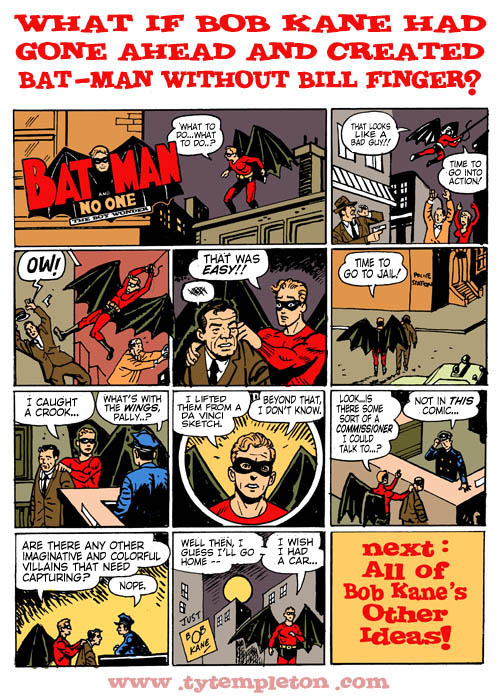
I admit I don't go into a lot of detail on this in my reviews. In my coverage of Detective Comics #27, I tried to be as fair and unbiased as possible as to who created what in regards to Batman, but the fact of the matter is this: Bob Kane was hired by National Publications to create a hero to go with Superman. Bob came up with the name "Bat-Man", inspired by the silent film "The Bat", he decided to give him no powers to contrast with Superman, and he gave him this stiff Bat-wing cape inspired by the art of Leonardo da Vinci. And then he ripped off a lot of stuff from Zorro (foppish secret identity mostly) and a lot of stuff from The Shadow (the plot of "Case of the Criminal Syndicate" is basically plagiarized from "Partners of Peril" and Kane swiped a lot of the art too). Kane's original look for Batman was a domino mask, red tights and those stiff Bat wings.
Bill Finger, the writer of that and the lion's share of Batman stories thereafter, came up with the cape, the cowl, the colour scheme, whiting out his eyes to make him more mysterious, the name Bruce Wayne, Comissioner Gordon, Gotham City, Robin, the Joker, and most importantly the origin story.
Each time I review an issue I give proper credit to it's writer (usually Finger), and it's artists (usually Kane and Robinson) and when I give Kane credit for pencils I should say that's with a pretty big asterisk, because after he hired Robinson and Roussos as inkers most of what Kane did was rough layouts, although he always penciled Batman and Robin himself he often left out backgrounds and sometimes whole characters, to be finished by his assistants.
Now, none of this is particularly out of the ordinary for the time period these comics were created, but what is bullshit is that on every single comic I've reviewed on this site, all the original issues said for credit was "by Bob Kane", and that's all they ever said until around 1964.
And to this day, every single Batman comic, movie, TV show, or video game has had a "Batman created by Bob Kane" credit on it.
Because Kane was essentially an evil genius. Kane, you see, was hired by DC directly, and then Kane hired out to Finger and Robinson and the others. So as far as DC knew for a very long time, Kane was doing it all. And even after the deceit came to light, Kane had an ironclad contract with DC that granted him credit in perpetuity on all the Batman comics. Even today, DC is legally unable to credit Bill Finger in his proper role as co-creator of the character, although at least on reprints of old comics they are able to credit him and the many other tireless creators who worked "with" and "for" Bob Kane on those issues where they were never originally credited.
And to almost the very end Kane denied Bill or any of his assistants and ghosts did anything, always claiming he was the sole creator of almost thirty years of Batman comics. Finally, after Bill had died and soon before Kane died, he said that he might consider letting Bill put his name on it. On Kane's tombstone, he does in fact share credit for Batman -- with God, for divine inspiration.
So join the petition to give Bill Finger a Google Doodle on his birthday and celebrate the man without whom we would NOT have the Batman we enjoy today. It's Batman's 75th anniversary after all.
Write to proposals@google.com.
"The Batman's Biographer"
Writer: Don Cameron
Pencils: Bob Kane
Inks: Jerry Robinson and George Roussos
Synopsis: B. Boswell Browne is a little old man who is nonetheless very popular with the children of Gotham City as he is a veritable font of knowledge about Batman and Robin!
Bruce and Dick overhear him entertaining some children in the park with tales of the Dynamic Duo, and Browne ends up inviting the two to his home where he has assembled a collection of facts and artifacts about Batman, in hopes of one day writing a definitive biography of the hero. However Browne feels he can never properly complete the book unless he actually meets and talks to Batman and Robin. Bruce and Dick feel like this could happen sooner than the old man thinks, *wink* *wink*!
Meanwhile, Batman and Robin have been tracking a criminal called "The Conjurer", who uses tricks and illusions to distract potential witnesses while he commits robberies. However Batman sees through their tricks and so the Conjurer and his gang are forced to abandon their loot.
The Conjurer realizes he must find a way to outsmart the Batman, and having heard of Browne he decides to press him into his service -- knowing so much about the Batman he must know of a way to defeat him.
Pretending to be a reporter for the "Evening News", the Conjurer milks Browne's knowledge of Batman's cases for ideas on how to outwit and capture the Dynamic Duo. At his next robbery, the Conjurer manages to outwit Batman into targeting the wrong building and then as they escape the crooks delay Batman and Robin with nets made of chicken wire!
However Batman recognizes this as an old tactic of the Penguin's and realizes the Conjurer has been doing some research. Our heroes decide to pay a visit to their "biographer", who realizes his has accidentally aided a criminal against his idols and falls into a deep attack of guilt.
After Batman and Robin leave, the Conjurer returns and now threatens to kill Browne unless he continues to help the criminals. Browne doesn't want to betray his heroes, but at the end of the day he's just a regular old man who doesn't want to die.
Browne helps the Conjurer develop an ingenious plot to steal a collection of art treasures from an auction (a plot so ingenious that it requires the comic to stop and post a diagram for the readers to understand it!) Browne's contribution to the plan is the idea to put an unlocked parked car with the engine running right by the villains' getaway that Batman and Robin will commandeer to chase after them, but rig the engine with a bomb.
However, when the crooks make their actual getaway, Browne himself gets in the rigged car, and uses it to run the crooks' getaway trucks off the road so that Batman and Robin can catch up and arrest them. Browne keeps driving the car until it's far enough away to not hurt anyone, intending to sacrifice his life heroically to make up for his past misdeeds, but Batman rescues him from the car just before it explodes.
Days later, Browne finishes his biography of Batman, which Batman himself writes the preface for -- and everyone lives happily ever after. (Except the Conjurer presumably)
~~~~
My Thoughts: A decent enough little story that is definitely in the "stories about other people featuring Batman" genre. It reminds me of the story about the druggist from Batman #14 in that it's also about crooks taking advantage of a kind hearted old man.
The Art: The full Kane Studio team of Kane/Robinson/Roussos is on this one and as such the art looks very polished. There are the usual bevy of swiped poses of course but nothing to complain about.
The Story: In a more modern context it may be interesting to compare the fictional character of "Batman's Biographer" with his real world biographers of Bill Finger and Bob Kane, but there really is no subtext or metaphor in the story to allow for any such metatextual analysis. What is fun is the number of accurate continuity references the Browne character makes to actual past Batman adventures. That kind of attention to detail is always appreciated, particularly in a Golden Age comic.
"The Penguin Goes A-Hunting!"
Writer: Don Cameron
Pencils: Jack Burnley
Inks: Ray Burnley
Synopsis: The last time we saw the Penguin, Batman had finally captured him and he had been sentenced to death for double homicide. As this story opens we suddenly learn that Penguin escaped from prison a month ago, in some awkward expositional dialogue as Bruce and Dick attend a lecture from prison Warden Keyes on criminology. As it so happens, the Penguin's immense ego and vanity persuades him to attend the same lecture!
Keyes describes Joker, Scarecrow, and Catwoman as topping the city's most wanted list, causing Penguin to become incensed and ask what the warden thinks of him, who replies that he feels the Penguin has no imagination and is a one-trick gimmick who relies too much on his umbrellas.
However the Penguin is recognized by some police officers in the audience who move to arrest him, but the crafty crook beats a hasty escape and manages to make it out alive, but with his dignity bruised. He decides to rob a sports equipment store and begin using some new techniques to replace his umbrellas to prove he's not a one-trick criminal.
And so the next day, almost a million dollars in bills and bonds are stolen out of various windows in the Gotham financial district by the Penguin using a fishing rod out the window of his penthouse hideout!
In the Penguin's next crime, he robs a mansion full of rich folk by shooting a gas pellet into the living room using a big game rifle! When the Dynamic Duo attempt to track the fiend down, his men overpower and capture them, and they awake tied up in the Penguin's penthouse.
The Penguin proceeds to unleash a pair of vicious trained hunting dogs on the two crimefighters and then leave to go rob a hunters convention rather than wait two minutes to make sure the dogs kill them.
Batman manages to stop the dogs' vicious behaviour by appealing to the innate bond between all dogs and men by using a gentle persuasive voice to break through the Penguin's abuse of the animals.
The Penguin arrives at the hunting convention riding trained show jumping horses allowing them to break in and out quickly despite obstacles and traffic jams. However Batman and Robin show up, take out two of Penguin's men (leaving them for the police) and follow Penguin himself down the streets of Gotham in a horse chase with the abused dogs now chasing Penguin and leading the Dynamic Duo!
They end up cornering Penguin at an outdoor cafe, where Batman knocks over all the open table umbrellas, trapping the fiendish criminal. Thus, after abandoning umbrellas, the Penguin is done in by them!
As the Penguin is arrested and sent back to prison, it is revealed that the Batman told the warden to badmouth the crook in his lectures, in order to goad the Penguin into overreaching himself, as the Dark Knight knows his enemy's greatest weakness is his vanity!
~~~~
My Thoughts: This is a fantastic Penguin story by Don Cameron, an amazing examination of the villain's character considering the age of this comic. Nowadays the Penguin is often reduced to being a joke Batman villains, mocked for his cheap and corny gimmicks, so it's incredible to see a comic addressing this mockery head on in 1943, in the character's sixth story!
And unlike a modern comic which might, upon deciding the Penguin is corny and needs reinventing, this issue doesn't completely throw the character under the bus or misunderstand him. Instead, it turns out to be a near-perfect analysis of his character and what makes him tick! Fantastic.
The Art: The Burnley bros really deliver here, with smooth clean linework, excellent blacks and shading, fluid action, and good expression. It's fun to see the Penguin in alternate costumes (fisherman, big game hunter, English gentleman, etc) but perhaps the coolest visual of all is Batman and Robin riding horses through Gotham traffic -- although maybe that's just because of my fanboy brain associating it with The Dark Knight Returns.
The Story: Really topnotch writing from Don Cameron, in managing to balance telling an action packed and typically wacky Golden Age superhero story with a simple premise -- Penguin trades his umbrella gimmick in for a sports equipment gimmick - and yet still have something new and unique to say about this character, keep things true to the established personalities and yet also comment on the Penguin and his place as a member of Batman's Rogues Gallery. (And hey, I'd be incensed too if I was ranked below the Scarecrow -- dude's only appeared in two stories!)
"Rogue's Pageant"
Writer: Don Cameron
Pencils: Jack Burnley
Inks: Ray Burnley
Synopsis: Alfred has insisted that Bruce and Dick take a vacation, and forbids them from bringing their Batman and Robin outfits -- this has Bruce and Dick incensed, but they still promise Alfred.
After hopping in the car, Bruce and Dick both reveal to each other they've been wearing extra suits under their clothes, because after all the whole point of this "vacation" is actually to do some crimefighting in Santo Pablo, "one of the oldest cities in the Southwest."
Flashback time: On a previous night, the Dynamic Duo foiled a bank robbery by "Ducky" Mallard's gang. However, the gang managed to escape and it's only by interrogating a stool pigeon that Batman and Robin learn they are headed for Santo Pablo, hence the vacation!
Arriving in the town, they discover it is celebrating the occasion of its 300th birthday!
The townsfolk are all dressed up in period costumes and the museum is displaying gold nuggets from the finds that made the town's fortune in the early days. So of course the gold is stolen.
With all the commotion in town it would have been easy for the crooks to escape, but Bruce is convinced they are still in Santo Pablo, and so the two take a look around the next day. At the city bank, the festivities continue with a reinactment of an old fashioned bank robbery. However, when the "actors" playing the crooks show up, it turns out they're real crooks and they rob the bank, escaping easily because the cops think it's all part of the show!
By this point Batman has determined the crooks are indeed Ducky Mallard's crew and also decided that the natural egotism of the criminal means that they won't leave early with their swag but instead stick around until that evening - the height of the festivities! With this in mind, Batman hatches a plan with the Santo Pable Police Department.
That evening is the big parade (an evening parade?) with everyone dressed up as "Indians", Spanish conquistadors, pioneers, etc. and Batman and Robin hiding in a belltower observing everything.
At this moment Ducky's gang sets off a series of dynamite explosions in several buildings around the parade area, in order to cause a panic big enough to distract everyone from their robberies. Because as Die Hard movies have taught us, acts of terrorism are always the best cover to larceny.
What the crooks didn't count on, however, is that the police department is wise to their plan and surrounding them dressed in parade costumes! Using special flashlight Bat-signals Batman has given them, they signal for the heroes in the trouble spots, and a quick fight scene later the crooks are in jail and the town is giving Batman and Robin their own spot in the parade!
When they return to Wayne Manor, Bruce and Dick think they have Alfred fooled, but news travels fast and the butler has already read of their exploits in the newspaper (which isn't surprising considering that would be a two-day trip with no breaks by car). Alfred simply demands that they take him with them the next time they leave on a crime-fighting trip!
~~~~
My Thoughts: This is yet another "Batman and Robin go somewhere, not Gotham" type story, and like so many of them it focuses on a town with a "pioneer" theme. I don't really like these stories, I don't see the appeal of putting Batman in these small towns that are always drawn like Wild West movie backlot sets regardless of where they are supposed to be or how modern.
The most uncomfortable aspect of this story for a modern reader is the glorification and nostalgic view of America's genocidal past. The town's parades paints pioneers and conquistadors alike as romantic heroes, and while a lot of time is also given to the "Indians", they are equally painted with a romanticized view that ignores the crimes done to their people.
Granted, none of this comes across as malicious in the comic, it's very much "of the time", it's just a little cringe inducing from a modern standpoint.
The Art: Another Burnley Bros. story here, but the art's only just okay. Nothing stands out about it, indeed it's all very generic. The "Indians" of Santo Pablo are drawn like Iroquois warriors instead of a more Southwestern tribe like the Kumeyaay. The town itself looks exceptionally generic and blocky, instead of appearing with interesting local architecture like one might find in San Diego or Los Angeles. Honestly it all renders the story itself kind've forgettable and almost negates the point of taking Batman and Robin to a different locale.
The Story: It's a real yawner, too. There are crooks, they're stealing stuff. They dress up to fool us, we dress up to fool them. They're caught. The end. What should have made this generic plot special is the unique setting, but it really ends up adding nothing at all. You could plop anybody into this story and it'd have the same exact feel.
"The Adventure of the Vitamin Vandals!"
Writer: Joe Greene
Pencils: Bob Kane
Inks: Jerry Robinson
Synopsis: Jenny Jones is a fishing vessel off the California coast on the hunt for soupfin sharks, also known as school sharks, because their livers are rich in vitamin A and is thus in desperate need by the United States Army for supply to soldiers fighting overseas (and this is entirely true). The sharks bring in $1,500 a ton (about $19,600 today) so this is good fishing -- but there's a problem.
A gang of crooks called the Phantom Raiders have been attacking fishing boats. When the fog rises up they appear out of nowhere, not having boarded the ships or stowed aboard. But regardless of where they come from the result is the same - the sharks are stolen and the sailors left with nothing, and the Raiders gone as mysteriously as they arrived.
Luckily, Bruce Wayne and Dick Grayson are in the area, vacationing at Malibu Beach! (Wait, weren't they just on vacation? In, like, the same area?)
Anyways, they hear about the mysteries Raiders and decide the best plan of action is to join the crew of the Jenny as seamen! Meanwhile, the fish brokers are now offering $2,000 a ton for soupfin sharks because of the shortage!
After some decent hard shark-catching labour for Bruce and Dick, the Raiders appear again - with Batman noticing that a crewman named Lefty seemed to signal something with his lantern before they did.
A customary fight with the crooks leads Batman to discover a rope ladder leading up into the clouds. Climbing it reveals -- a blimp! That's how the Raiders get in and out unseen! However a fight on the blimp results in the Dynamic Duo being thrown out of the blimp and falling a fatal distance into the water of the Pacific, where they of course survive because this is a comic book.
So having fallen into the Pacific there is only one possible outcome now, which if of course that Batman fights a shark. He stabs it with a knife until it's dead, as is his standard method for dealing with sharks.
Rescued by a passing patrol ship thanks to a portable Bat-signal, the Duo beat the Jenny to port, where they follow Lefty to the crooks' hideout - a large abandoned warehouse by the docks (y'know, like every other comic book hood).
Turns out the blimp docks in the warehouse and the roof opens up every night when the fog lifts. Batman and Robin stow away on the blimp and then spring into action when it attacks the Jenny... AGAIN (seriously, the same ship every time?) This time fish broker Gibbons is onboard to ensure a safe haul, but the Raiders attack anyway.
So of course Batman tackles Gibbons, who is of course behind the Raiders. The deal was to steal the fish and cause a crisis to drive prices up, then sell the fish to the government himself without having to pay back any of the fishermen. Pure fraud and war profiteering at its finest.
With the case closed, Bruce and Dick return to their lazy beach vacation.
~~~~
My Thoughts: "Adventure of the Vitamin Vandals" is kind've a lousy title for this story when something like "Case of the Phantom Raiders" would be so much more evocative. Other than that this is a much better example of "travelling Batman" than the previous story, and I am kinda perplexed that they put two stories of Batman going to the West Coast and fighting bad guys right next to each other in the same issue, especially when one is so lame and the other at least has cool blimp and shark stuff in it.
The Art: Decent work from Kane and Robinson. Nothing too special, but the shadows are really moody and the stuff with the blimp and the shark looks cool and the crooks are appropriately shady looking.
The Story: This story falls into the category of those inspired by the writer reading some odd fact somewhere. Bill Finger came up with a lot of his tales by basing them around little bits of trivia, but it's Joe Greene delivering this story. It is in fact true that soupfin sharks were harvasted for their vitamin A rich livers during WWII for supply to the US Army -- in fact the sharks were overhunted and today remain a vulnerable species.
The gag with the blimp is actually really clever because until that point it really is a total mystery as to how the Phantom Raiders operate, but once the blimp is introduced it seems so plausible. And of course there's the eternal cool factors of blimps. The ideal Golden Age Batman story for me features blimps, fights with sharks, an urban noir setting and shady crooks -- this story hits at least 3/4.
Number of Times Batman Has Fought a Shark: 2